Artist Fia Backstrom has always relied on photography and text in her works to explore topics such as grief-stricken communities, labour uprisings and environmental disasters. These issues have captivated her since childhood, she said.
“I have always been interested in what holds a community together, especially in the face of hardship,” she said in a recent interview.
Backstrom grew up in Sweden during the 1970s, which, she said “was like living in a large national community because the government bred a culture of caring with benefits like free high-quality healthcare and education.”
Backstrom’s expressive style is distinctive in that she never photographs people.
“I choose not to photograph people or their houses, because I wanted to avoid continuing an exploitative photographic tradition of photographing poor people in compromising situations,” she said.
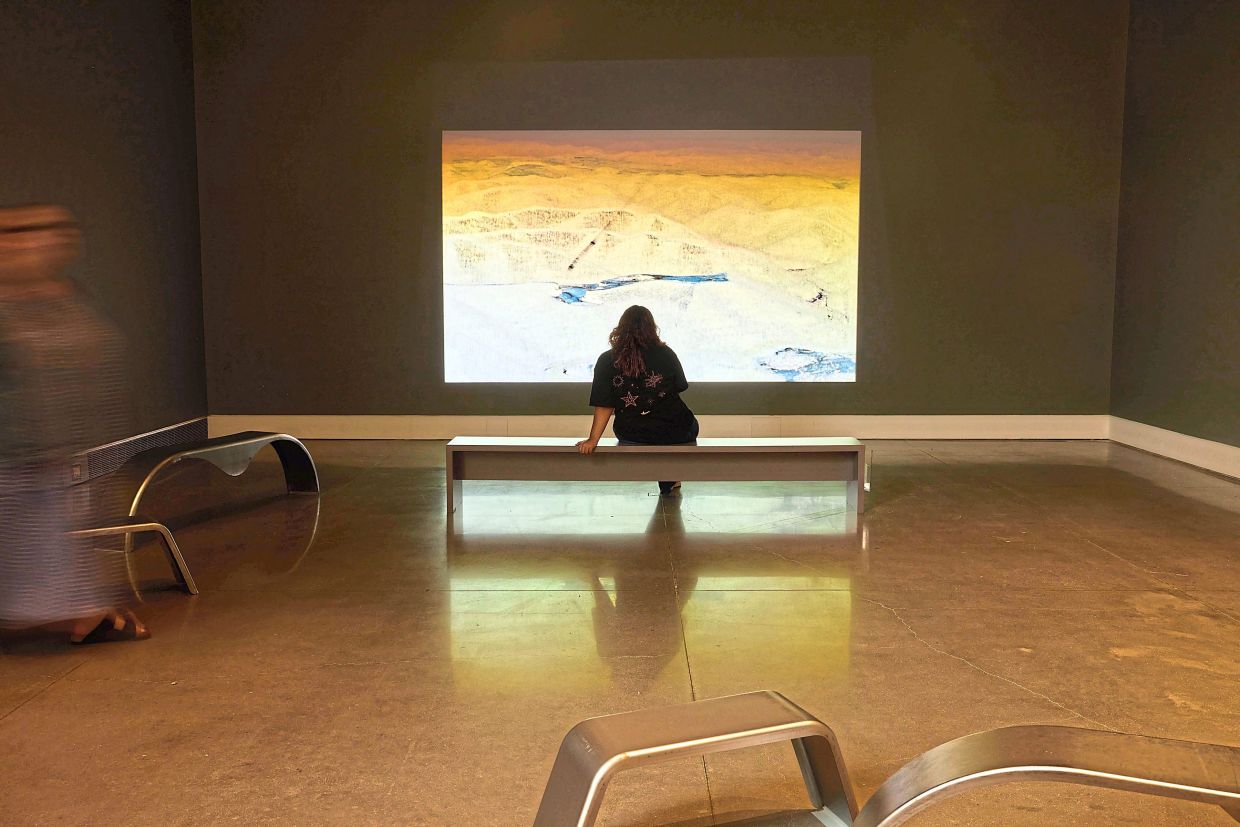
That holds true in the artist’s latest showing of her work, a collection of more than 100 photographs, videos and textiles now on display at the Queens Museum in New York City’s Flushing Meadows Corona Park. The exhibition, Fia Backstrom: The Great Society, takes up two galleries, and runs through Jan 18.
The works were selected by Backstrom.
Lindsey Berfond, an assistant curator and studio programme manager at the Queens Museum, said the institution supports artist like Backstrom, “whose practices respond to often overlooked histories through the lens of the present and who foster deep relationships to places and communities.”
“In this moment,” Berfond said, “when American politics are more polarised than ever, The Great Society asks us to question our own biases when looking back to history, as well as its impact on our current moment.”
The show draws from the extensive time Backstrom has spent in the West Virginia community of Buffalo Creek since she first visited in 2017.
“The area had a mining disaster in 1972 when three coal dams failed,” she said.
“More than 100 people died, and the community faced a collective trauma that still lingers today.”
The Great Society also captures Backstrom’s perspective on the Battle of Blair Mountain in West Virginia in 1921, when armed coal miners, seeking to unionise to improve working conditions and pay, were confronted by anti-union forces. The battle has been characterised as the largest labour uprising in US history.
The artworks in the exhibition include textiles, primarily embroideries on cotton tapestries.
Backstrom said the tapestries are her first professional embroideries and that she taught herself the craft during the pandemic.
“It’s a medium I felt was essential to this body of work,” she said.
“It is a slowed-down way of registering the world and has often been used for community healing.”
Backstrom, 55, was born in Stockholm and moved to the United States in 1996 to live and work. In addition to being a full-time artist, she is a professor at the School of Art at Cooper Union in New York. She lives in Brooklyn’s Bedford-Stuyvesant neighbourhood and has a studio there.
In phone and email interviews, Backstrom shared how she ended up in West Virginia, the exhibition’s most significant pieces and what she hopes audiences take away. This interview has been edited and condensed.
After the 2016 election, the news was filled with articles about people, including those who lived in West Virginia, who were called everything from “baskets of deplorables” to “trash”. I wanted to meet people who were the target of this stereotyping to understand it firsthand.
For one, it’s a state that has been thoroughly photographed, often in a derogatory way. I was interested in this history.
Also, I’m from Sweden, where mining has been a big industry, with labor uprisings occurring throughout its history. Since I’m interested in the topic, I knew about West Virginia’s mining and labour history.
The title can be understood in many ways. West Virginia is a poor state, so poverty is still an issue there, illustrating that the Great Society policy is relevant.
Also, during the 2016 election, accusations of racism and discrimination were thrown around from all sides of the political spectrum – in some instances, in connection with West Virginia, another reason why the aims of Johnson’s programme still matter.
I come from photography, so I’m always asking what photography can do. Recently, I began to work with video, mostly with sequenced still photography together with my voiceover. I can be personal and precise without being there myself, as in my performance-based work.
Fabric is a vulnerable medium; it sways with the wind and never stays still. I laser cut elements from the photographs in fabric to work more abstractly with colour and texture.
Photography has a murky history of being used to control populations, in, for example, scientific racism archives, mug shots and exploitative so-called “poverty porn”. My response to that history has been to not photograph people. For me, this opens opportunities to offer something else, another way of speaking, a smeared image, a poem, a shape or a shadow.
Sacrifice Zone is a large-scale display structure holding 84 photographs printed on transparent film. The photographs show the Buffalo Creek area: mining activity, museum artefacts and the surrounding landscape. It is a fragmented moving image machine, so when the viewer moves around, images overlap and make new combinations.
I also think that the Buffalo Creek Therapy Quilt is significant. When the original disaster happened in 1972, a group of women came together to embroider a quilt as a way to help themselves heal.
In 2022, in response to the original quilt, I invited the community to embroider a quilt with me in the Buffalo Creek Memorial Library, and this is what we created. We met for three hours each time, over the course of two to three years. I digitally embroidered a background, based on traced photographs I took of the area from a plane, and divided it into 28 blocks. The women embroidered these blocks with scenes from their lives in Buffalo Creek.
Now, more than ever, it seems incredibly important to build bridges and to think about how one’s own prejudices might prevent that. Hopefully, you leave with feelings of connection and reflect on how bias is created when people are portrayed in the media.
My work has always focused on the fabric of communities, often ones that have encountered grief. I always bring in other people’s voices, as I did with the quilt project. – ©2025 The New York Times Company