For contemporary artist Ivan Lam, every new exhibition is an opportunity to be someone else.
Who is he at his current show at Wei-Ling Contemporary at The Gardens in Kuala Lumpur?
He is a concerned citizen taking notes on the unfolding political drama in the country, a father who hopes for a brighter future for his children, and an artist who wants to put these reflections into paintings and pictures.
In a rather uncharacteristic move for Lam, this solo exhibition has a palpable feeling of patriotism, from its references in the artworks on our parliament system, to the states and federal territories of our country.
Even the exhibition title, The Soil On Which I Bleed, a translation of the line “Tanah tumpahnya darahku” from our national anthem, has a patriotic ring to it.
“This is a chapter of my life that took almost two years to say something that I thought was meaningful and significant, ” says Lam, 46.
It has been a tumultuous period for the nation in recent years, and like many people, he is feeling it keenly.

After a series of incidents – when the government that he voted for, fell, and when the pandemic swept across the world and the first movement control order (MCO) was enforced last year, when the healthcare system was stretched to breaking point – he knew he couldn’t just stand by and watch quietly from the sidelines.
“I felt something that was broken and wondered if it was just me or has the whole system let me down? I needed to be better. I needed to make art as a catharsis to get me out of this funk. I just needed something to hang on to, ” he says.
Lam was working on this body of work when the pandemic struck and he recalls how it was “strange, surreal and apocalyptic” in those early, uncertain days.
“I couldn’t even begin to comprehend what was going on. There was this invisible enemy – the Covid-19 virus – but so little information about it. It seemed that people were making things up as they go along, and we just had to follow, ” he relates.
Is art a reflection of its time?
During the pandemic and the ensuing lockdowns, Lam said he felt confined physically, but his mind was free.
“I took what was happening outside my studio and brought it in. It was like an osmosis process and I was the conduit. This time of reflection made me more sensitive towards my surroundings, my senses were heightened and I tried to express these feelings and emotions through my art.
“It is a genuine reflection of the times we live in. If there is one lesson to be taken away from this ongoing pandemic experience, it is to never take anything for granted again, ” he says.
The Soil On Which I Bleed became a way for Lam to introduce some semblance of order and focus in a world that was fast descending into chaos.
The paintings in this exhibition speak of how we, the citizens and individuals, matter.

The overarching theme here is that the whole might be greater than the sum of its parts, but it is all the components that make the whole possible.
“Don’t be afraid to start small, because it is through these small deeds and actions that we can collectively make a difference. Who is going to sort out the details if everyone is busy seeing just the big picture?” he questions.
This is illustrated in Negaraku, one of the paintings of this series, where stones, representing all the states and federal territories of Malaysia, are arranged in a circle. Flanking this entity are three other rocks, illustrating the importance of the individual, family unit and community, in shaping the identity of the nation.
In another painting, titled MCO (Master Control Operator), Lam brings back the rifle, a recurring symbol we have seen in previous works, such as They Will Kill Us All (2015) and They Can’t Kill Us All (2017).
He painted MCO (Master Control Operator) during the first lockdown last March. The rifle in this artwork is presented not as a whole, but as fragments, each piece on the canvas labelled with the date he painted them.
“The rifle is a sum of its parts. We are better and stronger if we are united. We can be powerful as a nation, but we are scattered and disunited. And we are afraid, ” he says.
There are a total of three paintings in The Soil On Which I Bleed, each accompanied with a smaller-format artwork, a laser-jet print which served as a reference for Lam when painting.
Each painting also has a poster displayed beside it, with its composition of words conveying clues to the meaning behind the images and offering a peek into the artist’s train of thought.

“These posters are like a distilled version of the ideas behind the artwork, that people can pick up for themselves. So much has happened around us since I started working on this more than two years ago, and it is only fitting that I include the smaller reference artwork to have a bit of a past, present and behind-the-scenes look at this series, ” he says.
Being a mentor artist
While working on this body of work, Lam confesses that he learned a lot about the country he was born and raised in, about its political system and all the bits and pieces of information that he feels he should know about as a citizen, but did not.
“By taking on this challenge to learn more, I am humbled. I have to say that I felt ashamed and embarrassed that I knew so little of my own country. I might have asked many dumb questions along the way, but I got my answers. I feel better now, but I still have ways to go.
“Someone once said that the only person that stumbles is one who is moving forward. So be brave, don’t be afraid to take risks and don’t worry about failing, because this is when you will learn and grow, ” he adds.
Lam was one of four Malaysian artists to represent Malaysia at the country’s first ever National Pavilion at the 58th International Art Exhibition – La Biennale di Venezia in 2019.
In 2017, he was the sole artist from Malaysia invited to create a project for the Karachi Biennale.
At the inaugural Art Basel Hong Kong in 2013, he was the only Malaysian artist selected to present a one-man project.
Last year, he mentored Anas Afandi and Tang Tze Lye in the first edition of the WLG Incubator Young Artists Mentorship Program. The programme, launched in April 2020, is part of Wei-Ling Gallery’s initiative to identify and support the next generation of young artists.
The five-month mentorship programme culminated in an exhibition at Wei-Ling Contemporary in October and November, featuring artworks by Anas and Tang produced during this time.
“Anas and Kenry Tang are such wonderful and gifted artists in their own right. As much as they learnt from me, I learnt from them. The respect was mutual and it was a great experience overall, ” says Lam.
He notes that he didn’t have any mentors in his early days as an artist, and that reading books and surfing the internet can never replace a mentor being by your side.
“It can be very scary to navigate the art world on your own as there are so many pitfalls and traps, especially if you are just starting out. I wished I had a mentor but never did. I am glad to play another role, other than an artist. So if there is any platform out there for a senior to lead and guide a junior, sign me up!” he says.
The second edition of the programme, WLG Incubator Young Artists Mentorship II, will be kicking off this month (April), with Anurendra Jegadeva mentoring Alya Hatta, Anwar Suhaimi and Shika.
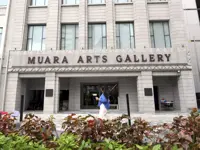
The Soil On Which I Bleed is on at Wei-Ling Contemporary, The Gardens Mall in KL till April 25.
Already a subscriber? Log in
Get 20% OFF The Star Digital Access
Cancel anytime. Ad-free. Unlimited access with perks.