


The tale of the greatest Malay warrior that ever lived is one for the ages. His legacy is so ingrained in Malaysia’s cultural history that he has roads named after him and movies made about him. If you grew up in Malaysia, you know who we’re talking about even if we don’t mention his name, don’t you?
Even the weapon he wielded is legendary. “Ask any Malaysian and they will know the name of Hang Tuah’s keris,” says Malay Heritage Museum director Dr Muhammad Pauzi Abd Latif.
Bestowed upon him after he defeated the silat master to whom it belonged, the keris is a folklore treasure in its own right.
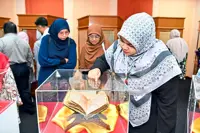
And now, for the first time, a manuscript on display at the museum depicts the famous Taming Sari.
Written in the 19th century by Abdul Samad Faqih Abdullah Tok Pulai Chondong from Kelantan, the document consists of annotated drawings detailing the weapon’s make and worth. “This is the only manuscript in the world that illustrates what Taming Sari looks like,” says Dr Muhammad Pauzi.
What’s more, it also depicts the keris of Hang Jebat. This is special, the historian explains, because Hang Jebat’s keris is the more elusive of the two.
“Everyone knows that Hang Tuah’s keris is called Taming Sari. But when you talk about Hang Jebat, not many people know about his keris, because it is not mentioned in Malay texts.”
Now, this manuscript provides a name: “Pengarang”, a Javanese word meaning author or editor. “For the first time, we know the name of Hang Jebat’s weapon!”
But what of the fact that some among academic circles argue that the story of Hang Tuah (and, presumably, his fellow warrior, Hang Jebat) is just a myth? Three years ago, historian Prof Emeritus Tan Sri Dr Khoo Kay Kim made news when he said there was no written record to verify that Princess Hang Li Po, Hang Tuah or Hang Jebat actually existed; whatever stories that had made it into the history books were myths.
Overnight, Prof Khoo created a frenzied debate and even sparked calls for a review of the country’s History syllabus.
“But to me, if a manuscript more than 200 years old can mention the names of Hang Tuah and Hang Jebat, I believe that both of them exist,” says Dr Muhammad Pauzi.
“This is evidence enough for me.”
According to the document, the Taming Sari was forged from 20 types of iron, one being the mystical and magical besi kursani.
“It is believed that whoever holds the Taming Sari is invincible, and it is this otherworldly metal that is believed to give the weapon its power of invincibility.”
The writer values the weapon as the price of one state – he is referring to Malacca during its days as an empire, says Dr Muhammad Pauzi. As one version of the story goes, Hang Tuah dropped Taming Sari into the Malacca river. “The empire then fell into the hands of the Portuguese and so the Taming Sari is a symbol of the fall of Malacca.”
The manuscript is part of the new Malay Manuscript Exhibition on now at the museum housed on the grounds of Universiti Putra Malaysia in Serdang, Selangor. Twenty new exhibits on loan from private collectors around the country will be on display until Aug 13.
According to Dr Muhammad Pauzi, a Malay manuscript is one that is, obviously, in Malay; it can be written in either the modern Roman alphabet or in Jawi, but whichever script is used, it must be handwritten; and it must date from the 15th to early 20th century – “If it meets these criteria, then only can we call it a Malay manuscript,” he says.
A notable item in the collection is a manuscript detailing how to determine the Qibla direction when at sea using the location of the sun.
Written by Al Haj Che Muhammad Ibn Al Haj Jalaludin from Kelantan in 1892, the written description comes complete with an intricate compass diagram alongside it.
“Back then, the East Coast was full of sea-faring folk and this was written with the sailors in mind.”
Another is a text dated 1920 that shows the mathematical workings of Sheikh Omar Nuruddin. He was a famous Malay mathematician from Kelantan who would come up with his own formulas, says Dr Muhammad Pauzi. “We imagine that he travelled quite a bit to the Middle East where he acquired the skills and knowledge.”
The new exhibits are an opportunity for visitors to experience something unique, says Dr Muhammad Pauzi. “We chose the manuscripts based on their rarity. They are all one-of-a-kind – you won’t find them anywhere else.”
And they all, in some way or another, reflect Malay wisdom and knowledge from a long time ago, he adds.
Serving up a slice of Malay heritage, the museum also includes displays of traditional costumes and textiles, traditional weapons, and traditional household items.
There are also four traditional Malay houses on the museum’s grounds in an outdoor exhibit. From Negri Sembilan, Perak, Terengganu, and most recently, Pahang, the houses are between 90 and 200 years old and offer a glimpse of traditional Malay architecture.
The Malay Manuscript Exhibition is on until Aug 13 at the Malay Heritage Museum, Universiti Putra Malaysia, Serdang, Selangor. The museum is open to the public from 9am to 5pm on weekdays; admission is free. For enquiries, call the university at 03-8946 6000.
Already a subscriber? Log in
Get 20% OFF The Star Digital Access
Cancel anytime. Ad-free. Unlimited access with perks.
