
SOUTH-East Asia remains a beacon of growth. But its growth outlook faces increasing risks from persistently high oil prices, tighter monetary policy, and uncertainty over the sustainability of the artificial intelligence (AI) investment boom.
Concerns over investor confidence, including those arising from market transparency and accessibility issues in Indonesia flagged by index provider MSCI, are another setback.
Still, the International Monetary Fund’s (IMF) regional economic outlook for Asia and the Pacific region was surprisingly upbeat given current conditions. The IMF revised its 2026 growth forecast for the Asean-5 economies comprising Indonesia, Malaysia, the Philippines, Singapore and Thailand to 4.4%, from 4.1% previously.
For Asean as a whole, growth is projected at 4.9% this year, up from its earlier forecast of 4.5%.
For 2027, the Asean-5 growth projection remains at 4.3% while Asean as a whole is projected to grow 4.7% from the previous projection of 4.6%.
These upbeat projections, however, mask underlying weaknesses across the region, with several economies facing domestic challenges even as external risks mount.
Thailand continues to grapple with sluggish growth, high household debt and weak domestic purchasing power, while higher energy prices are adding to inflationary pressures in the Philippines, threatening to weigh on consumer spending.
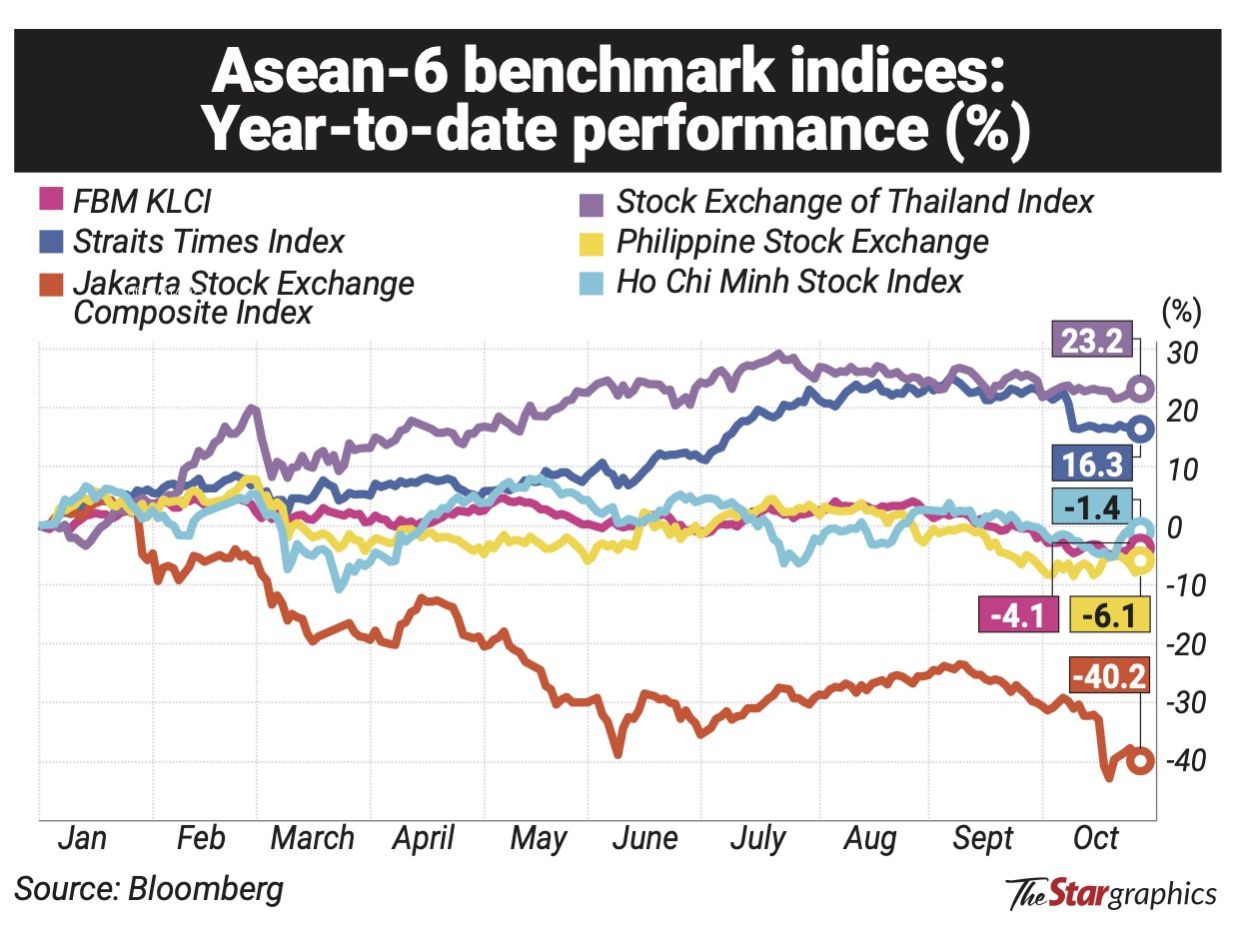
The Asean-6 economies (including Vietnam) have also recorded varying growth performances in recent years.
Their benchmark stock market indices have also performed differently, reflecting diverging investor sentiment across the region (see charts).
The IMF cautioned that downside risks to the outlook dominate, but it pointed to stronger growth should the AI-related momentum from the technology cycle continue, which will support private consumption while faster adoption of AI can lead to stronger productivity gains.
Can mounting uncertainties, combined with weakening investor confidence and external economic pressures, trigger a financial crisis in the region, or even an Asian financial crisis 2.0?
Economists say the region is now better equipped to withstand financial shocks than it was during the 1997 Asian financial crisis.

SPI Asset Management managing partner Stephen Innes tells StarBiz 7 he would not put another such crisis at the top of his risk list, although he would not dismiss the “warning signs” and “cracks” across the region.
He says the 1997 crisis was fundamentally a currency and balance-sheet failure, with heavy foreign-currency liabilities, vulnerable exchange rates and banking systems that were not equipped to handle sudden capital outflows.
Today, Asean economies have more flexible exchange rates, stronger capital buffers and better-developed domestic financial markets, he says.
“My bigger concern is that Asean economies are increasingly moving at different speeds, just as the global investment environment is becoming less forgiving,” he says.
“Thailand is struggling with household debt and structural growth constraints, the Philippines has its own fiscal and economic challenges, while Indonesia is dealing with something potentially more damaging: investor confidence.”
He says concerns in Indonesia, including those raised by index provider MSCI, is particularly important as it could weigh on investor sentiment.
“When international investors begin questioning market transparency and accessibility, that’s not something you fix with a good GDP (gross domestic product) print. Confidence can take years to rebuild,” he notes.
Still, Innes says Malaysia is “reasonably well positioned” to absorb a shock specific to Indonesia, given its established domestic institutional investor base, local-currency bond market and relatively sound banking system.
However, he cautions that stronger fundamentals would not shield Malaysia from market volatility if investors began cutting their exposure to emerging markets.
The most immediate effects would likely come through portfolio flows and currencies rather than direct banking contagion, he says.
“If international investors continue losing confidence in Indonesian assets, we could see a broader reassessment of Asean exposure, putting pressure on regional equities, bonds and currencies, including the ringgit.”
The risk would be more serious if Indonesia’s difficulties coincided with tighter global US dollar liquidity, rising US yields or another geopolitical shock, he adds. In such conditions, he says markets that are fundamentally stronger could still be caught in the broader selloff.
However, Malaysia could benefit if investors redirect capital away from markets facing transparency and governance concerns, Innes says, although such a shift would likely come after initial volatility.
For Malaysia, the growing divergence between Asean economies presents both trade and financial risks.
A slowdown in neighbouring markets could weigh on demand for Malaysian goods, while a broader loss of investor confidence could trigger capital outflows across the region.
In the first nine months of 2026 (9M26), Malaysia’s trade with Asean surged 29% to RM744bil, accounting for slightly over a quarter of the country’s total trade of RM2.91 trillion.
Malaysia also recorded a trade surplus of RM111.2bil with Asean, accounting for nearly half of its overall trade surplus of RM232.38bil.
In September alone, exports to Asean jumped 46.2% year-on-year to a record RM59.55bil, supported by a 50.4% increase in shipments to Singapore to RM35.45bil.
While weaker regional demand could affect Malaysia’s trade and supply chains, Innes says the bigger risk is financial contagion, as global investors pull back from emerging markets.
“When global funds start reducing exposure to emerging markets, they often sell the entire neighbourhood before deciding which houses are actually on fire,” he says.
“So no, I do not see 1997 repeating itself but I do see a period when Asean’s economic differences become increasingly difficult for investors to ignore.”
Yeah said Malaysia’s financial system was better positioned to withstand external shocks, with banks remaining well-capitalised and the low level of impaired financing.
While government debt has risen, he said corporate debt was not excessively high, while household debt has declined as a share of GDP over the past decade.
“Malaysia is vulnerable. But what’s important here is to what extent our financial sector is overexposed or not.
“The overall financial system should be able to withstand (any shock),” he says.
Federal government debt rose 5.9% to RM1.32 trillion in 2025, with the statutory debt-to-GDP ratio at 63.9%, below the government’s 65% limit, according to the Auditor-General’s report.
Household debt stood at 84.4% of GDP at end-March 2026, down from 88.4% a decade earlier.
Bank Negara Malaysia data showed the banking system’s net impaired financing ratio at 1% in August 2026.
According to the Securities Commission, bond and sukuk issuance totalled RM280bil in 7M26, compared with RM427.74bil for the whole of 2025, while the outstanding market stood at RM2.23 trillion.
Yeah says the circumstances that led to the 1997-98 Asian financial crisis were also different from those facing the region today.
During the crisis, bank failures, rising non-performing loans, collapsing stock and property markets, and a sharp withdrawal of foreign capital combined to trigger severe financial stress and balance-of-payments pressures.
“We are not seeing all those now,” he says.
Yeah says regional cooperation has also improved, providing another layer of protection against financial shocks.
He cites the Chiang Mai Initiative Multilateralisation, a US$240bil regional financial safety net established by Asean and its plus three partners – China, Japan and South Korea – to address balance-of-payments and short-term liquidity difficulties.
“Individual economies also have the necessary tools and buffers to protect themselves against any sharp capital withdrawal or collapse in asset prices,” he adds.
However, a risk for Asean is the sustainability of the global AI investment boom, which has become an increasingly important driver of demand for the region’s exports.
The global economy is increasingly being driven by investment in AI, with demand for chips, data centres and related technologies also benefitting Malaysia and the wider Asean region.
The impact of AI-driven demand is reflected in Malaysia’s electrical and electronics exports, which surged 49.5% to RM766.38bil in 9M26, accounting for 48.8% of total exports, up from 43.7% in 9M25.
However, a sharp slowdown in AI investment could put this growth at risk.
Innes says an AI investment correction is one of the biggest risks to watch, given how closely the investment cycle is tied to global stock market valuations, corporate spending and Asia’s manufacturing outlook.
“Malaysia has considerable exposure to the upside, but it also inherits some of the downside risk,” he says.
“I don’t think the debate is whether AI will transform the global economy. It probably will. The question is whether the extraordinary amount of capital being spent today can generate the returns investors are already pricing in.”
Innes distinguishes between a correction in AI-related stock valuations and an actual contraction in AI capital expenditure.
While a correction in technology stock valuations could hurt market sentiment, a cut in spending on chips, servers and data centres would have more direct implications for Malaysia’s manufacturing exports and investment pipeline, he says.
“The danger isn’t necessarily that the AI boom ends. It’s that the pace of investment slows sharply before the anticipated returns materialise,” he says.
“That could turn one of Malaysia’s biggest growth opportunities into a meaningful external vulnerability.”
Yeah says a reversal in the AI investment cycle would add to pressure on global economic growth, with the initial impact likely to be felt in stock markets before spilling over into the wider economy.
A slowdown in investment and capital expenditure would weigh on data-centre construction and other AI-related projects, with knock-on effects on consumption and other business activities, Innes says.
“AI-led investments are the major driving force of investment activities now. If we lose that, then we may see a slowdown. We have to look at other offsetting investments,” he says.
Yeah says investment in renewable energy, climate adaptation and food security could help cushion the impact by providing alternative sources of growth.
He adds that while AI adoption can improve productivity and efficiency, it could also displace workers and slow job creation, particularly among those without the skills needed to adapt to new technologies.
He notes that job displacement linked to AI adoption is already emerging in some overseas industries, although the effects have yet to be felt as strongly in Malaysia.
Beyond the risks posed by an AI investment slowdown, persistently high oil prices could add further pressure on growth in 2027.
Yeah expects the impact to be particularly pronounced if crude oil prices remain above US$100 a barrel for an extended period.
“Global economic growth will likely be revised downwards because of these persisting high oil prices,” he says, citing inflationary pressures and tighter financial conditions in major economies.
“We will likely see weakening growth going into 2027 because of high oil prices.”
Brent crude broke above US$100 a barrel on Sept 9 following an re-escalation in the Middle East.
While the futures temporarily fell below the threshold to settle at $99.25 per barrel on Sept 22, the retreat was shortlived.
The benchmark has since rebounded and is trading around $114.27 per barrel at last look.
Yeah warns that a further escalation in the conflict, particularly if oil facilities and infrastructure are targeted, could disrupt supply keeping oil prices elevated for longer. and push the global economy towards recession.
“If there’s a flare-up in the Middle East, the world will likely go into a recession period,” he says.
For Asean, he expects high oil prices to moderate growth, although continued AI-related investment and trade links with China should provide some support.
“The overall region will still remain an attractive destination for international investments, as well as sustaining overall, about 5% growth,” he says.
He says country-specific challenges are unlikely to derail the region’s overall growth trajectory, given continued trade and investment within Asean and its close economic ties with major Asian economies, particularly China.
China’s economy is an important source of demand for Asean exports, and a slowdown there could also have spillover effects on the region.
The IMF projects China’s economy to grow 4.5% in 2026, up from its previous forecast of 4.4%, before moderating to 4% in 2027.
For Malaysia, Innes says the country has several advantages, including domestic consumption, infrastructure spending, tourism, manufacturing and foreign investment.
Its established position in the global electronics and semiconductor supply chain also provides a competitive advantage.
“Malaysia doesn’t have to manufacture the world’s most advanced AI chips to benefit from the technology cycle. Assembly, testing, packaging and electronic components are all essential parts of that ecosystem,” he says.
However, he cautions against assuming that announced investments, particularly in data centres, will automatically translate into sustainable economic growth.
“There’s a big difference between money being committed, money actually being spent and investments eventually generating sustainable economic returns,” he says.
While domestic demand and infrastructure projects could cushion the impact of weaker global growth, Malaysia’s reliance on exports leaves it exposed to a prolonged slowdown in electronics demand, he says.
“Malaysia can maintain respectable growth, but the real question is whether its different growth engines are genuinely diversified or are increasingly tied to the same global technology investment cycle,” he says.
“Malaysia has more than one engine keeping the economy moving. The danger is discovering that several of these engines are running on the same fuel.”
Innes says Malaysia’s economic stability, credible financial markets and established manufacturing base could help it stand out amid regional uncertainty.
However, he cautions that a global reassessment of AI investment could pose a broader challenge to the country’s growth outlook.
“The bigger external shock may not come from Indonesia or Thailand at all. It could come from a global reassessment of the AI investment cycle.
“That, to me, is where the real test of Malaysia’s resilience may ultimately lie.”
Already a subscriber? Log in
Get 20% OFF The Star Digital Access
Cancel anytime. Ad-free. Unlimited access with perks.