KUALA LUMPUR: Asia-Pacific is set to drive global aviation growth over the next two decades, with passenger traffic in the region forecast to grow at a compound annual growth rate (CAGR) of 5.1%, outpacing the global average of 3.9%, according to Airbus' latest Global Market Forecast (GMF 2026-2045).
“With passenger traffic growth in the region projected to grow at a compound annual growth rate (CAGR) of 5.1%, outpacing the global average of 3.9%, traffic volumes will more than double over the forecast period.
“Asia-Pacific is projected to require 19,120 new passenger aircraft, representing 45% of the total global demand for 42,060 new aircraft over this period,” Airbus said in a statement.
Of the 19,120 new passenger aircraft needed in the region over the next two decades, one-third will be for replacement, with the remainder supporting growth.
Airbus said the expansion will be supported by strong economic fundamentals, rapid urbanisation and a growing middle-income population, which is projected to reach three billion people in Asia-Pacific by 2045.
In terms of aircraft size, the region is expected to account for almost half of global widebody deliveries, with demand for 3,420 new aircraft.
Airbus said its A330neo and A350 families have increased its share of the region's widebody backlog to 50% over the past three years.
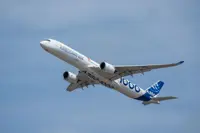
The A350 has also become a preferred choice among airlines in the region for long-range intercontinental flights, with the A350-1000 emerging as a successor to the 777-300ER.
“The demand in Asia-Pacific also remains strongly anchored on single-aisle capacity with 15,700 aircraft in the 100-244 seat size category required by 2045, reflecting ongoing domestic and intra-regional network expansion, driven by fleet replacement and long-term capacity growth,” Airbus said.
New airport infrastructure and longer-range single-aisle aircraft such as the A321XLR and A220 are also expected to expand connectivity by enabling new city pairs and allowing airlines to connect secondary cities without relying on traditional mega-hubs.
Airbus said the A220 has already created more than 400 new routes globally and could unlock more than 800 unserved city pairs in Asia-Pacific.
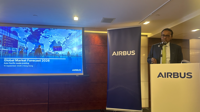
“We are seeing an evolution in the Asia-Pacific networks and how they connect,” said Anand Stanley, President Airbus in Asia-Pacific.
“Alongside sustained expansion in long-haul networks, airlines are decentralising beyond traditional hub-and-spoke models to connect secondary cities directly to the global economy. By leveraging latest generation aircraft technology, carriers in the region are rewriting connectivity maps and driving the region’s long-term economic prosperity.”
As of end-August 2026, 119 airlines in Asia-Pacific operated 5,000 Airbus commercial aircraft, giving the manufacturer a 58% market share in the region. Nearly 3,500 aircraft were also on order for future delivery.
This represents 61% of the backlog for all aircraft manufacturers in the above-100-seat jet market.