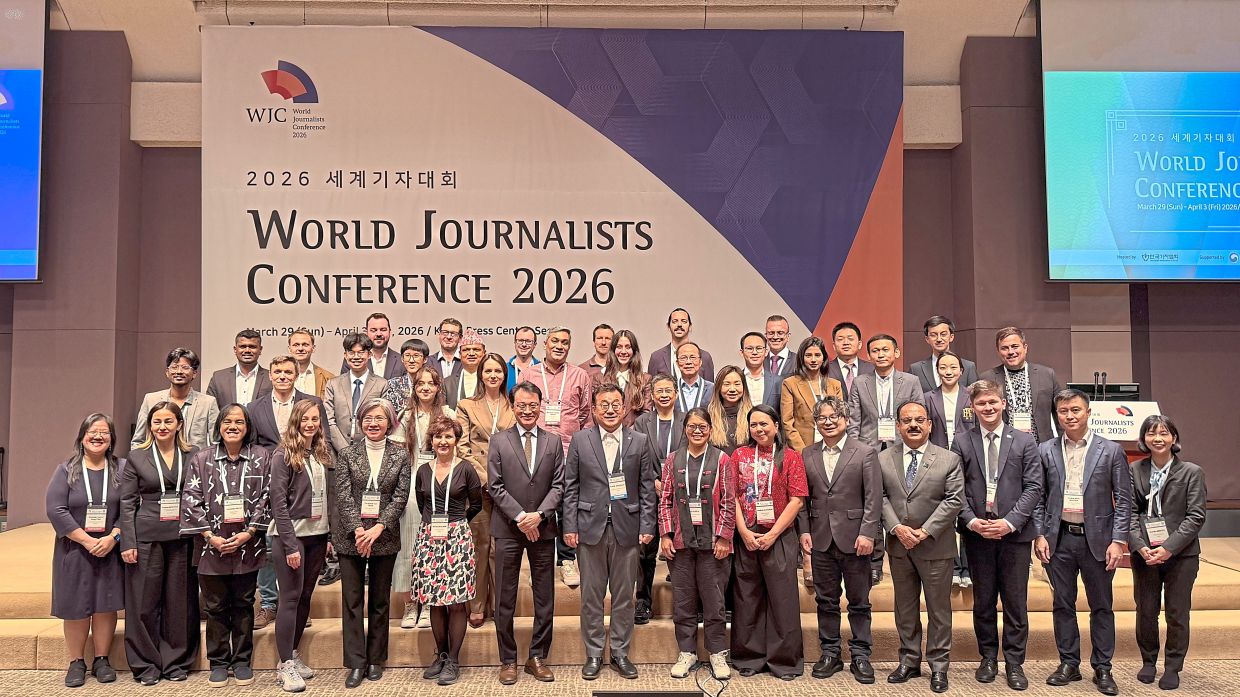
PETALING JAYA: Technology is changing how news is produced and consumed, but one message that stood out at the World Journalists Conference 2026 in Seoul, South Korea, was that “journalism matters”.
As misinformation spreads across borders and trust in the media comes under strain, Journalists Association of Korea president Park Jong Hyun said the role of journalists is becoming more critical than ever.
“The world we face today is increasingly unsettled. Misinformation and hate speech are spreading across borders, and democracy is facing profound challenges,” he said in his opening remarks, adding that journalism remains essential in such an environment.
“It is in times like these that we must act with greater clarity in fulfilling our role.”
Against this backdrop, The Korea Herald managing editor Lee Joo-hee said journalism is defined by its strict verification process, but the industry now faces a balancing act.
“The future path of journalism has to be more engaging to our audiences, but also maintain the rigid verification process and being factual and objective,” she said, while moderating a session titled The Role of Media in Times of Crisis.
Similarly, RedaktionsNetzwerk Deutschland correspondent Felix Lill said that journalists face persistent tension in the digital age.
“Denouncing manipulation must be fast, but fact-checking needs time,” he said, stressing that the industry must remain both quick and accurate.
Lill pointed to continued strain in trust in traditional media, even as audiences remain reliant on journalism for information.
He cited a survey in Germany that showed 20% of respondents believe “the media” lies, while 42% do not trust it.
At the same time, 75% said public broadcasters remain trustworthy and 66% trust newspapers, suggesting that institutional credibility still holds, albeit unevenly.
However, 42% also believe politics dictates reporting.
Lill said media organisations adapting to the current environment are focusing on several strategies, including building more diverse newsrooms in terms of gender, ethnicity and political perspectives to strengthen credibility, recruiting well-known influencers to expand audience reach, and repositioning print as an add-on rather than a core product alongside digital platforms.
He added that while print circulation is generally under pressure, some publications in Germany are still growing, particularly monthlies and weeklies rather than daily newspapers.
The Korea Herald’s Lee also warned that journalism is being reshaped by structural changes in how information flows, with sources increasingly able to bypass traditional media and reach audiences directly.
She noted that this shift is blurring the line between news and information, as governments, companies and other actors communicate directly with the public.
Thailand’s Daily News head of foreign news Pattraporn Paibulsin described the current environment as a “paradox of plenty”, where unprecedented access to information has made truth harder to establish.
“Never before have journalists had access to such vast amounts of information. However, this abundance of information has not necessarily made truth easier to find,” she said, adding that competing narratives and misinformation have complicated verification.
“In journalism, credibility is ultimately more valuable than speed,” she said.
The importance of a free and functioning press was underscored by South Korea’s short-lived martial law declaration in December 2024, according to SisaIN chief political editor Kim Eun-ji.
She pointed to how the episode, reversed within hours after a parliamentary vote, briefly tested civil liberties, including the ability of the media to operate freely during moments of political uncertainty.
Against these backdrops, Union of Bulgarian Journalists board director Martin Georgiev said journalism ultimately goes beyond technology.
“It is about trust, it is about responsibility and it is about truth,” he said during a session titled AI in the Newsroom: From Practice to the Next Phase.
“From the technology perspective, China’s Xinhua News Agency director of social media desk of international news department Kaijun Zheng said the organisation has deployed more than 230 AI tools in newsroom operations.
“It frees us from some weight-lifting tasks and allows us to focus on what can only be done by humans,” he said.
However, he pointed to what he called a “crisis of truth” if AI-generated content is not properly checked, adding that unchecked automation risks eroding public trust.
He also raised concerns over copyright and attribution when AI systems paraphrase reporting without credit, as well as the growing “blurring of journalism roles”, stressing the irreplaceable human element.
“We believe in empowerment, not replacement,” he said. “A dangerous paradox: technology that is meant to connect us is dividing us.”
Newsweek Polska veteran journalist Renata Ewa Kim traced the evolution of newsroom technology, from typewriters to computers to the Internet, noting how information access has shifted from physical research to instant digital retrieval.
She said each technological shift has transformed newsroom practices, but has not replaced the core role of journalists in verifying and contextualising information.
“I believe AI will not replace journalists,” she said, offering a quiet note of reassurance amid concerns over the future of the profession.