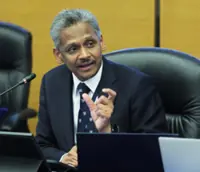
JAKARTA: Indonesia’s tough-talking, pro-growth Finance Minister Purbaya Yudhi Sadewa says he and his unconventional policies, which have broken from the country’s fiscally conservative approach, are at the centre of growing concerns about how the economy is being run.
But he remains confident that the concerns will not linger.
Fitch’s downgrade of Indonesia’s sovereign credit rating outlook to “negative” from “stable” last week was the latest in a series of setbacks for the country.
Concerns have centred on a lack of policy certainty and fiscal discipline, which have underpinned investor confidence in Indonesia since the Asian financial crisis in the late 1990s.
Together, the downgrades have battered sentiment on the US$1.4 trillion economy, with concerns now mounting that global uncertainties, including war in the Middle East, could amplify Indonesia’s troubles.
A market rout in January erased US$120bil from the Indonesia stock exchange, while foreigners have sold a net US$415mil in Indonesian equities as of March 5, according to IDX data, as well as US$240mil in sovereign bonds, according to the Finance Ministry.
“By any international standard, we are conducting good fiscal policy,” Purbaya told Reuters earlier last week in an interview, his first one-on-one with foreign media since he took office in September as a surprise replacement for the respected veteran Sri Mulyani Indrawati.
“But because I’m still new, they still think that this is not a good minister. He doesn’t know what he’s doing,” Purbaya said, referring to the concerns of international investors and ratings agencies.
“I know what I’m doing,” said the 61-year-old economist, who has a doctorate from Purdue University in the United States.
Purbaya’s tenure has been a sharp departure from that of Sri Mulyani, who was long viewed as a bulwark of financial discipline.
While Sri Mulyani was diplomatic and cautious, Purbaya is direct and unconventional – which has made many in Jakarta’s policy circles uncomfortable, according to three people with direct knowledge of Cabinet dynamics who spoke on the condition of anonymity.
Purbaya will have to gain investor trust, said Trinh Nguyen, senior economist for emerging Asia at Natixis in Hong Kong.
“He’s got to work harder (than Sri Mulyani) for it,” she said. “There’s been this huge comfort of competence in terms of management. I’m not saying there isn’t competence (now), but there’s that big question, big doubt.”
Purbaya’s most controversial policy was to move more than 200 trillion rupiah (US$12bil) of government money from the central bank to state-owned lenders in a bid to supercharge private sector credit growth.
At a handover ceremony last year, Purbaya called himself a “surprise minister” and openly admitted that his predecessor had likened his style to that of a “cowboy.” What that meant became clear in the months that followed.
When asked at a public event about the Economist magazine likening the state bank liquidity injection to the government raiding its “rainy-day pot,” he told the crowd the magazine was “stupid.”
Last month, when Citigroup said Indonesia’s fiscal deficit could breach the legal limit of 3% of gross domestic product (GDP) in 2026, Purbaya, once again in public, said the author was not a real economist and that people should “ask a PhD” instead – referring to himself.
Purbaya said he is confident despite the early negative feedback from ratings agencies, even as he seeks to assuage concerns that he would breach the 3% fiscal deficit cap under any circumstances.
During the interview, which was on the eve of Fitch’s rating review, Purbaya was asked if he thought they, like Moody’s, would also downgrade Indonesia’s outlook, which was widely expected.
“If they are smart enough, they will not follow Moody’s,” he said, adding, with a chuckle into a camera: “Can I say something like that?”
“If they are using data as their base of decision, I don’t believe there’s a way, there is a room, to say that we are moving in a negative direction,” he added.
But, he said, even if Fitch said the outlook was “negative” – which it did the next day – it would not matter if economic growth hit 5.6% to 6%.
“(That would mean) everybody has, including you, probably, conducted a wrong calculation of the direction of the Indonesian economy,” he said. “The best way to contradict you is by giving you the best economic figures.”
Indonesia reported its best economic expansion in three years in 2025 as growth accelerated more than expected in the fourth quarter (4Q25) on robust household spending and strong investment, official data showed.
The 4Q25 was Purbaya’s first in charge. Analysts, according to a poll, had expected Indonesia’s 4Q25 growth to come in at 5.01%. It came in higher at 5.4%.
Asked about some economists questioning the authenticity of the figures, Purbaya challenged anyone to prove the numbers wrong, pointing to several indicators including economic activities, industrial electricity consumption and consumer confidence, which is close to a historic high.
“We have this GDP figure from normal sources of the economy, but we are also using every market-based figure that can confirm that we are moving in the right direction,” he said.
Purbaya has given himself a tight timeline. “Six months from now, are we moving in the right direction or not? If, let’s say, we are moving in the wrong direction, you can lambaste me as much as you like,” he said.
“But I think it will be the other way around.” — Reuters