
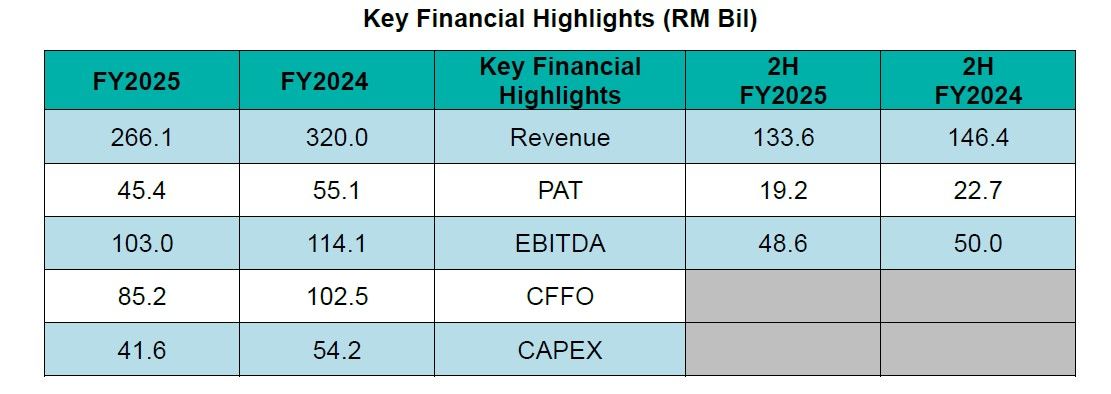
KUALA LUMPUR: Petroliam Nasional Bhd (PETRONAS) saw its profit after tax decline 18% to RM45.39bil for the financial year ended Dec 31, 2025 (FY25), from RM55.09bil in FY24, no thanks to weaker oil prices and lower sales volumes of crude oil and condensates.
Revenue fell 17% to RM266.14bil from RM319.96bil previously, while earnings before interest, tax, depreciation and amortisation (Ebitda) slipped 10% to RM103bil from RM114.09bil.
Following the weaker performance, the board approved a RM20bil dividend payout to the government for 2026, lower than the RM32bil distributed in 2025.
PETRONAS president and group chief executive officer Tengku Muhammad Taufik said FY25 was a challenging year for oil companies globally, as energy security concerns, geopolitical shifts and an increasingly competitive environment reshaped the industry.
“I do not exaggerate in saying that the year under review was one that truly tested oil companies, whether they were international oil companies (IOCs) or national oil companies (NOCs) across the globe.”
He added that the industry was grappling with margin erosion, reshaped trade routes, supply chain reconfiguration and unprecedented technological disruption.
“One long-acknowledged reality is that the oil and gas industry stands at the intersection of politics, economics, and diplomacy.”
Against this backdrop, Taufik said PETRONAS would need to pursue all available avenues to strengthen its resilience.
“Petronas will need to pursue all avenues available to build further resilience, both for our portfolio and indeed for our balance sheet.”
Taufik said FY25 performance was significantly affected by a softer pricing environment, with average Brent crude prices falling 14% year-on-year to US$69.10 per barrel from US$80.76 previously, due to oversupply concerns and persistent macroeconomic uncertainties.
He said lower average realised prices, foreign exchange impacts and reduced sales volumes, mainly from crude oil and condensates, had weighed on revenue.
But, this was partially mitigated by lower operating expenses, which declined 16% to RM228.4bil from RM271.8bil in FY24.
As a result, PETRONAS’ profit margin remained stable at 14%.
Taufik noted that while oil prices weakened, the average LNG spot price rose 7% year-on-year to above US$12.70 per million British thermal units (mmBtu), reflecting stronger demand not only in Northeast Asia but also across Europe.
On capital expenditure, he said PETRONAS spent RM41.6bil in FY25, down from RM54.2bil a year earlier, with about 46% allocated to upstream activities.
Around 60% of total capex was deployed domestically, and nearly half of Malaysia’s capex was channelled into the upstream segment.
On the domestic front, Taufik reiterated PETRONAS’ role as Malaysia’s NOC and custodian of the country’s hydrocarbon resources.
“We are Malaysia's national oil company. We will manage to ride our resources that are trusted to us under the Petroleum Development Act 1974, and we will do so for the benefit of all Malaysians.”
He said PETRONAS manages an extensive ecosystem comprising more than 10,700km of pipelines, over 3,000 wells, 405 offshore platforms and more than 100 active production sharing contracts, serving households, industries and power generators locally and abroad.
Despite ongoing global uncertainties, Taufik said PETRONAS’ commitment to its stakeholders remained unchanged.
“As the global landscape continues to be reshaped by shifting geopolitical forces, and even as Petronas adapts by building a more resilient portfolio, what remains constant is Petronas' commitment to those we serve, both in Malaysia and to customers and communities around the world where we operate. We will continue to fulfil our obligations,” he said.
He added that PETRONAS had contributed nearly RM1.6 trillion to the Malaysian economy over the past five decades through dividends, royalties, taxes and other payments, and remained committed to fulfilling its obligations to the nation and the markets it serves globally.
On sustainability, Taufik said PETRONAS recorded a slight increase in greenhouse gas (GHG) emissions of 2.2% to 56.95 million tonnes of carbon dioxide equivalent, attributing the rise to operational changes rather than higher output.