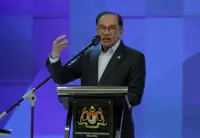
PETALING JAYA: Prime Minister Datuk Seri Anwar Ibrahim moved to plug a leadership gap at the centre of Malaysia’s growth agenda, appointing a close ally of former economy minister Rafizi Ramli to take over the Economy Ministry and naming a tycoon-cum-politician to lead the Investment, Trade and Industry Ministry (Miti).
Industry observers have well received the appointment of the 39-year-old Akmal Nasrullah Mohd Nasir as the new Economy Minister and the 61-year-old Datuk Seri Johari Abdul Ghani as the new Miti boss.
The two appointments are the most prominent changes in a Cabinet refresh that also promoted Datuk Seri Ramanan Ramakrishnan to head the Human Resources Ministry and shifted Steven Sim to the Entrepreneur and Cooperatives Development portfolio, among other adjustments to fill vacancies and rebalance responsibilities.
For Anwar, the reshuffle is designed to steady an administration that has kept growth on track and attracted foreign investment since taking power in late 2022, but has faced public frustration over living costs and criticism that reforms are moving too slowly.
In announcing the changes, Anwar said the Cabinet needed to work “as a team” and focus on addressing the people’s problems.
Speaking with StarBiz, economist Geoffrey Williams said the appointments of Akmal and Johari should help restore clarity at two ministries that shape everything from household incomes to corporate investment decisions.
“It is good that these appointments have been finalised because it ends uncertainty and provides some leadership ahead of a possible election in 12-18 months time,” he said.
Williams said Akmal’s early agenda should focus on long-running structural weaknesses rather than short-term optics.
“For Akmal as the new economy minister, the priority should be to address structurally low incomes and the pensions crisis.
“These are major areas that need attention but have been overlooked,” he said.
Johari, an Umno leader who previously served as minister in charge of plantation and commodities, takes over Miti as trade and investment flows are shaped by tariffs, industrial policy and tighter compliance regimes.
Apart from his political role, Johari also holds major equity stakes in companies like MyNews Holdings Bhd, JAG Capital Bhd and Media Prima Bhd .
.
As the new Miti minister, Williams said Johari’s priority is to keep foreign direct investment (FDI) strong while reviving domestic direct investment (DDI), which he described as “languishing.”
On trade, he urged Johari to press on with tariff and non-tariff barrier reforms linked to the US-Malaysia Agreement on Reciprocal Trade (ART), warning: “It will be a big mistake to try to delay or unravel ART by taking a protectionist stance.”
Industry groups welcomed the appointments, but stressed that the next phase must be defined by delivery.
Kuala Lumpur and Selangor Indian Chamber of Commerce and Industry president Nivas Ragavan said: “In my view, both appointments are positive and timely, especially as Malaysia navigates a delicate period of economic recovery, cost pressures and global uncertainty.”
He added that what businesses want now is “execution, coordination and speed”.
Nivas said the Economy Ministry should prioritise reforms that strengthen small and medium enterprises’ (SMEs) resilience and productivity, while improving policy clarity and consistency on taxation, incentives and digital compliance.
For Miti, he said expectations include accelerating both FDI and DDI with stronger spillovers for local SMEs, helping exporters manage currency volatility and rising compliance costs, and sharpening Malaysia’s pitch as a regional manufacturing, services and trade hub across Asean, India, the Middle East and Africa.
Datuk William Ng, national president of the Small and Medium Enterprises Association (Samenta), described the reshuffle as a signal that Anwar is placing trusted figures in ministries that will shape the country’s next economic chapter.
“These are heavyweight appointments that reflect the prime minister’s confidence in their capabilities,” he said, referring to Johari, Akmal, Sim and Ramanan.
Ng said that after two years under Ekonomi Madani, there have been “some encouraging developments, but also mixed outcomes” in turning ambition into effective plans and programmes, and argued the refreshed cabinet offers a chance to sharpen policy delivery.
He pointed to the rollout of the 13th Malaysia Plan in 2026 as a near-term test of whether Malaysia can gain from the shift toward a circular and sustainable economy while benefitting from its position as a neutral and effective supply chain hub.
Securing quality investments that translate into new industries and new opportunities for SMEs should matter more than headline numbers, Ng said, while calling for faster structural reforms to raise labour productivity through more aggressive support for automation and technology adoption.
He also urged the government to rein in bureaucracy and put ease of doing business at the centre of economic policy.
“Samenta looks forward to working with new ministers in making Ekonomi Madani a success.”
“Still, the political runway is short. “The new appointees to the Cabinet have to deliver positive economic benefits if the unity government partners are to be successful at the next election,” Williams said.