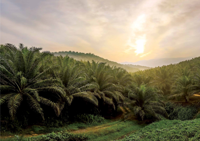
IN Malaysia’s early plantation days, life was tough, but creativity flourished.
While latex and fresh fruit bunch flowed, so did amusing stories behind estate names.
More than a formality, naming was an art, full of humour and quirky charm.
These tales remain a delightful part of the plantation heritage.
Let’s take a stroll down memory lane and discover how inventive those names truly were.
Tennamaram Estate
It’s been 108 years since Malaysia’s first commercial oil palms were planted at Tennamaram in Batang Berjuntai (now Bestari Jaya), Selangor.
In 1911, inspired by oil palm development in Sumatra, Frenchman Henri Fauconnier brought seeds to his coffee estate, and by 1917, Tennamaram became the nation’s pioneering oil palm estate.
Now here’s the twist: “Tennamaram” comes from the Tamil words “tennam maram”, meaning coconut tree.
Why name an oil palm estate after coconuts? Apparently, Tamil workers mistook the young palms for coconut trees, giving the estate its “coconutty” name.
The actual Tamil for oil palm is “sempanai maram” or “enney panai”, so the estate’s name was based on a botanical blunder. And so, Malaysia’s oil palm legacy – serious business with global impact – was born from a linguistic mix-up.
Bangsar
In 1906, the London-based Kuala Lumpur Rubber Co Ltd (KLR) was founded to plant rubber around Kuala Lumpur, driven by rising demand for tyres as motorcars replaced horse – drawn carriages.
Veteran planter M R Chandran, who once worked with Socfin, fondly recalled KLR’s Belgian and French founders – Edouard Bunge and Alfred Grisar – who left a lasting mark on the region’s agricultural landscape.
Back then, naming the estate was a no-brainer for Bunge and Grisar: they simply merged their surnames.
Thus, Bunge-Grisar was born. But “Bunge-Grisar” didn’t roll off the tongue for local workers under the Malayan sun.
Over time, it was shortened to “Bungsar”. As the plantation made way for city life, the name got a final polish – becoming “Bangsar”.
Thankfully for today’s branding, B came before G – otherwise we would be living in Sarbang.
What began as a humble rubber estate under Socfin eventually morphed into the buzzing suburb.
Yam Seng Estate
Here’s a cheerful tale from The Planter by D B Gardner about how a rubber estate in Larut, Perak came to be named Yam Seng – the Cantonese toast meaning “Cheers!”
At the turn of the century, an Irishman – rare among the mostly English and Scots planters – was managing the only Irish-registered rubber company operating in Malaya.
When his company acquired land from a local Chinese towkay, tradition called for a handover celebration.
The chairman threw a party, complete with rounds of brandy.
As spirits soared, so did the shouts of “Yam Seng!” from the Chinese guests.
When the time came to name the estate, the official turned to the Irishman, who, perhaps buoyed by both cultural warmth and brandy, simply raised his glass and declared, “Yam Seng!” Applause followed.
And just like that, Yam Seng Estate was born.
Fittingly, “Yam Seng” also means “Drink to Victory”, a perfect tribute to the estate’s hopes for prosperity, success and unity.
Today, the name celebrates more than a good cheer – it honours a unique blend of Irish wit, Chinese tradition and the shared toast to progress.
MOBE Estate
Here’s another classic from The Planter about MOBE – a rubber estate named after a frustrated Englishman’s sarcastic outburst.
Estate rules required a giant signboard listing the estate name.
After refusing to register a name and facing repossession, he gave in with that cheeky acronym for his outburst “My Own Bloody Estate” – and it stuck.
MOBE remains a legendary blend of British sarcasm and colonial red tape – with a wink.
Nordanal and Lanadron Estates
In Panchor, Johor, a clever plantation owner made waves not just with rubber but with naming flair.
His estate, Nordanal, sounded grand and mysterious. When he bought a neighbouring plot, He kept it simple – just reversed the original name.
And so, Lanadron was born.
Workers laughed, “Did Tuan just flip the name?” But the strategy caught on.
Today, both estate names remain as cheeky reminders that sometimes, the smartest move is just flipping the script.
Jeroco and Trushidup
Let’s head to Sabah, where plantation names blend branding genius with local flair. First, Jeroco – a name that sounds like a masked superhero but is actually a clever acronym coined by Hap Seng Plantations in Lahad Datu.
No, it’s not biblical Jericho with crumbling walls and trumpets. This is Jeroco –practical and all about tropical crops. The name fuses four key ones: JE for Jelutong, R for Rattan, O for Oil Palm and CO for Cocoa.
A compact showcase of agro-diversity!
Of course, not all crops are created equal. Over time, only oil palm proved unstoppable – efficient, productive and needing fewer resources than its plant cousins. It’s the last crop standing.
Then there’s Trushidup of Genting Plantations Bhd .
.
Sounds like a mythical forest where nothing dies – and in a way, it is.
A poetic spin on Terus Hidup (Malay for “live on”), it evokes images of ever-flourishing palms swaying with eternal purpose. Immortality, estate-style.
Excellent Challenger 1 and 2
Back when I was in IJM Plantations Bhd, now KLK, there were two estates in Sugut named Excellent Challenger 1 and 2 – grand names that stuck from day one.
Naturally, we shortened them to EC1 and EC2, which, in true Malaysian fashion, became “Easy-one” and “Easy-two”.
But don’t be fooled by the breezy nicknames.
These estates sat near the Sugut River, and during the early days, heavy rains regularly turned them into giant ponds. Plantation life was anything but “Easy”, though “Challenger” felt very accurate.
And if battling floods wasn’t enough, the rising waters brought more than fish.
Yes, there were crocodiles too.
So along with tending to the crops, we had to watch the riverbanks. A true test of nerves – and definitely not so “easy too” after all.
As plantation ownership changed over time, many colonial-era names were replaced – taking with them small pieces of our past. But were those changes necessary? Rather than erasing history, we might learn from it and move forward.
Shakespeare asked, “What’s in a name?” But on plantations, names were more than labels.
They carried wit, sentiment and history – whether as acronyms, tributes or clever wordplay.
Some planters also named estates after places or people from home, turning distant memories into emotional anchors in unfamiliar lands.
Joseph Tek Choon Yee is the past president of the Malaysian Estate Owners Association and former chief executive of the Malaysian Palm Oil Association. The views expressed here are the writer’s own.