
VOLATILITY in the capital markets is a clear indication that investors dislike uncertainty.
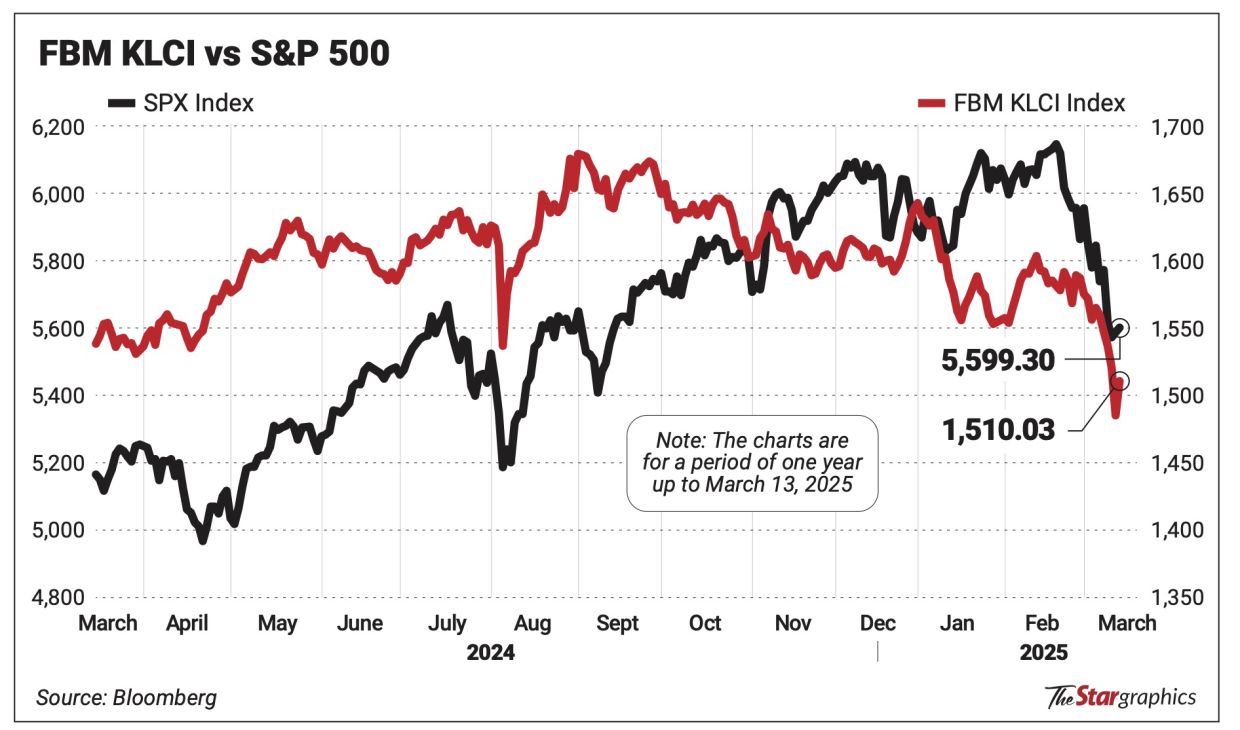
Selling of US equities started early this month, and bond prices rose as President Donald Trump threatened another round of tariffs.
Markets around the world have been affected by the rout in US equities, as scepticism about the US economy and the potential impact of a recession has added to the worries.
The US Federal Reserve’s (Fed) trajectory of interest-rate cuts has contributed to this challenging market environment.
Will the Fed lower interest rates gradually as it stays on course to get inflation closer to its 2% target, or will there be more cuts to support an economy that many expect to be affected by higher inflation from the tariffs?
Generally, when interest rates are cut, stock prices will rise, but with the current uncertainties, this may not happen despite what some analysts say.
Trump has not ruled out a recession either.
This has added to the already jittery investor sentiment, and many are still confused over Trump’s haphazard policy announcements of the past few weeks, especially on tariffs, which can also be reversed or delayed depending on what “deals” have been struck or what “cards” each side has.
The world of diplomacy, trade, and even defence has become a game of high-stakes poker.
Steel and aluminium tariffs have been imposed on all countries for the first time, which could result in a global trade war, or it could not, depending on what deals are negotiated.
Canada and the European Union have retaliated with tariffs of their own.
As a result of the heightened uncertainty caused by unpredictable policy announcements, governments will be wondering what is next on the agenda.
Just before Trump’s Jan 20 inauguration, the International Monetary Fund (IMF) projected US economic growth to be 2.7% this year, 0.5 percentage points higher than in the October 2024 update.
This projection reflected strong consumer demand and jobs data, along with accelerating investments. However, this positive outlook is now at an increased risk.
US recession risks
US economic recession odds have risen from last year, with predictions ranging from 50% by Larry Summers, the former US Treasury secretary, to 40% by JP Morgan Chase & Co economists.
Despite all the noise and volatility, nothing is certain at this point. Meanwhile, there is also the countervailing view that cooler heads will prevail in the Trump administration as risks escalate.
It is currently unclear how these risks can be measured, whether they are mounting job losses, accelerating inflation or slumping markets.
In a March 13 report, AHAM Capital says the Trump administration “is unlikely to push the US economy into a full-blown recession due to political costs.”
It expects policymakers to soften their trade stance if economic conditions deteriorate further.
AHAM Capital adds that as tariffs are being used more as a bargaining chip than as a long-term strategy, recent equity market weakness might be a good opportunity for long-term investors, with a successful trade negotiation or modest concessions from key trading partners serving as catalysts for market stabilisation.
The asset manager says the market reaction has been overdone for Malaysian equities, which have been weighed down this year by a combination of external and domestic factors, including tariff threats from the United States, concerns about a slowdown in data centre spending, and investors switching to Chinese stocks.
Malaysia’s strong domestic fundamentals, underpinned by ongoing policy execution and foreign direct investment inflows, are likely to attract investors again once the dust settles, it adds.
As a result of continued consumer spending growth and a multi-year expansion of private and public investments, as well as a diversified economy, goods produced, and export markets, Malaysia can weather a mild US recession, according to Lee Heng Guie, executive director of the Socio-Economic Research Centre.
He cautions, however, that the country’s exports will be affected by a slowdown in the United States, along with a slowing global economy caused by trade wars.
In 2024, shipments of electrical and electronics (E&E), machinery, equipment and parts, and rubber products to the United States increased 23.2% from the previous year to RM198.65bil, according to the latest trade statistics from the Malaysia External Trade Development Corp.
As a result, the United States is Malaysia’s second-largest export market, with a 13.2% share, and its third-largest trading partner, with a 11.3% share of total trade. Malaysia also relies heavily on US investment.
Lee says the risks for Malaysia, as a small open economy, can be assessed through trade, income and investment channels.
“Overall, the direct and indirect impact on Malaysia (via rerouting) on Malaysia’s exports will depend on the substitutability of the affected products, reconfiguration of supply chains and production, transshipment and Malaysian firms’ products’ cost and price competitiveness,” he says.
According to Oversea-Chinese Banking Corp Ltd senior Asean economist Lavanya Venkateswaran, the bank’s base-case scenario is for slower US economic growth, not a recession, but she does not discount the implications for Malaysia if it happens.
According to a White House fact sheet, Trump is scheduled to announce the Fair and Reciprocal Plan on April 2, an initiative to restore fairness to US trade relationships and counter non-reciprocal trade.
According to Lee, Malaysia will not face a blanket reciprocal tariff since the country’s trade deficit is relatively small compared to those of China, Mexico, Vietnam, Canada, India, South Korea and Japan.
In addition, he points out that the United States removed Malaysia from its currency manipulation monitoring list last November.
Trump has complained about countries lowering their currencies to make their goods cheaper and gain a competitive advantage.
In light of the numerous US companies operating in Malaysia, including those involved in E&E production, investing in data centres, and developing artificial intelligence chips, Lee cautions against any drastic tariff measures or export restrictions.
As a precautionary measure, Malaysian businesses exporting technology or high-tech components must demonstrate full compliance with the United States export control framework, he says. (For more on this developing story, see Page 7.)
Malaysia is the United States’ 19th-largest trading partner, with a US$24.8bil deficit in its favour, ranking it 14th on the trade deficit list and accounting for 2.1% of US trade deficits.
Global Trade Alert reports that 25.3% of US imports to Malaysia have higher average tariffs than the 12.5% of Malaysian imports to the United States, raising concerns over fairness and reciprocity.
This time around, Lee believes the risk of wider tariffs can be mitigated by expanding intra-Asean trade and deepening supply chains across industries in the region.
The only tariffs imposed by Trump during his first presidency that had a neutral to mildly negative impact were tariffs on photovoltaic products, he says.
In contrast, tariffs on steel and aluminium products, solar panels and washing machines had no significant effect.
Asean members with export-oriented economies or those who have a positive trade deficit with the United States are most likely to face tariffs, according to Lavanya.
According to her, Vietnam, Thailand, Malaysia, Indonesia and the Philippines will be vulnerable in that pecking order, and it would take a miracle for the grouping of 10 to escape tariffs, given the region’s nuanced approach of differential tariffs, unfair taxes and non-tariff barriers.
The impact of tariffs will depend on the order in which they are applied, the economies affected, and the items affected.
Should tariffs materialise, exports to China could stabilise, but they won’t be able to offset sharply weaker exports to the United States.
The IMF in its January update urged multilateral cooperation in containing fragmentation, maintaining growth and stability, and addressing global challenges, warning that tariffs could exacerbate trade tensions, lower investment, reduce market efficiency, distort trade flows and disrupt supply chains.
Economies may experience growth slowdowns in the near and medium terms, but to varying degrees.
Already a subscriber? Log in
Get 20% OFF The Star Digital Access
Cancel anytime. Ad-free. Unlimited access with perks.