The spotlight on a transaction fee – the merchant discount rate (MDR) – to be imposed on merchants for accepting payments via the DuitNow quick-response (QR) code service has raised questions about whether Payments Network Malaysia Sdn Bhd (PayNet) should fully absorb the cost.
As it is, Bank Negara’s PayNet, which operates the DuitNow QR code infrastructure, made a profit to the tune of RM230mil in the financial year ended Dec 31, 2022, bringing its retained earnings to a whopping RM1.16bil.
Bank Negara is PayNet’s single largest shareholder, along with eleven Malaysian financial institutions as joint shareholders.
By introducing a fee, that profit could more than double if the trend in digital payments continues on its upward trajectory.
At the same time, the migration away from the use of paper money and cheques will lead to cost savings for Bank Negara and the banking system.
Why does it then need to make a significantly larger profit when it is already making a sizeable income from the migration to digital payment?
Bank Negara says it is not profiting from PayNet.
“Bank Negara does not profit from the operation of PayNet. As the operator of DuitNow, PayNet plays an important role in building an inclusive, resilient, and efficient payment and financial ecosystem as envisioned under the Financial Sector Blueprint to progress Malaysia’s economic development. In line with this developmental objective, all dividends and surplus profits generated by PayNet are reinvested to ensure the domestic payment infrastructure remains resilient, competitive and accessible to all,” the central bank says in a reply to StarBizWeek.
Bank Negara adds that the increased adoption of digital payments by the public can provide meaningful cost-savings and greater efficiencies to the entire economy.
“Individuals can conveniently make payments securely at anytime and anywhere, without having to make a trip to an ATM machine. Businesses also save on additional overheads and administrative costs associated with handling cash payments,” it says.
The central bank points out that the cost of accepting cash, for businesses, includes time-based costs (the time taken to visit the ATM machine to withdraw cash), labour (manual paperwork and reconciliation), travel (transport of cash to and from the banks), and security (costs relating to loss, robbery, fraud, theft and pilferage).
The central bank adds that local financial institutions also derive potential savings from lower cash-handling costs.
“Such savings enable banks to reinvest into their payment infrastructures and therefore keep e-payment costs low for users. Similarly, savings from lower currency production costs with a reduction in cash usage would also be channelled back to the economy,” Bank Negara says.
Some industry observers suggest the imposition of fees on e-transactions might be a step back in encouraging greater adoption of digital payments
E-payment solutions such as DuitNow QR code should help consumers, especially in rural areas, to participate in the digital economy and have access to a wide range of goods and services.
“Digital payment services in Malaysia are provided by banks and non-banks. In the e-payment space, transaction fees are an important source of income, especially to the non-bank players, to help them cover the costs to upkeep their digital payment systems and maintain high service and security standards for users of e-payment,” Bank Negara explains, adding that non-bank players have had an increasingly important role in the Malaysian payment ecosystem in recent years, becoming more agile and nimble.
“This has helped create a vibrant and competitive payment ecosystem as they continue to offer innovative and improved value-added services for the benefit of customers, including the underserved segments. For now, major banks and non-bank financial service providers will continue to waive transaction fees for micro and small businesses accepting DuitNow QR payments while individual customers using DuitNow QR to make payments will not incur any additional charges,” the central bank says.
The MDR was initially waived to promote QR payment adoption nationwide in 2019, and with the onset of the Covid-19 pandemic the waiver was extended further until Oct 1, this year. For businesses, any transaction fee imposed on QR payments remains as low as, or lower than, fees imposed on payments using credit cards, Bank Negara says.
Rakuten Trade head of equity sales Vincent Lau says it would be a good move by banks to defer the imposition of the MDR.
“There should be a balance between making profits and encouraging the adoption of digital payments. While banks have a role to play by continuing to absorb the cost, merchants should also bear some of the cost of enjoying the convenience of e-payment solutions,” Lau says.
However, there are concerns that merchants will eventually pass the cost to consumers by raising their prices. To ensure consumers are not overly burdened, shouldn’t Bank Negara dictate the fee imposed on e-payments, instead of leaving it to the banks to charge arbitrarily?
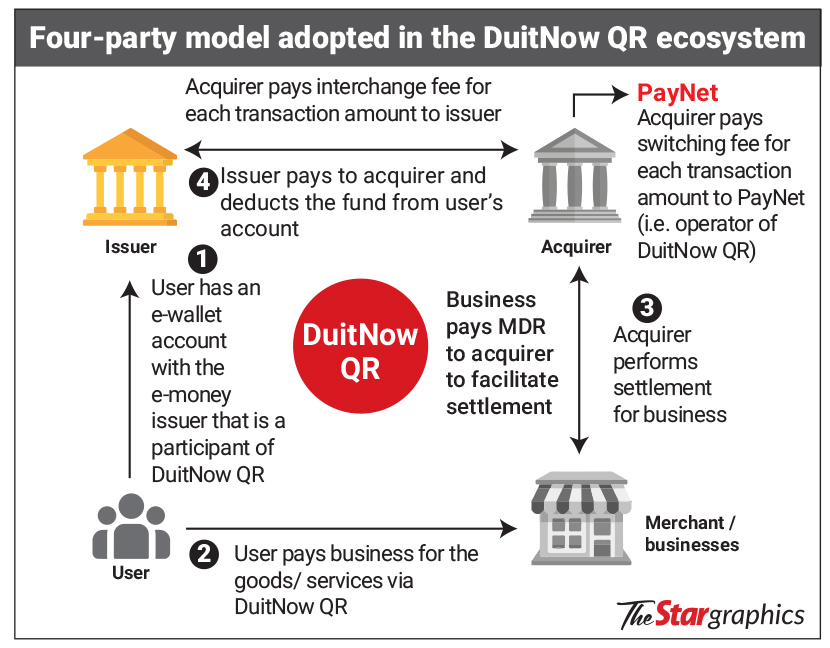
“These transaction fees are a common fee imposed on businesses by the acquirers (which can be banks or non-bank financial service providers) for the provision of e-payment services, including card-based payments.” Acquirers are banks or non-bank financial service providers that provide merchant-acquiring services that enable businesses to accept electronic payments for the sale of goods and services.
“In Malaysia, the MDR is determined by the market in line with the objective of encouraging a competitive market that will enable businesses to choose from a variety of service providers that best suit their business needs, including those that can provide businesses with access to a wider customer base,” Bank Negara adds.
Already a subscriber? Log in
Get 20% OFF The Star Digital Access
Cancel anytime. Ad-free. Unlimited access with perks.