A SMALL and open economy like Malaysia is highly sensitive to global macroeconomic challenges.
With its trade valued at 141% of national gross domestic product (GDP), Malaysia relies heavily on external demand, especially from its top trading partners such as China, the United States and Singapore.
The three countries contributed over 40% of Malaysian exports value in the first seven months of 2023.
In fact, Malaysia is so intertwined with the global manufacturing landscape that one out of five chips imported by the United States in February 2023 came from Malaysia.
These countries are also the top investors for Malaysia. In 2022, the United States and Singapore contributed nearly 66% of total net foreign direct investment flows into the country.
In good times, when the countries are booming, Malaysia will be one of the first to benefit from the positive spillover effects.
On the contrary, when the same countries go through economic slowdown, the country and its currency will be the first to be negatively affected.
This is what happened in the second quarter of 2023 (2Q23).
Global economic growth turned modest, with the world’s second largest economy – China – recording lower than expected growth.
Its consumer spending, factory production and investment in long-term assets all slowed further in July from a year ago, according to the country’s National Bureau of Statistics.
Meanwhile, most countries in South-East Asia posted continued decline in exports, reflecting weaker external demand amid global technology downcycle.
Singapore, for example, saw its key exports – non-oil domestic exports – fall for the 10th straight month in July by 20.2%, dragged by weakness in both electronics and non-electronics exports.
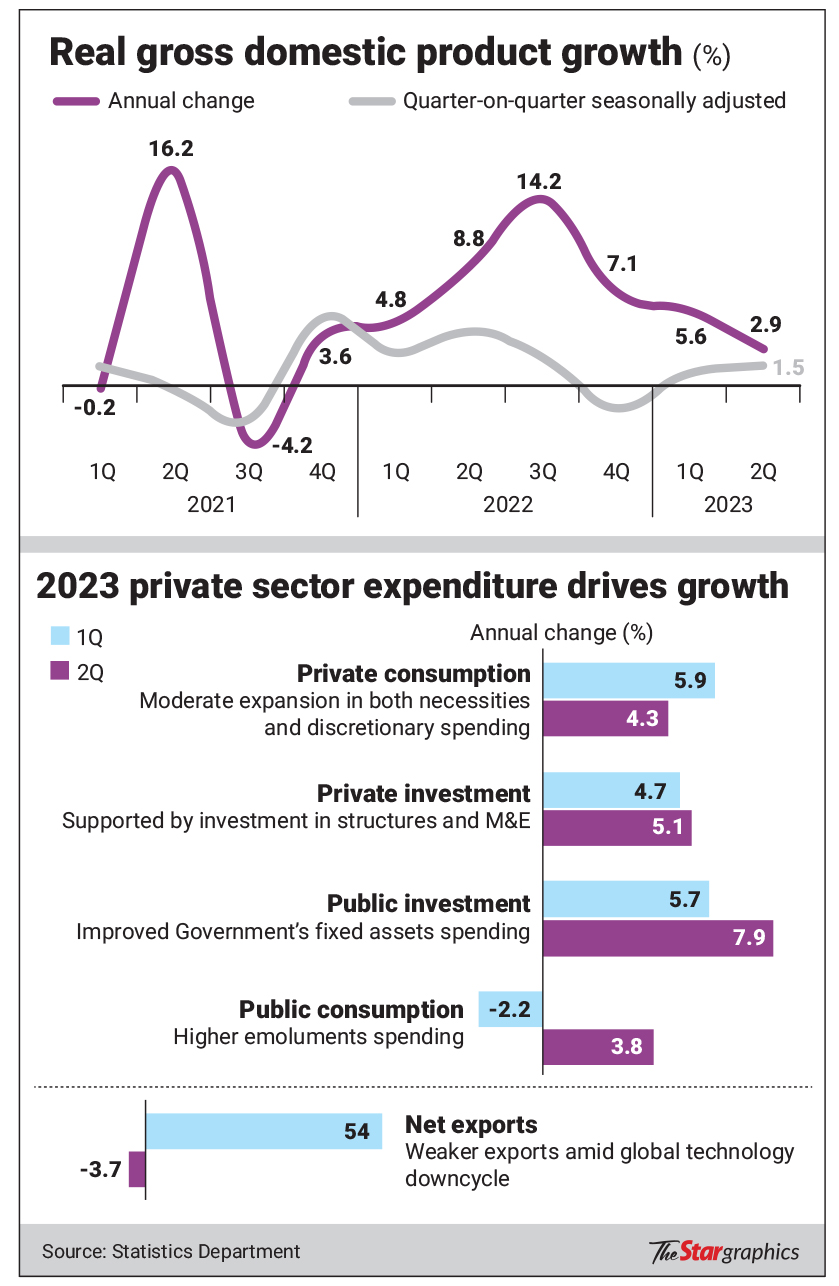
As a result of the challenges, Malaysia’s GDP only managed to grow by 2.9% year-on-year (y-o-y), below the market prediction of 3.3%.
In comparison, the economy had grown by 5.6% y-o-y in 1Q23.
The country’s economic growth was seen moderating for a third consecutive quarter after hitting 14.2% in 3Q22.
The high base effect from 2022 and the 3.7% contraction in net exports also dragged down national growth in 2Q23.
Bank Negara governor Datuk Abdul Rasheed Ghaffour clarifies that the GDP growth in 2Q23 would have been recorded at 3.3% – in line with market prediction – had it not been for the “synchronised commodity-related factors”.
“Let me reiterate that the moderate growth in 2Q23 was partly driven by several temporary factors, including plant maintenance in the mining sector, hot weather affecting agricultural output, as well as high base effects from the economic reopening and policy measures in the second quarter last year,” he says in a media briefing yesterday.
On a positive note, the GDP expanded by 1.5% in 2Q23, on a quarter-on-quarter (q-o-q) seasonally adjusted basis. In 1Q23, the economy grew by only 0.9% q-o-q.
Fortunately, despite the weakness in the external front, the Malaysian economy is supported by both private and public sector expenditures.
Private consumption, which grew by 4.3% y-o-y in 2Q23, was underpinned by firm labour market conditions.
Meanwhile, spending expanded moderately across both necessities and discretionary items.
Private investments grew stronger by 5.1% y-o-y, supported by further progress in construction projects and continued capacity expansion.
Sector-wise, services – the bedrock of the economy – expanded at a slower pace of 4.7% y-o-y, compared to 7.3% in 1Q23. This was due to a moderation in consumer- and business-related services.
The construction sector saw a growth of 6.2% y-o-y amid continued progress of large infrastructure projects and support from higher special trade activities.
The manufacturing sector recorded a flattish growth of 0.1% y-o-y in 2Q23, down from 3.2% in 1Q23. This was caused by weaker electrical and electronics production as well as lower refined petroleum production amid a decline in mining output.
Meanwhile, the mining and agriculture sectors contracted in 2Q23 by 2.3% and 1.1% respectively.
Weak external demand risk
Looking ahead, Bank Negara is still positive that Malaysia will be able to hit its 4% to 5% growth target in 2023, although it is likely to be close to the lower-end of the forecast.
The economy will remain supported by domestic demand, continued revival in tourism activities and the improvement in the labour market.
Easing price pressures amid the slower increase in headline and core inflation figures would support household spending.
Stronger approved investments announced over the past two years will also drive private investments moving forward, as these projects are realised and implemented.
However, the governor cautions that the global economy will remain challenging and would be a major headwind for Malaysia in the near term.
“The economy is facing downside risks stemming from weaker-than-expected global growth and a deeper or longer-than-expected technology downcycle.
“Beyond that, there could be lower-than-expected commodity production domestically due to stronger impact from El Nino and prolonged plant maintenance,” says Abdul Rasheed.
The governor has also noted that the weakness in exports is likely to continue in the coming months, but it may gradually recover by end-2023 or early next year.
However, the recovery in exports is subject to global developments, including how long the weak demand from countries like the United States and China sustains.
In June this year, the World Bank warned that “grey days likely lie ahead” and expected sluggish GDP growth this year and in 2024.
It slashed its GDP growth forecast for the United States to 0.8% in 2024, as compared to the previous forecast of 1.6%.
As for China, the World Bank forecasts a growth of 4.6% in 2024, moderating from 5.6% this year.
If major economies like the United States and China take a longer recovery period than expected, Malaysia’s economic slowdown could extend into next year.
Malaysia University of Science and Technology economics professor Geoffrey Williams believes that the slow global growth could continue into 2024, if policymakers overseas continue with their “bad policies”.
“Unfortunately it looks very much like they will. Malaysia cannot rely on external market recovery.
“If external markets improve it will be a bonus but emphasis must be placed on the domestic economy, long-term reforms and raising incomes across the majority of the population,” he tells StarBizWeek.
Centre for Market Education CEO Carmelo Ferlito, however, cautions about Malaysia’s growing dependence on domestic consumption.
This is consistent with the previous statement of Investment, Trade and Industry Minister Tengku Datuk Seri Zafrul Abdul Aziz, who lamented that the contribution of trade and investments to Malaysia’s GDP has declined over a 10-year period.
He highlighted that trade and investments used to contribute 38% of the country’s GDP in 2011, but it has fallen to 27% by 2021.
Ferlito says that recent research shows that Malaysia’s GDP growth has increasingly been led by consumption.
“Research shows that consumption-led expansions tend to be significantly weaker than when growth is driven by other components of aggregate demand, often because of the build-up of imbalances.
“The incidence of consumption-led growth can lead to rising debt service ratios and thus it can significantly dampen growth in the medium to long run.
“Policies that aim at fostering durable growth should focus on strengthening investments,” he says.
Ferlito adds that an increasing share of private consumption in GDP can be a leading indicator of future growth slowdowns, particularly if consumption-led expansions come on the back of growing imbalances and rising debt burdens.
“High household debt service ratios tend to become a potent drag on economic growth, frequently leading to costly deleveraging processes,” he says.
Malaysia can withstand headwinds
The Bank Negara governor expressed his optimism that Malaysia can withstand risks from global growth slowdown, especially from China, thanks to its well-diversified economy.
Abdul Rasheed points out that Malaysia does not depend heavily on one particular trade partner or industry.
China, despite being a major trading partner, only accounts for 13.6% of Malaysia’s total trade.
“While China’s reopening remains supportive of the global economy, we acknowledge that its pace of recovery has slowed in recent months.
“Nevertheless, the Malaysian economy is well diversified in terms of products and trade partners, thus it is capable of cushioning the impact coming from China,” he says.
Commenting on the outlook for the rest of 2023, Abdul Rasheed says that upside risk factors such as stronger-than-expected tourism activity and faster implementation of projects could boost GDP growth.
However, Williams expects a further normalisation in GDP growth in the second half.
“Growth will likely be slower and towards the lower end of the 4% to 5% official forecast with a strong chance that it will be below that.
“Only high government spending, inventories and statistical adjustments are holding up the figures at the moment,” he adds.
OCBC Bank senior Asean economist Lavanya Venkateswaran also foresees a slower GDP growth in 2H23 at 3.7%, as compared to 4.2% growth in the first six months of 2023.
This reflects a bigger drag from anaemic external demand conditions.
Following the disappointing GDP performance in 2Q23, Lavanya reduced her GDP growth forecast for full-year 2023 to 4% y-o-y from 4.4% y-o-y previously.
“For 2024, we lower our GDP growth forecast to 4.2% from 4.5%, previously, as the drag from global growth is expected to persist.
“This nonetheless underscores an improvement in growth momentum relative to 2023,” she says in a note.
Despite the market concerns about the outlook, Bank Negara appears to be positive on the country’s medium to long-term growth potential.
The Madani Economy Framework will anchor the comprehensive restructuring of the economy, supported by several important transformations, such as having a revitalised industrial sector, it says.
“The country’s economic vision also includes creating quality and higher paying jobs, positioning ourselves as a globally competitive investment destination, and becoming a climate resilient and greener economy.
“Besides, it will also improve fiscal governance and transparency, which will enhance confidence from investors and also credit rating agencies,” according to Abdul Rasheed.
Ferlito is “quite positive” on the Madani Economy Framework, but highlights the importance of implementation.
“It can potentially be a driver for investment and international trade, but this can happen only if policies are implemented at the level of economic reforms, rather than with direct interventions in the economy,” he says.
Meanwhile, Williams calls for the government to focus on basic bread-and-butter economics and not be distracted by “boy-toy projects, sunshine and windmills”, if it is serious about boosting long-term economic growth.
Among the structural reforms needed in Malaysia, according to Williams, is the approach to remedy the brewing pension crisis that may affect future spending, if left unaddressed.
The second major issue that needs to be resolved by the administration of Datuk Seri Anwar Ibrahim is income inequality that holds back growth.
Williams points out that half of Malaysians in formal employment earn less than RM2,600 per month and 45% earn less than RM2,000 per month.
“We need a significant redistribution policy to rebalance the share of economic growth going to the majority,” he says.
The third reform needed is to address the existence of an informal economy in Malaysia.
“Malaysians in formal employment make up less than 40% of the labour force, so there is a very large informal economy out there.
“The government needs to embrace the opportunities this offers and not default to over regulation. This requires deep thought on policy options,” he says.
Already a subscriber? Log in
Get 20% OFF The Star Digital Access
Cancel anytime. Ad-free. Unlimited access with perks.