

WHILE Malaysians in general, especially domestic households, have been spared from higher electricity rates when the government imposed the 20 sen per kilowatt hour surcharge back in January, there could be more surprises to come in the form of other utility charges.
This time, it could be in the form of higher water tariff rates as mentioned by the Natural Resources, Environment, Climate Change Minister Nik Nazmi Nik Ahmad, late last month.
However, any increase in domestic users will be subjected to a maximum cap to be introduced by Suruhanjaya Perkhidmatan Air Negara (SPAN).
Unlike electricity rates, water rates are very much a state matter. Every state has its very own tariff rates and domestic consumers are charged depending on the amount of water that is consumed and the corresponding tariffs that are imposed at different consumption levels.
For easy reference, a quick study was carried out among Peninsular Malaysia states and the results can be surprising as to how much is water sold for.
Based on three different buckets of consumption of 20 cubic meters (cu m), 50 cu m, and 100 cu m, water bills for domestic users ranged between RM4.40 and RM16, RM25.65 and RM91.00, and RM79.40 and RM241 for states in Peninsular Malaysia respectively.
Table 1 summarises the findings of monthly water bills based on different levels of domestic consumption.
Cheap in Penang
Based on the domestic consumption, Penang is the cheapest for water consumption of less than 50 cu m per month while the highest is in Johor.
For consumption of 20 cu m or less, Penang only charges 22 sen per cu m but in Johor, the rate is at 80 per cu m.
Penang charges 46 sen per cu m for consumption of more than 20 to 40 cu m while Johor’s rate is at RM2 per cu m for consumption of more than 20-35 cu m. The rate escalates to RM3 per cu m for consumption of more than 35 cu m in Johor, while in Penang, the rate is 68 sen per cu m for consumption of more than 40 to 60 cu m. The rates in Penang are further broken down for the consumption of more than 60 to 200 cu m and more than 200 cu m at RM1.17 per cu m and RM1.30 per cu m, respectively.
In addition, Penang also imposes a 48 sen per cu m water conservation surcharge for consumption in excess of 35 cu m per month.
For consumption of 100 cu m per month, Terengganu has the cheapest total bill of RM79.40 while in Johor, the rate is almost three times more.
Commercial rates
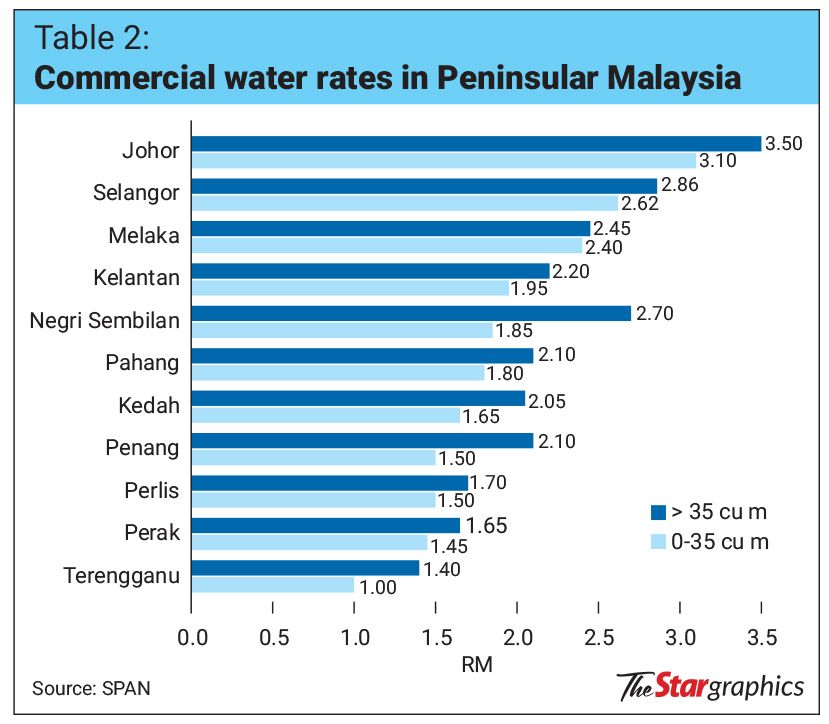
Similar to domestic consumption rates, the commercial rates too have a diverse range between states. Johor imposes the highest rate of RM3.10 per cu m for consumption of up to 35 cu m per month and this escalates to RM3.50 per cu m for consumption in excess of 35 cu m per month.
In comparison, Terengganu is the cheapest with a rate of RM1 per cu m and RM1.40 per cu m for the same tariff buckets.
Table 2 summarises states in Peninsular Malaysia based on their commercial water tariff rates.
Loss-making?
Among all the state-owned water companies, only PBA Holdings and Ranhill Utilities are listed entities and investors have direct access to the performance of the two water companies.
In 2022, PBA recorded revenue of RM348mil, up 1.7% year-on-year (y-o-y) but pre-tax profit fell by 6.8% y-o-y to RM35.4mil.
For Ranhill SAJ, which is the operating unit of the Johor water works, the company reported a revenue of RM1,154.9mil last year, up 1.2% y-o-y, while pre-tax profit improved by almost 90% to RM244.5mil, boosted by the recognition of non-revenue water (NRW) reduction incentives to be received by Ranhill SAJ amounting to RM142.3mil.
In essence and excluding the one-off gain, PBA and Ranhill SAJ had a pre-tax profit margin of approximately 9.5% and 8.8%, respectively, in 2022.
It is generally believed that most other state-owned water concession companies are loss-making including Air Selangor, Malaysia’s largest water concessionaire.
Based on the information provided on its website, Air Selangor generated revenue of RM2.18bil in 2021 but operating expenditure for the year totalled some RM2.43bil, giving it a deficit of RM250mil in that year.
Air Selangor implemented an adjustment to its non-domestic customers on August 1, 2022, whereby the tariffs were raised by 55 sen and 58 sen for the 0-35 cu m and >35 cu m, which is a 26.6% and 25.4% adjustment, respectively.
This will likely boost Air Selangor’s revenue by approximately RM200mil at least, enabling it to be able to reduce its deficit significantly.
Water in Malaysia is unique today as the setting up of Pengurusan Asset Air Bhd in 2006 allowed state assets (excluding Terengganu) to be transferred to the federal-owned entity, which acts as the holding company for water assets in Malaysia.
These water assets, worth RM24.2bil as at the end of 2021, are then leased to the respective state-owned water concessionaires for the operations and maintenance of the assets and licensed by SPAN.
NRW has room for improvement
Both Penang and Johor have NRW at 26.3% at the end of 2022 against the national average (excluding Sabah and Sarawak) of 34.4% and the lowest among all.
According to the 2022 Water and Sewerage Handbook 2022, states with horrible NRW levels are Perlis with a NRW of 61.5%, followed by Kelantan at 53.7%, and Kedah at 51.5%.
More work needs to be done to reduce NRW, as the high NRW cost some RM2bil in losses to the states.
Given that Penang and Johor water companies are profitable entities, perhaps mainly due to the low NRW, more efforts need to be done by both the federal and state governments to tackle the high NRW, as any improvement in NRW enables these states to improve their bottom line significantly.
The fact that Penang has one of the lowest tariff rates, despite the conservation charge, is a testament that good water management is more than just raising tariff rates.
Pankaj C. Kumar is a long-time investment analyst. The views expressed here are the writer’s own.
Already a subscriber? Log in
Get 20% OFF The Star Digital Access
Cancel anytime. Ad-free. Unlimited access with perks.