



IN the previous article, this author argued that Malaysia will likely trend close to the World Bank’s high-income threshold without surpassing it or falling back to the upper-middle income bracket upon “graduation”.
Much of this is due to the lack of growth catalyst and how the government defines growth. Hence, the “so close yet so far” argument.
Malaysia’s V-shaped post-pandemic recovery was underwhelming, to say the least. In 2021, the country’s real gross domestic product (GDP) growth came in at 3.1%, lower than most other regional countries such as Singapore (7.6%), Indonesia (3.7%), the Philippines (5.7%), South Korea (4.1%) and China (8.1%).
But a year later, Malaysia reopened its international borders fully and early, and kept inflation in check aggressively through subsidies and price controls amid raging global inflation.
As a result, the country’s real GDP growth print in 2022 was the region’s highest and the best since 1995 at 8.7%.
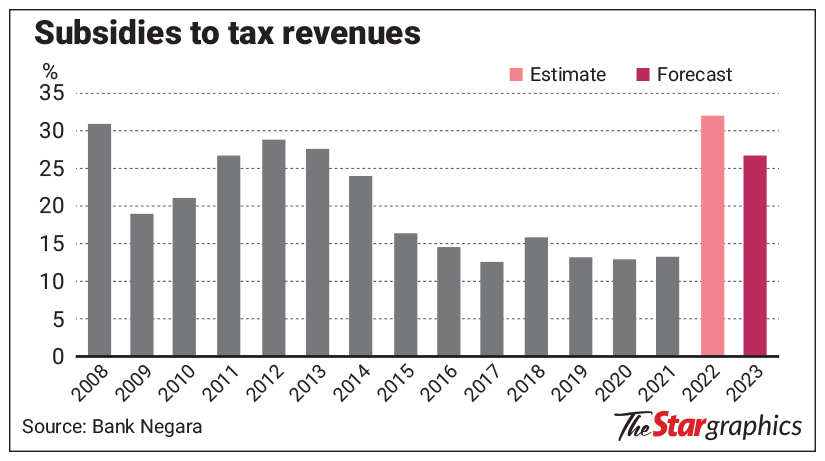
Despite the stellar growth performance, it was not celebratory from the government’s standpoint. Subsidy bills skyrocketed to a historic high of 32.3% of its tax revenues in 2022, higher than in 2008 (31.2%) when Brent crude oil reached an all-time high of US$147.50 (RM667.10) per barrel in July 2008.
Understandably, the government is now hellbent on cutting the subsidies bill. But at what cost? Answer: growth prospects.
It appears that the government wants the rich “pay” for the country’s growth.
Following the removal of the goods and services tax (GST) in 2018, the government introduced a slew of peripheral taxes intended to plug the revenue loss with taxes on sugar, windfall and foreign-sourced incomes, among others.
Now, the government is seen as more aggressive in targeting individuals rather than companies with the planned subsidy removal on fuel, electricity and luxury goods.
This author understands that these peripheral taxes represent the government’s answer to substituting GST in the economy.
The regressive nature of GST by applying a blanket tax rate on all goods and services may be seen as “harmful” to low-income earners in percentage terms. However, the rationale for having GST is to broaden the tax base, not the tax rate.
We are missing the forest for the trees here. One assumption about abandoning GST because of its “regressive” nature is that low-income earners would remain “poor” regardless of Malaysia’s developmental stage. Ergo, they should pay less for everything, especially for food.
As we get richer, the percentage spent on food will diminish, but other lifestyle-related spending will surely increase.
Across all income groups and household sizes, Singaporeans only spend a little on food other than eating out. As household size increases, they spend even less on food but more on commuting.
Iceland, the lowest household income spending among Organisation for Economic Co-operation and Development countries, spends more on housing and utilities than food.
Therefore, the government’s argument about low-income households’ spending patterns does not hold water because public economics cannot remain constant over time.
The biggest fallacy of Malaysia’s Robin Hood-inspired economics is the problem with measurement.
The Malaysian government spent RM27.9bil on fuel subsidies, or about two-thirds of total subsidies, in 2012.
The government initiated an unconditional cash transfer programme to eligible households based on income categories to rebalance Malaysia’s fiscal burden away from fuel subsidies.
The pilot programme was initially intended to act as an income buffer for low-income earners.
Due to its popularity, the programme had morphed into an income support programme and the cost ballooned from RM2.2bil in 2012, covering 4.3 million recipients, to RM8bil, representing nine million recipients in 2023, or 60% of Malaysia’s adult population.
For the record, the accounting application of cash transfers is separate from fuel subsidies.
Are we measuring the income groups correctly if the cash transfers appear to increase in time? First, there is an apparent time lag in income surveys, done through the Household Income and Basic Amenities survey once every two years or so.
The latest official report was done in 2019, and estimates in 2021, while we wait for the unveiling of the 2022 report in the coming months.
Second, which T20 group is the government targeting to pay for growth? Is it at the mean or median, or urban or rural T20 group(s)? Mean and median T20 groups differ greatly from state to state as well.
What about the composition of households? Should we treat all households comprised of dual-income earners equally?
There is a tendency for the government to under-target, leading to over-targeting of subsidies in time. This is why the cost and coverage of Malaysia’s cash transfer programmes have swelled since a decade ago.
And third, subsidy rationalisation may result in the re-categorisation of fuel subsidies to social assistance expenditures. They are practically the same, i.e. to aid social mobility, not commuting.
Few Malaysians could sustain their incomes if they commute less than a 10-kilometre radius of their residences.
Shifting the fiscal burden from one expenditure item to another cannot be construed as a rationalisation exercise, similar to how we define debt and contingent liabilities.
Therefore, the government needs a more holistic approach to addressing Malaysia’s “high” subsidy bill.
Ultimately, the idea here is to improve Malaysia’s growth prospects. While the government is correct in attempting to make the country’s fiscal position more robust over time, we should not trim the fat resulting in a smaller fiscal size.
Reducing one item in the budget must lead to an increase in another or higher. The entire targeting exercise, in all shapes and forms, will likely lead to an unintended negative consequence in one way or another.
Look at how advanced economies are using monetary means to tame inflation of late, leading to banking stress. If targeting T20 will unlikely yield to the original purpose of subsidy rationalisation, i.e. to control fiscal deficit, why bother?
We cannot deny that subsidy targeting is sensible, but it makes policy formulation more complex and notoriously difficult to administer. Malaysia is still a developing economy with great growth potential, so our policy should reflect just that.
We should steer clear from being a nation that is “so close yet so far” to “too soon yet too late” to join the rich club.
It is all about implementation, they say, which is rightly so. We have the answers to all problems, but one that would strategically place Malaysia among high-income economies is missing.
Post-pandemic policies require new thinking in solving economic problems in the rapidly changing world and not the ones time-tested as ineffective.
Firdaos Rosli is Bank Islam Malaysia Bhd
chief economist. The views expressed here are the writer’s own.
Already a subscriber? Log in
Get 20% OFF The Star Digital Access
Cancel anytime. Ad-free. Unlimited access with perks.

