
ON Sept 21, 2021, our then Prime Minister announced that the incomes of 589,000 middle-income households – about 20% of the M40 group – had slipped into the bottom household income classification, the B40 group.
The B40s comprise households earning less than RM4,850 per month under the Statistics Department’s household income classification.
The M40s, in contrast, earn within the RM4,850 to RM10,959 bracket and T20s earn RM10,960 and above.
The efficacy of socioeconomic policies hinging on this classification, it is worth noting, is questionable given the disregard for, among other things, different living costs by location.
Pandemic impact
The Sept 21 announcement did not come as a surprise, given the pandemic’s impact.
It is further evidence of already ongoing shifts in household incomes that are leading to a shrinking middle-income class; an expanding low-income class; and a widening absolute average income gap between the low-income class and the overall population.
These developments signify rising income disparity and polarisation.
The situation can only get worse amid and between the difficult twin headwinds of the pandemic and the Russia-Ukraine war.
This will, unfortunately, threaten our collective future.
As alluded to above, there were already foreboding signs even before the pandemic triggered the seismic shift in household incomes.
Many households were, for example, already facing financial deprivation. Khazanah Research Institute’s pre-pandemic report titled “Are both the B40 and M40 ‘poor’?” was one of several efforts monitoring the situation.
Income gap
Not surprisingly, the absolute average income gap between the B40 group and the overall population had been widening.
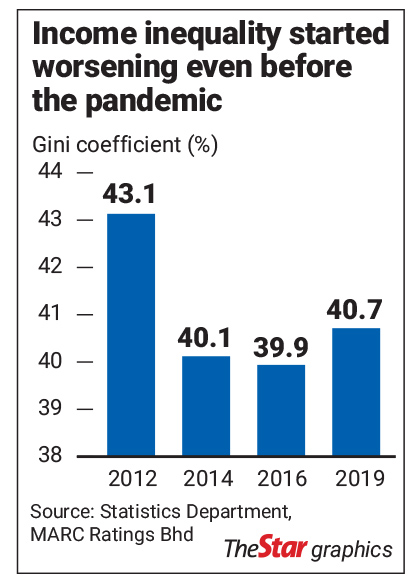
Malaysia’s Gini coefficient, a measure of income inequality, worsened over the 2016 to 2019 period as it rose to 40.7% from 39.9% as displayed in the chart on income inequality.
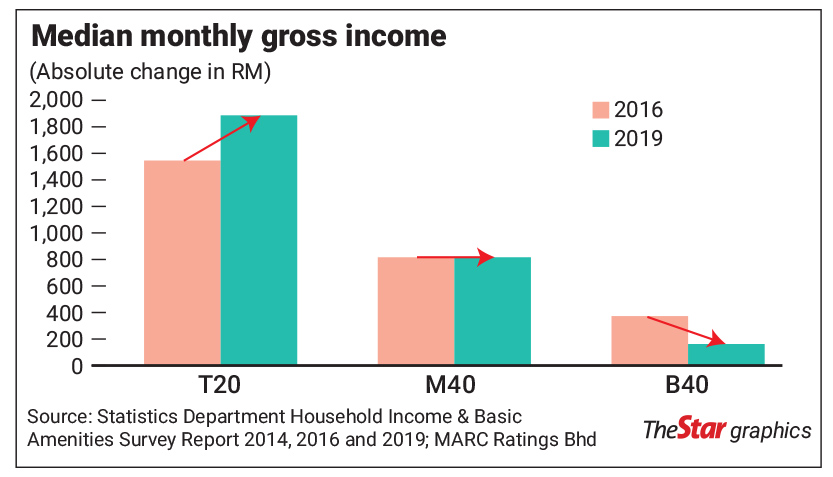
As shown in the chart on the median monthly gross income, the T20s saw gains in their median monthly gross income accelerate over the same period.
On the other hand, the M40s saw theirs stagnate, and the B40s decelerate.
Given this, many M40s and all the B40s are expected to continue seeing their accumulated pre-pandemic income gains gradually wiped out by surging living costs triggered first by the pandemic and then the Russia-Ukraine conflict.
As M40s and B40s have higher marginal propensities to consume than T20s, private consumption growth – the economy’s main engine – will be affected.
Slower growth will in turn affect the process of recovering the economy’s pre-pandemic capacity and building sustainable socioeconomic resilience.
Persistently strong external headwinds will not help.
It is apparent that continuing to plan to achieve high-income economic status against this backdrop will be foolhardy, especially with income disparity and polarisation potentially worsening.
The achievement will, after all, also be meaningless for many.
Economic reset
But for sure, we need an economic reset. The success of our 12th Malaysia Plan (2021-2025) and subsequent five-year development plans has thus become urgently critical to stem our socioeconomic decline.
The current development plan’s concepts and strategies are, however, nothing new. Like previous plans, there are, for example, strategies to stimulate structural economic transition and quality investment.
Policy outcomes, unfortunately, remain largely unsatisfactory.
Many blame the lack of political will. Worsening governance and institutions amid an uncertain political landscape have not helped.
Inadequate accountability
According to the World Bank, corruption, inadequate accountability in the handling of public funds, an ineffective education system, and low productivity continue to bog the country down.
These issues, and more, need to be tackled urgently through committed reforms.
With this, the economic environment will hopefully change for the better as policymaking and implementation improve. If not, challenges — including income disparity and polarisation — will continue to worsen and snowball.
It might be too late to turn the tide when the economic and political implications of a shrinking economic pie become too foreboding to contemplate.
Quah Boon Huat is senior economist at MARC Ratings Sdn Bhd. The views expressed here are the writer's own.
Already a subscriber? Log in
Get 20% OFF The Star Digital Access
Cancel anytime. Ad-free. Unlimited access with perks.