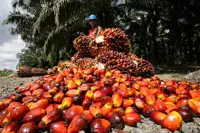
KUALA LUMPUR: Malaysian palm oil futures rebounded from losses earlier in the day to chart a first day of gains in four sessions, lifted by a weaker ringgit and some short covering, traders said.
The benchmark palm oil contract for October delivery on the Bursa Malaysia Derivatives Exchange edged up 0.4 percent to 2,213 ringgit ($540.42) a tonne at the close of trade.
Palm had declined to a one-week low in its previous session when it recorded its sharpest daily decline in a month.
Trading volumes stood at 43,246 lots of 25 tonnes each at the end of the trading day.
"The ringgit's weakness along with short covering gave the market some support above 2,200 ringgit," said a Kuala Lumpur-based trader.
A weaker ringgit, palm's traded currency, usually makes the edible oil cheaper for holders of foreign currencies.
The ringgit fell 0.1 percent against the dollar on Tuesday to its lowest levels since November 2017.
Palm oil prices were down earlier in the day on the back of weak demand, said traders, and also on concerns that a sharp drop in the Indian rupee would dampen exports.
India's palm oil imports slumped 33 percent in July from a year earlier to 550,180 tonnes as higher duties and a depreciating rupee made imports more expensive, a leading trade body said on Tuesday.
India is the world's biggest importer of edible oils, and a depreciating local currency reduces its ability to buy palm oil.
The Indian rupee on Monday touched an all-time low of 69.62 per dollar in early trade tracking other weaker emerging market currencies and on concerns of a spill-over from a crisis-hit Turkey.
It was last up 0.2 percent at 69.89 against the dollar by Tuesday evening.
Malaysia's palm oil exports rose 6.8 percent in July from June to 1.21 million tonnes, according to industry regulator data.
In other related oils, the Chicago December soybean oil contract was down 0.6 percent, while the January soybean oil contract on China's Dalian Commodity Exchange gained 0.5 percent.
Meanwhile, the Dalian January palm oil contract edged up 0.5 percent.
Palm oil prices are affected by movements of other edible oils, as they compete for a share in the global vegetable oils market. - Reuters
Already a subscriber? Log in
Get 20% OFF The Star Digital Access
Cancel anytime. Ad-free. Unlimited access with perks.