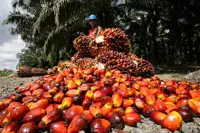
KUALA LUMPUR: Malaysian palm oil futures slumped to a three-week low on Wednesday evening as a firmer ringgit and weak demand weighed on the market.
The benchmark palm oil contract for April delivery on the Bursa Malaysia Derivatives Exchange was down 1.2 percent at 2,487 ringgit ($629.30) a tonne at the close of trade, a second straight session of decline.
Earlier in the session, it dropped as much as 1.9 percent to 2,471 ringgit, the weakest since Dec. 26.
Trading volumes stood at 52,062 lots of 25 tonnes each at the end of the trading day.
"The market is down on lack of demand, causing stocks to remain high," said a trader from Kuala Lumpur. "The stronger ringgit has also impacted demand, putting us at uncompetitive levels again."
Gains in the ringgit, palm oil's traded currency, typically make the vegetable oil more expensive for holders of foreign currencies.
The ringgit hit a fresh 18-month high on Wednesday morning at 3.9410 per dollar, and was last up 0.1 percent at 3.9520.
Palm oil inventories in Malaysia rose to a more than two-year high of 2.7 million tonnes at end-December, up 7 percent on the month, as demand remained weak.
Shipments from Malaysia declined in the first half of January from a month earlier, cargo surveyor data showed. Intertek Testing services reported a 7.4 percent drop, while Societe Generale de Surveillance showed a 2.8 percent fall.
Another trader said the market is also expected to be cautious ahead of a European Union vote to curb palm oil imports.
Europe is Malaysia's second-largest export market, but the European Parliament backed a call last April for greater vetting of palm and other vegetable oils used in biofuels in an effort to prevent the EU's post-2020 renewable transport targets from leading to deforestation.
A large portion of Europe's palm oil imports is used to make biofuels. The EU Parliament is set to vote on the proposal on Wednesday.
Continued appreciation in the ringgit and listless competing vegetable oils may also weigh on the market and hamper any recovery, he said.
In other related edible oils, the March soybean oil contract on the Chicago Board of Trade fell 0.3 percent, while the May soybean oil on the Dalian Commodity Exchange was down 0.5 percent.
The Dalian May palm oil contract declined 1.3 percent.
Palm oil tracks the performance of other edible oils, as they compete for a share in the global vegetable oils market.
Palm oil may stabilise around a support at 2,491 ringgit per tonne, and then bounce towards a resistance at 2,555 ringgit, said Wang Tao, a Reuters market analyst for commodities and energy technicals. - Reuters
Already a subscriber? Log in
Get 20% OFF The Star Digital Access
Cancel anytime. Ad-free. Unlimited access with perks.