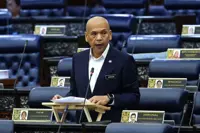
PETALING JAYA: He came to the venue of a talk on the Employees Provident Fund (EPF) unannounced, and without any fanfare – he drove his own car to the car park and walked up to the hall without an entourage of escorts or officials to accompany him.
However, after a good 90 minutes, of which more than half the time was spent on answering questions from mostly retirees, the audience left feeling assured that their money was in safe hands.
The overwhelming factor in tilting the confidence of the audience towards Malaysia’s largest retirement fund manager is the way its chief executive Datuk Shahril Ridza Ridzuan handled the questions easily without a pause or hesitation.
Even the most sensitive of questions – which is whether the EPF has been told to do things by the Government was handled with ease.
Shahril, a 45-year-old Oxford-trained lawyer, said there was a dual-way check and balance mechanism between the Government and EPF.
“The Government cannot tell us what to invest in; the EPF decides for itself what to invest in. But we have to ask permission from the Government for any particular investment or asset class that we want to invest in, and the Government can say no to us.
“It works both ways. They cannot tell us what to do but they can say ‘no’ to any proposal that we put forth. It reflects the supervisory role of the Government, which takes the view that it still has the final say to ensure that the EPF doesn’t take too much risk,” he told the audience in reply to a question at the Star Media Group’s PowerTalk: Business Series on Saturday.
Answering a question on 1Malaysia Development Bhd (1MDB), Shahril said the EPF’s exposure was RM200mil in the form of Islamic bonds issued in 2009, when 1MDB was then still known as the Terengganu Investment Authority (TIA).
“That is the safest part of the total 1MDB’s exposure... They are fully government-guaranteed, so even if 1MDB were to go bust, the Government would pay us,” Shahril said in reference to the RM200mil papers.
Apart from that, the retirement fund had also subscribed to bonds issued by several power plants that were subsequently acquired by 1MDB.
Even so, 1MDB’s power assets, which were all parked under Edra Energy Bhd, had already been sold to China General Nuclear Power Corp for RM9.83bil since last November.
Now, at the current market condition, whereby interest rates around the world have collapsed, and uncertainties and volatilities make it is hard to earn decent returns from any form of investments, Shahril’s assertion that the EPF would strive to maintain its target of generating a dividend rate of 2% above inflation, was certainly comforting to many.
Still, it would be unrealistic for EPF contributors to expect high rates of return under prevailing market conditions.
“A lot of people tend to focus on the nominal dividend rate – but it is not something that one should be focusing on,” Shahril said.
“What one should look at is the spread,” he explained in reference to the gap between the dividend rate and inflation, as measured by the consumer price index (CPI).
He said there was no point in having high nominal dividend rates if the CPI was equally high, thus rendering the spread to be zero or negative, as that would imply that one’s money did not grow.
“The goal of the EPF is long-term sustainable return for its contributors,” Shahril said.
According to Shahril, EPF’s internal estimation was that Malaysia’s economy would grow 4% to 4.5% while CPI would range between 2% and 2.5% this year.
He also gave more insights into the two-tier EPF withdrawals at 55 and 60.
“We recognise the fact that most Malaysians will have to work much longer,” Shahril said.
In conjunction with the new retirement age of 60, from Jan 1, 2017, the EPF would introduce the Age-60 withdrawal, while the option for full-withdrawal at 55 would remain.
“Those who elect to continue working after 55 will have their new contributions move into the Age-60 withdrawal scheme, and this portion of money will be protected for them until they reach 60 years old, which is now the minimum retirement age,” Shahril explained.
Shahril said there would be no change to the RM60,000 annual limit for self contribution into EPF accounts, which had been implemented since 2013, to address money-laundering concerns.
Before the limit came into place, there were contributors who came to the provident fund with bags of money and the EPF had no way of assessing where the source of money came from.
Already a subscriber? Log in
Get 20% OFF The Star Digital Access
Cancel anytime. Ad-free. Unlimited access with perks.