



MESDAQ-listed Vitrox Corp Bhd expects its first-generation printed circuit board (PCB) automated optical inspection machines (AOI) to be a major contributor to group revenue by 2010.
Group managing director Chu Jenn Weng told StarBiz three units of the machines, worth about RM1.5mil, would be shipped to China and South Korea next month.
“These customers are in the PCB manufacturing business, which use the machines for checking defects on the PCBs,” Chu said.
 |
»We aim tocapture at least15% of the globalmarket shareby 2010«CHU JENN WENG |
The global market for AOI machines is estimated at RM600mil this year and will rise to RM850mil by 2010.
“The global demand for AOI is expected to rise to 1,000 per annum in 2010 from 700 units per annum in 2007. We aim to capture at least 15% of the market share by 2010, which is equivalent to selling 150 AOI machines,” he said.
Chu said that by 2010, the AOI business segment could contribute about 50% of group revenue, compared with less than 10% now.
“Depending on the complexity of the machines, each unit is priced at US$100,000 to US$200,000,” he said, adding that the group's present market share was small.
There are four major PCB AOI machines manufacturers – located in Germany, USA, and Japan – capturing 95% of the market share.
Chu added that Vitrox had appointed a distributor in China and Taiwan for its AOI machines.
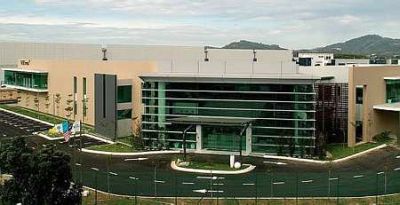 |
Vitrox plant in Penang |
“We are in the process of appointing a distributor in South Korea,” he said.
Previously, before the advent of PCB AOI technology, PCB manufacturing companies used electronic probes and manual inspection to detect faults.
As consumer electronic products shrunk in size, the PCBs used also became more multi-layered and smaller, making it necessary to use AOI machines to check defects.
“The competitive edge of our PCB AOI machines is that they can detect faults on PCB's trace with width less than 4mils, high speed, and have user friendly features.
“Our machines are also priced at about 25% lower than those international brands in the market,” Chu said.
He said the group was developing the second generation of AOI machines, which could detect faults on PCB's trace with width less than 2mils.
“We expect to commercialise the product by mid-2008. We embarked on the research and development (R&D) for AOI machines two years ago.
“About RM6mil was allocated to develop the first and second generation of the machines,” he said.
On the group's machine vision system products, Chu said Vitrox had installed 35 units of its Dual-Cam 5S package inspection system for major integrated circuit manufacturers in Malaysia, Thailand, the Philippines, Taiwan, and China for the past nine months.
The Dual Cam 5S package inspection system is currently deployed at semiconductor back-end assembly operation to inspect and control quality of packaging of leadless integrated circuits.
“We are developing the next generation machine vision inspection system, which provides two and three-dimensional solutions for the fast growing light-emitting diode markets in Malaysia, Taiwan and China,” he said.
Chu added that Vitrox had recently secured orders from SRM Intergration Sdn Bhd, a world leading integrated test handler maker for semiconductor, for 200 sets of its vision system and 1,500 electronics communication system products worth about RM7mil.
“We expect to complete the delivery of these orders next month. This sales should reflect in the revenue for the fourth quarter of 2007,” he said.
Chu said despite the down-cycle experienced in semiconductor and electronics for the past three quarters, the group's machine vision and electronics communication system products still enjoyed growth.
“This is due mainly to the increasing demand for inspection quality during the manufacturing process and acceptance of our innovative products by customers.
According to the Automated Imaging Association (AIA), the market for global vision system products would grow to about US$10bil by 2008, representing a compounded annual growth rate 8.8% a year from 2003 to 2008.
Chu said Vitrox would spend about RM30mil over the next three years on expansion in building, R&D as well as human capital enhancement.
“We plan to expand our floor space to 150,000 sq ft in three years from 30,000 sq ft currently.
“We will continue to invest in human resources to enhance core competencies in machine vision and electronics technologies,” he said.
There would also be investment in training and development to further improve the group's operational efficiency, Chu added.
For the nine months ended September 30, Vitrox posted RM10mil in pre-tax profit from RM25mil in turnover.
VITROX : [Stock Watch] [News]
Already a subscriber? Log in
Get 20% OFF The Star Digital Access
Cancel anytime. Ad-free. Unlimited access with perks.
