



LIFE was a breeze for Sirivat Voravetvuthikun until the 1997 Asian financial crisis came and dealt him a crushing blow, changing him from a millionaire to a pauper.
However, this did not stop him from bouncing back and making a name for himself as Thailand's Mr Sandwich through Sirivat Sandwich.
“Although we are still small, we have potential,” he told StarBiz.
This was a far cry from what he used to be: a successful fund manager and property developer.
A graduate of the University of Texas, Austin, Sirivat made his first million baht in his 30s as a private fund manager before founding his own property development company, Tong Gween.
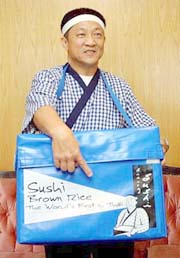 |
Sirivat Voravetvuthikun explaining how he sells his sandwiches andsushi brown rice on the streets of Thailand |
In 1993, he embarked on a project to build a US$9mil luxury condominium complex northeast of Bangkok. The complex was still under construction when Thailand's economy started to collapse and Sirivat found himself deeply in debt, having sold only a few apartments there.
By early 1997, Tong Gween was all but bankrupt, and Sirivat was left with the prospect of telling his 40 employees that he could no longer pay them.
Twenty of his staff turned to him for help to keep them working, and Sirivat turned to his wife, Vilailuck, for ideas.
Vilailuck came up with the idea of selling sandwiches using her favourite Japanese brand of bread, Yamasaki.
“April 20, 1997, was the date we started selling sandwiches. My wife woke up at three in the morning to make 20 sandwiches, which we sold in the Bangkok General Hospital. We made 500 baht (RM50) that day,” he said.
Sirivat then thought of selling his sandwiches on the streets of Bangkok, with a special sandwich box slung around his neck, like popcorn sellers in the United States.
In the beginning, it was a humbling and embarrassing experience for Sirivat. However, thinking of his wife and children kept him going.
“They never complained about being poor,” he said, adding that his king also inspired him by being humble and behaving like a commoner despite being a royalty.
Sirivat admitted that he became a good example to the Thai people by accident.
“It was the media who brought my plight to the people's attention. They gave me moral support by buying my sandwiches and this enabled me to regain my confidence,” he said, adding that the breakthrough in his business came when customers realised that his sandwiches actually tasted good and continued to buy them.
He said the main challenge was to change the people's concept that street products were of low quality and unclean.
“I always ensure that my products are clean and fresh, my sandwich boys uniformed,” he said.
Always looking to improve his product range, Sirivat later started to sell sushi white rice after he saw his wife making sushi for his children.
“It took a month's practice before it was approved by a Japanese chef in Bangkok,” he said.
Extremely patriotic, Sirivat then moved on to sushi brown rice in 2001, after listening to his king encouraging the Thais to eat brown rice to conserve energy. He now has the intellectual property for Sushi Brown Rice.
Sirivat Sandwich currently produces 1,200 sandwiches, 300 pita sandwiches and 600 sushi rice sticks daily, and employs staff of 70.
Other products include pita sandwiches, shelf-life products like crispy rice snacks and butter-toasted bread. Sirivat plans to sell his shelf-life products through agents in cities like Chiengmai and Haadyai next year.
“I am looking for joint ventures with Malaysian biscuit manufacturers to make small crispy sandwiches with cheese, tuna and crabmeat flavours,” he said.
Sirivat also set up a coffee corner in BNH Hospital in Bangkok in December 2001 and has now progressed to coffee catering, a coffee break service, in January.
Currently, 60% of the revenue generated is from sandwiches, 10% from coffee catering and 30% from his other products.
He also intends to collaborate with Thai universities to set up coffee corners on the campuses. According to Sirivat, the coffee corners would be a place for students to work, and once they graduate, they may even become a franchisee.
“Three years from now, when I list my company on the Thai Stock Exchange, I would be able to raise enough funds to open more coffee corners and also sandwich shops,” he said, adding that his shops would be next to McDonald's as he planned to become the “McDonald's” of Thailand.
Sirivat also plans to franchise his business two years after listing.
For a man who has been through so much, it comes as no surprise that his guiding philosophy is “where there is a will there is a way” and “be daring, be first, be different.”
Sirivat was in Malaysia recently to speak at a motivational seminar organised by his Malaysian representative, Niche Consulting Network, and marketed by People Achievement Works Sdn Bhd.
Already a subscriber? Log in
Get 20% OFF The Star Digital Access
Cancel anytime. Ad-free. Unlimited access with perks.
