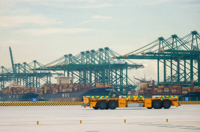
SINGAPORE: Work on the second phase of Tuas Port – the third and largest of four extensions or fingers – began on Friday (Nov 20) on nearly 400ha of reclaimed land, close to the size of Clementi Town.
From 2028, Finger Three will begin operations, with 21 mega berths, each 23m deep. It will be fully operational by the mid-2030s and will feature an 8.6km wharf for ships to load and unload cargo.
When the entire port is completed in the 2040s, all of Singapore’s container operations will be consolidated at a single location – making Tuas Port the world’s largest fully automated port, capable of handling 65 million twenty-foot equivalent units (TEUs) a year.
The number of TEUs handled is the maritime industry’s standard measure of container traffic.
Transport Minister Jeffrey Siow, speaking at the ground-breaking ceremony for the facility on Nov 20, said Tuas Port is the port of choice for many shipping lines today.
He said: “Finger Three at Tuas Port will equip us to handle the world’s largest container vessels for at least the next decade. But we are not growing just our physical capacity. We are also improving the reliability and the value we deliver.”
Shipping lines, he added, know they can count on Singapore for a fast turnaround or even to make up for delays elsewhere along their routes.
“At the same time, we are helping cargo owners do more with their goods while they are here – to store, process, consolidate and distribute goods quickly to regional markets,” he said.
Tuas Port has handled 25 million TEUs since it officially opened in 2022. It now operates 15 berths and remains on track to expand to 18 by 2027.
“As a small island nation without any natural resources, maritime connectivity is our lifeblood,” Siow said.
This is because Singapore imports almost all of its food, energy and supplies – and a significant share of these come by sea through the ports, he said.
“Our seaport connects us to over 600 ports worldwide, supporting over 140,000 jobs and powering our wider service and manufacturing economy,” he added.
To uphold and improve the country’s maritime connectivity, he added that the Government needs to plan ahead to develop the next masterplan for the maritime sector – which will be launched in April 2027.
The plan will focus on building up Singapore’s port and maritime ecosystem. The upcoming extension, for instance, will enable the port to handle the world’s largest container vessels for the next decade, Siow said.
Beyond the port’s physical capacity, there are plans to create greater value for shipping lines and cargo owners.
A key plank will be port operator PSA’s new supply chain hub, which will anchor logistics and warehousing at Tuas Port, Siow said.
PSA International group chairman Peter Voser, in his address, said the wider development of the Tuas industrial area will help cargo move more seamlessly between vessels, terminals, warehouses, manufacturers and markets.
It also supports efforts to grow PSA from being a port operator to a supply chain orchestrator, he added.
The port and business ecosystem will reinforce each other, said Siow.
That means a thriving port draws ships and cargo to the nation’s shores and, therefore, generates demand for maritime services. At the same time, a strong maritime business hub gives shipping lines and cargo owners more incentive to choose Singapore.
As part of the masterplan, the Government is looking to harness technology and innovation more, Siow said.
PSA will scale up its fleet of autonomous vehicles to about 1,000 next-generation intelligent guided vehicles, he added.
Unlike earlier versions, the new vehicles are not bound to fixed routes. They will calculate and opt for the best routes on the go, adjusting to real-time traffic while operating safely alongside manned port vehicles.
Shore-to-ship drones at anchorages for the delivery of urgent spare parts and fuel samples, as well as fresh food and supplies for the crew, are also being tested, he added.
Siow said the Government is working towards using artificial intelligence, digital twins, autonomous systems and real-time data to allow the whole port to operate as one integrated system.
It is also supporting decarbonisation by investing in various clean fuels, such as scaling up liquefied natural gas bunkering, licensing new clean-fuel suppliers for LNG and methanol, running live trials and developing safety standards for alternative fuels such as ammonia.
Another feature of the plan is to step up the training of maritime workers to help them stay ahead of new technologies, Siow said.
Operations at Tanjong Pagar, Keppel and Brani terminals will be moved to Tuas Port by 2027, but Pasir Panjang Terminal will remain open until its operations are transferred to the new port by the 2040s.
Siow said: “We want Singapore to be the port of choice for global shipping and a hub of flows where global maritime trade is managed and shaped.
“A place where businesses create greater value, and where Singaporeans will enjoy better jobs and opportunities.” - The Straits Times/ANN