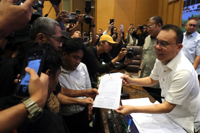
JAKARTA: Former vice president Gibran Rakabuming Raka faces an uncertain political future following his resignation, with questions mounting over his ability to rebuild his political base and run in future elections in light of the ongoing controversy over his academic credentials.
Since stepping down last Thursday (Nov 12), Gibran, the eldest son of former president Joko 'Jokowi' Widodo, has largely stayed out of the public spotlight, with no reported major political engagements or updates on his social media accounts.
His relative absence marks a contrast with his short-lived tenure, during which he frequently made impromptu visits or blusukan to local communities, a tradition popularised by his father Jokowi during his decade in office.
Hours after formally submitting his resignation to President Prabowo Subianto and the People’s Consultative Assembly (MPR), Gibran gathered with supporters and politicians from the Indonesian Solidarity Party (PSI), a small party chaired by his younger brother Kaesang Pangarep, at the Vice Presidential Palace.
Since then, Gibran’s only public appearance was at a mosque in Kebayoran Baru, South Jakarta, last Friday, where he attended Friday prayers and was greeted by dozens of residents and children who approached him for photographs and brief conversations.
When asked whether he would return to his hometown of Surakarta, Central Java, where Jokowi now resides, Gibran said: “No, I will stay here [in Jakarta].”
Gibran’s resignation came amid mounting pressure over his educational qualifications, following separate court rulings concerning the validity of documents used for his 2024 vice presidential candidacy.
A former Surakarta mayor, Gibran became Prabowo’s running mate following a controversial last-minute Constitutional Court ruling overseen by Gibran’s uncle, then-chief justice Anwar Usman, that enabled him to place his bid.
Prabowo and Gibran also won the election with the tacit backing of Jokowi, who has since joined the PSI.
Unlike his father and younger brother, Gibran is not currently affiliated with any political party. His departure from the vice presidency has since raised questions about what political assets he can still draw on to retain his support base and stage a comeback in future elections.
Political analyst Adi Prayitno of Parameter Politik Indonesia said that while his resignation could generate sympathy from some sections of the electorate, Gibran’s political future remains uncertain, with several legal and political obstacles potentially complicating his return to the national stage.
“The road ahead will be winding and steep. [...] His political future and influence will no longer be as strong as before," Adi said, noting that Gibran was now an ordinary citizen without a family member holding power in government.
Should he seek public office again, including in the 2029 election, Adi said Gibran would need to secure a political party’s backing, provide valid proof that he meets the educational requirement for office, and, most importantly, work hard to improve his electoral appeal.
Gibran is still facing a police investigation over allegations that he used a falsified high school education equivalency certificate to qualify for the 2024 presidential election, with the National Police saying on Monday that the case remained at the preliminary investigation stage, tempo.co reported.
Political analyst Dedi Kurnia Syah of Indonesia Political Opinion said Gibran’s future would largely depend on the outcome of the legal proceedings and his ability to rebuild public trust.
“Gibran still has the potential to rebuild a political career, provided he is not found guilty of falsifying documents for his 2024 vice presidential candidacy,” Dedi told The Jakarta Post on Wednesday, adding that an impeachment and a criminal conviction would disqualify him from running for future public office.
He said Gibran could also seek to establish a political foothold through the PSI, potentially by taking a leadership role and steering the party toward securing legislative seats in the 2029 election.
Dedi stressed, however, that Gibran could find it increasingly difficult to rely on the volunteer networks that had supported his father, as those groups might gradually distance themselves from the family as its political influence waned. - The Jakarta Post/ANN