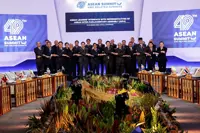
MANILA (Reuters) - US President Donald Trump met the leaders of regional allies India, Japan and Australia in the Philippines on Tuesday, at the start of an Asian trip that also includes a much-anticipated trilateral meeting with his Chinese and Russian counterparts.
Trump arrived in the Philippine capital at the tail end of a Southeast Asian summit, and began his three-day regional visit with the first meeting in two years of the Quad group of Indo-Pacific democracies.
"Our countries are the four corners of a free, open, stable, and prosperous Indo-Pacific," Trump said in remarks ahead of the meeting. "We have outstanding relationships and coordinate closely on matters of regional security, economic security and diplomacy."
Trump's three-day trip to Asia, which also includes the Asia-Pacific Economic Cooperation forum in Shenzhen, comes after his Republican Party's defeat in midterm elections, plus spy allegations and new US curbs on China's access to AI chips that could complicate a fragile trade-war truce.
Demonstrators gathered in Manila for a fifth day of protests that have included the burning of Trump effigies, calls for an end to the Middle East war and the scrapping of the US-led Pax Silica supply chain initiative.
It was Trump's first meeting of the Quadgrouping - which his predecessor Joe Biden regarded as a signature foreign policy initiative - and he said the leaders' discussions would include security and the development of artificial intelligence.
"We want to ensure that the future of this critical technology is dominated by nations that share our values and our common interests and make sure that it turns out to be as good as it can be," Trump said, announcing the Quad would launch a new AI accelerator.
Trump arrived at the end of the Association of Southeast Asian Nations summit and after the Quad meeting will join a US-ASEAN "Special Summit" later on Tuesday.
It comes ahead of the APEC gathering hosted by Chinese President Xi Jinping, who has previously objected to the Quad as an effort to encircle Beijing. Quad members have said the grouping is not directed against any one country.
Trump also said on Tuesday that Thailand will eliminate all tariffs on US exports and remove substantial non-tariff barriers as part of a trade agreement expected to be finalised soon.
Trump said at the signing of a joint statement on reciprocal trade that it would be "a wonderful deal".
QUAD MEETING THE 'BEST POSSIBLE SIGNAL'
At the Asean summit on Monday, Chinese Premier Li Qiang hailed what he called the "truly extraordinary" economic achievements of China and Asean in the face of global trade restrictions, expressing Beijing's commitment to free trade and the need to "stand united, ward off interference, and work together".
China is Asean's largest trading partner and a key source of investment, but the biggest economies of the 11-member bloc - which has a combined GDP of more than $3.9 trillion - want to deepen ties with the US despite protracted trade and diplomatic uncertainty under the Trump administration.
Former US Deputy Secretary of State Kurt Campbell credited Washington's top diplomat, Marco Rubio, with the timing and reconvening of the Quad, which he said had lost ambition under Trump.
"Part of what he (Rubio) is thinking is that this is probably the best possible signal if you're going to go into a trilateral meeting," said Campbell, co-founder of The Asia Group, referring to Thursday's US-China-Russia talks.
"The linchpin of everything that we do in Asia is the US-Japan relationship, and a perception that this is not at the top of the president's mind would concern me."
White House spokesperson Olivia Wales on Friday said that under Trump's leadership, the Quad had demonstrated it is "a partnership of action, tackling the region's toughest challenges and driving opportunities to ensure a free and open Indo-Pacific".
A Japanese foreign ministry official said it was expected that Quad leaders would try to show unity, with maritime security, export restrictions, critical-minerals supply-chain diversification and AI among potential discussion points.
JAPAN TO PLAY MORE PROACTIVE ROLE, PM SAYS
Asean's leaders held meetings on Tuesday involving counterparts from Japan, South Korea, China and India.
Japanese Prime Minister Sanae Takaichi pledged to work with ASEAN to boost regional economic and energy resilience, to address export restrictions and vulnerabilities from rapid AI development, and to strengthen supply chains, including on critical minerals.
"While the international order is experiencing a period of great instability, Japan will play an ever more proactive role," Takaichi said.
Trump was due to sign a joint statement with Thai Prime Minister Anutin Charnvirakul on Tuesday on an agreement on reciprocal trade. Thai media have reported the two would hold talks and the statement would be about progress on negotiations.
The US is Thailand's largest export market, accounting for 24% of its total shipments this year. The US designated Thailand as a major non-NATO ally in 2003.
Trump will meet Philippine President Ferdinand Marcos Jr on Wednesday, before heading to Shenzhen.
(Reporting by Mikhail Flores, Karen Lema, Nestor Corrales and Trevor Hunnicutt in Manila; Additional reporting by Saurabh Sharma, David Brunnstrom in Washington and Tim Kelly in Tokyo; Writing by Martin Petty and Kate Mayberry; Editing by John Mair, Lincoln Feast, Saad Sayeed, Alex Richardson, Peter Graff) -- Reuters