CHIANG MAI (Asia News Network): Stricter censorship, existing criminal defamation laws, and a volatile digital landscape continue to pose significant threats to press freedom across Asia, according to media experts speaking at a keynote panel hosted by the Konrad-Adenauer-Stiftung (KAS) Media Programme Asia in Chiang Mai, Thailand.
The ‘Voices under Pressure: Perspectives on Press Freedom across Asia’ panel addressed declining media freedom indexes, authorities’ weaponisation of legal frameworks, and increasingly prominent digital threats targeting journalists across various Asian newsrooms.
Chia-Wei Lin, development officer from the Reporters Without Borders’ (RSF) Asia-Pacific Bureau, highlighted findings from RSF’s 2026 Press Freedom Index – noting how governments and regimes across the region are increasingly using judicial mechanisms to stifle and criminalise journalism, especially through censorship and criminal defamation laws.
“RSF’s legal indicator, which evaluates the extent to which journalists can work without any judicial harassment, has seen a sharpest decline across all the other four indicators in this year.
“The legal aspect in terms of how the law is now weaponised to criminalise journalism is a very concerning point that we observed during this year’s index analysis,” she said.
In countries like Bangladesh, for example, proposed legislations like the draft Cyber Security Act pose a direct threat to news outlets, said Mahfuz Anam, publisher and editor-in-chief of The Daily Star.
Mahfuz highlighted how laws initially meant for cyber defence are now being expanded to also target media platforms. He also stressed that political divisions among journalists, alongside growing financial challenges in an increasingly digitalised world, also further undermine the industry’s ability to report freely and extensively.
“The media in many parts of the world are now facing existential challenges. Part of it is due to lack of revenue sources.
“Somebody mentioned that now global technological platforms are taking away the revenue from news organisations in different countries.
“In Bangladesh, Google and Facebook take away about 80% of the revenue initially made for the media in Bangladesh. So the rest of us are struggling for the 20%,” he said.
Mahfuz also urged for increased solidarity among journalists – nationally, and regionally as a means to continue advancing the cause of press freedom.
Meanwhile, in countries like Afghanistan, heightened repression under the Taliban regime has also significantly crippled the country’s journalism landscape.
Zahra Nader, editor-in-chief of exiled media outlet Zan Times, cited findings from RSF, which showed how half of Afghanistan’s media outlets had closed within only four months of the Taliban takeover in 2021.
Most significantly affected by these restrictions were Afghan women journalists – where in most parts of the country, women media workers are no longer allowed to report at all.
“The media are not allowed to report on anything that could be considered negative to the regime in power, meaning that talking about women’s rights, talking even about women’s health is impossible,” she said.
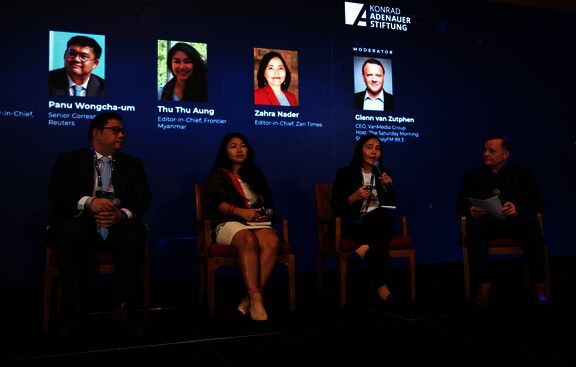
Despite running the newsroom from exile in Canada, Zan Times nevertheless prioritises the work of women reporting directly in Afghanistan – ensuring their safety by adhering to strict confidentiality and anonymity protocols.
Similarly, Thu Thu Aung from Frontier Myanmar described the operational difficulties of managing a newsroom in exile following Myanmar’s 2021 military coup.
More significantly, the editor-in-chief emphasised the critical need for care and ‘trauma-informed journalism’ when reporting on communities affected by armed conflict and political violence.
“When we interview people, when we ask questions to the sources who, for example, experienced airstrikes or, who lost their family members – we definitely need to care for sources’ protection. It is not only about the physical danger, but also about the mental health and psychological harms,” she said.
Operating from abroad also creates significant fact-checking and verification challenges for exile newsrooms, balancing the need for safety and accuracy.
“Getting information is not difficult for us. But verifying this information is what takes a lot of time and resources,” she added.
Beyond legal and physical barriers, online threats posed by disinformation and harassment campaigns also continue to pose significant challenges.
Panu Wongcha-um, senior correspondent for Reuters in Thailand, highlighted the evolving risks within the digital sphere, noting that beyond legislative measures, today’s information environment has “hugely transformed.”
Panu also observed that during regional conflicts such as the 2025 Cambodia-Thailand border dispute, media professionals frequently encountered coordinated information operations utilised “to discredit journalists, to tarnish their reputation, and to conduct internet trolling.”
The panel, moderated by VanMedia Group chief executive officer Glenn van Zutphen, was part of the Journalism in Transition: Marking 30 Years of the KAS Media Programme Asia conference (November 5–7, 2026) in Chiang Mai, convening over 100 media professionals, alumni, and partners across the region.