BENGALURU: An AI-generated poster is now popular at several protests across India today. It shows Prime Minister Narendra Modi and Home Minister Amit Shah kissing the cheeks of Chief Election Commissioner of India Gyanesh Kumar in the style of Betty and Veronica smooching Archie in the American comic series.
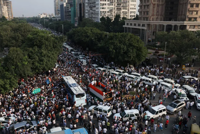
Why is the Modi government protecting Kumar, ask demonstrators as youth-led protests hot up in Delhi and other cities demanding the resignation of the election official.
Protesters from student unions and the Cockroach Janta Party (CJP) allege that Kumar oversaw a sweeping revision of electoral rolls that has unfairly removed more than 130 million names, potentially disenfranchising legitimate voters.
Similar nationwide Gen Z protests in July over exam paper leaks forced education minister Dharmendra Pradhan to resign. Now, however, the Modi government has deployed 30,000 police and paramilitary personnel to block protesters, who want Kumar gone.
The wider scale, inconvenient timing and electoral implications of the ongoing protests have landed Modi’s ruling Bharatiya Janata Party (BJP) in a dilemma, analysts say.
Defend the election commissioner or let him go – either decision would have troubling consequences for Modi. On top of that, how the government handles the protesters’ demands also has major implications for India’s democracy.
“The protest has created an atmosphere in the country that, if it goes on, could reinforce any pockets of dissatisfaction or fatigue with the ruling party. It is early days, but I can say that the game has opened up. The BJP is on the back foot,” said political analyst Neerja Chowdhury.
The practical issue first. Unlike ministers, Kumar cannot be sacked or removed by the PM’s executive order. As head of an autonomous body, the Chief Election Commissioner (CEC) enjoys constitutional protection and can be removed only through a parliamentary impeachment process.
Analysts say that Kumar, who opposition parties allege is close to the BJP, could be requested to resign. But this might not help the ruling party either.
“The BJP senses clearly that even if it persuades the CEC to go, to buy peace with the protesters, it won’t necessarily work in its favour,” Chowdhury said. “The opposition would have tasted blood. It will ask for the resignation of the home minister next, and the PM, too. If the BJP gives in, it won’t end with the CEC.”
This could explain the Delhi police’s blockade of the protest site at Jantar Mantar, near Parliament, and the repeated detentions of student protesters. India’s Ministry of Home Affairs oversees the Delhi police.
However, it allowed a rally by opposition parties, including the Congress, to proceed peacefully in central Delhi on Oct 12.
Attempt to break unity
The government’s varying strategies are intended to break the unity of the protesters, said CJP founder Abhijeet Dipke, who was detained by the police with two other members as they were on their way to an Oct 10 protest in Delhi. A court ordered their release the next day.
“See through these tactics. Today, they may allow one protest and crush another. Tomorrow, they could reverse the roles. The idea is to keep us doubting each other instead of questioning those in power,” Dipke posted on X on Oct 13.
The Modi government has quashed many protests before, often by ignoring them till they fizzle out, breaking their momentum by jailing their leaders, or allowing its own supporters into the mix to introduce chaos.
On the rare occasion the ruling BJP has given in, for instance, by withdrawing agriculture reform Bills after the farmers’ movement in 2021, it was a response to a policy demand, not a generalised institutional crisis, said political scientist Pratap Bhanu Mehta.
This time, the challenge is wider.
The ongoing protests, led by a generation that has grown up almost entirely under the Modi administration, articulate a crisis of trust in the government and its institutions.
Their demands are reasonable – efficient and non-corrupt exams, and fair elections without excluding eligible voters – and reflect public grievances that run deep across Indian society. Their youthful, irreverent, barricade-vaulting methods show that they do not fear the government as many did before.
“It is the first time Mr Modi has been mocked. There is a palpable sense of questioning the fundamentals of his authority. Given the nature of the BJP and its history, it can’t be seen as not responding to the mockery of its leaders,” Mehta told ST.
“This government will most likely respond with more repression. It tried and failed to block the right to assembly, so we may see other methods of repression now – legal, administrative, financial.”
Electoral repercussions
Indeed, on Oct 14, a Delhi court remanded CJP co-convenors Saurav Das and Ashutosh Ranka to five days of judicial custody for allegedly trespassing at Jantar Mantar on Oct 13, a historic protest site. The government had revoked its status as an approved protest site the day before.
Electoral repercussions are at the heart of the Modi government’s apprehensions about the youth-led protest. Not only because the party likes winning elections (every party does), but also because dominating polls has been the BJP’s proudest claim to legitimacy.
“More than other parties, the BJP sees electoral victory as the main yardstick of its popularity and legitimacy. Its strategy is to win as many elections as possible. If it can win elections, it believes this whole issue will die down,” Chowdhury said.
Even after 12 years in power and in its third term in the central government, the BJP considers every state election paramount.
In 2027, elections are due in Uttarakhand, Punjab, Himachal Pradesh, Goa, Manipur and Gujarat, but “the big prize”, as Mehta called it, is Uttar Pradesh, India’s most populous state that is often a bellwether of any party’s national prospects.
The BJP’s seats in Uttar Pradesh fell from 62 to 33 in the 2024 general election, and from 325 to 225 in the 2022 state assembly election. The Special Intensive Revision or SIR, the Election Commission’s controversial voter-roll revision exercise, deleted 20 million voters from Uttar Pradesh in April, about 13 per cent of total voters.
Chowdhury said the state polls are expected to be a close battle, influenced by the SIR deletions but also myriad regional factors like caste groupings.
A victory in Uttar Pradesh, the BJP hopes, will deflate any negative public opinion. But if it loses, it may lose momentum for the 2029 General Election – “the beginning of the end of the current regime”, Mehta said.
While the opposition parties do not yet seem to be galvanising public anger against the SIR in Uttar Pradesh, they have dug in their heels in Delhi, asking a broader question. How can election victories be a decisive measure of public opinion if the elections themselves are not free and fair, and millions of eligible voters are wrongly excluded?
The protests thus highlight the stakes for the world’s largest democracy.
Till today, few election results in India have been challenged, Chowdhury said. “Losers took their defeat with grace and humility, and transitions of power happened without violence or question. Everyone trusted the electoral system,” she noted.
“Whether or not the election commissioner resigns, rectifying the process of the SIR and voter roll revision is most important today. Unless you do that, every election result in India, going forward, is going to be challenged,” she added, noting that as long as voter lists are seen as faulty with millions excluded unfairly, every poll outcome could be deemed tainted.
If protesters last week carried placards of the CEC Gyanesh Kumar with a red X on his face, more of them this week held up hand-drawn appeals for “Free and Fair, not Fixed elections”. India’s electoral process is facing a litmus test today, one that matters to everyone. - The Straits Times/ANN