NEW DELHI: Parts of India’s New Delhi remained under lockdown on a second straight day as the Cockroach Janta Party pressed ahead with its call for protests despite tight security, demanding the resignation of India’s top election official over a contentious revision of voter rolls.
Thousands of protesters were detained Saturday (Oct 10), according to media reports, including CJP founder Abhijeet Dipke and fellow leaders Saurav Das and Ashutosh Ranka. Most protesters were released Saturday evening, while a court ordered the release of the three CJP leaders on Sunday after they appeared before a magistrate.
CJP has vowed to continue protesting while opposition parties led by the Indian National Congress, which spearheaded a march to the Election Commission headquarters last week, plan to resume demonstrations on Monday.
The tensions were triggered in late-September by an investigation in a local newspaper accusing India’s Chief Election Commissioner Gyanesh Kumar of ignoring concerns raised by two election officials over changes that resulted in more than 130 million names being removed from the electoral rolls.
The election body has denied the claims, saying its decisions were unanimous and that differing views are part of the decision-making process.
The demand for Kumar’s resignation comes ahead of key state elections, including in Uttar Pradesh, India’s most populous state, raising the political stakes for Prime Minister Narendra Modi’s ruling party and its opponents.
On Sunday, Delhi Traffic Police warned of possible disruptions at 30 major roads and intersections across New Delhi and Central Delhi, with restrictions taking effect from 6 a.m.
Commuters were advised to avoid non-essential travel and allow extra time for journeys. Train services resumed normal operations, while Delhi Metro reopened all stations following Saturday’s shutdown.
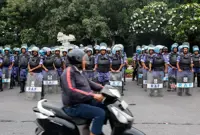
Police personnel were stationed outside key metro stations in central Delhi, particularly those providing access to Jantar Mantar, a major protest site. About 30,000 police personnel, backed by paramilitary forces, remained deployed across the capital as protesters sought to gather for a second consecutive day, according to local media reports.
On Saturday, police deployed thousands of security personnel across Delhi to prevent protesters from gathering in large numbers. The police had denied permission for the protest, organised by CJP, warning that any gathering would be illegal and that participants could face legal action.
The protests are the latest challenge for Prime Minister Narendra Modi’s government after thousands of angry students took to the streets in July over exam irregularities, forcing the education minister to resign. The police faced criticism at the time for their heavy-handed methods in breaking up the student demonstrations.
The dispute also comes at a challenging time for the economy when the government is seeking to bolster investor confidence and boost growth. Indian equities have slumped, while the rupee is one of the worst-performing currencies in Asia this year.
On Saturday, the Reserve Bank of India broadened its defences to steady the rupee, taking some of its strongest measures since the 2013 taper tantrum. However, questions remain over how far the central bank is willing to go as external pressures mount. - Bloomberg