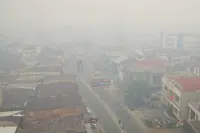
The orang utan clings to the top of a mostly leafless tree in the Borneo region, as waves of thick smoke from the forest fires burning below waft over her.
Nicknamed Novita, the ape shown in footage released by a conservation group is among dozens that have been rescued from wildfires burning across parts of Sumatra and Borneo in recent months.
They include Bara, a male orang utan plucked from the haze on Thursday, authorities said.
“He was found on top of a tree on razed land. The haze was quite thick in the area because fires were burning around there,” Handi Nasoka, a local natural resources conservation agency official, said yesterday.
“Seeing the condition of the recently burned lands... we didn’t dare to gamble and assume he’d survive.”
Bara was “relatively healthy with minor burn injuries,” Handi added, and will be moved to a nature reserve elsewhere in the Central Kalimantan region where he was rescued.
Wildfires have piled pressure on already endangered orang utans, forcing local groups and authorities to carry out high-stakes rescues of animals suffering smoke inhalation and burns.
Novita, a female estimated to be three to four years old, remains at the Nyaru Menteng rehabilitation centre in Indonesia’s Palangkaraya after being rescued last month.
“Novita is still receiving intensive care,” Andi Muhammad Khadafi, head of the Central Kalimantan Natural Resources Conservation Agency, told reporters on Thursday.
“We’ve been told that the burns on her hands and feet are improving, although even after she recovers, she may not return 100% to how she was before she suffered the burns.
“She had to leave her habitat and we had to rescue her primarily because of the flames,” he added.
Novita was rescued by the Borneo Orangutan Survival Foundation, which has taken in several apes caught up in forest fires.
She was found clinging to a tree in late September and tranquilised by a rescue team who administered oxygen and intravenous fluids before moving her to the rehabilitation centre.
“We rescued her from an area that was burning. Before we reached her, she had to walk through the fire to get to the tree and climb it, so the soles of her feet and her toes were burned,” said foundation CEO Jamartin Sihite.
Indonesia regularly battles wildfires during the dry season, which in Borneo typically peaks between July and September.
The fires have intensified this year in part because of the El Nino weather phenomenon, set to be one of the strongest since comparable records began four decades ago.
El Nino typically brings severe drought to Indonesia, but experts note that slash-and-burn practices and drying of peatlands have made previously resistant landscapes increasingly fire-prone.
Between January and July alone, more than 202,000ha were razed by fire, according to government figures that have not been updated since.
The Nusantara Atlas project, which uses satellite monitoring, estimated nearly 896,000ha – over five times the size of Greater London – had burned by the end of August.
The fires have created severe haze locally, with tens of thousands of cases of respiratory illnesses, and also caused regional air pollution spikes in Singapore and Malaysia. — AFP