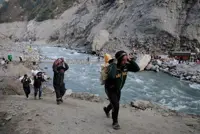
Every day, Shanti Dangol stares down at Nepal’s Trishuli River from her makeshift shelter, searching for traces of the home she lost and wondering when she will have a roof over her head again.
Dangol is among hundreds of people living in tent shelters following a catastrophic Himalayan flood triggered by a mountain and glacier collapse near Nepal’s border with China on Aug 26.
More than 1,400 people died and over 5,000 remain missing after tsunami-like waves swept through northern mountainous areas, destroying homes, roads, bridges and settlements.
Dangol, a former hotel owner, now lives in a tent in a forest clearing in Betrawati, Rasuwa district.
She shares the plot with 25 other families who also lost their homes.
“Where are we supposed to go? What are we supposed to do? The river now flows where our house once stood,” Dangol said.
“Where will the government settle us?”
Dangol lost 18 relatives in the disaster, as well as two four-storey houses.
Four employees from her hotel are still missing.
“We just want somewhere to live, we don’t need anything more,” she said. “That is what worries us more than anything else.”
Prime Minister Balendra Shah told the United Nations last month that the flooding “was a warning to the world” about the rising dangers of climate change.
A government report shows that more than 7,500 private houses were damaged in the floods.
In Rasuwa district alone, over 1,000 people are in temporary shelters, said Kamal Prasad Pandey, the district’s chief administrative officer.
“We are also equally concerned about their permanent settlement, their hygiene and mental health issues,” he said.
Aarati Magar, 26, who lost her newly opened hotel in the disaster, lives in the same plot in a tent with her daughters, aged eight and three, worrying about their safety and education.
“It is tough to stay here. There is no bathing place and no proper place to live,” she said.
For 58-year-old Narayan Man Dangol, the prospect of spending months in a tent is particularly worrying as winter approaches.
“I don’t see a situation where we can stay in the tent for a long time,” he said.
“The wind will carry it away and then it will rain again. This is just cloth. Living inside a cloth house is very difficult.”
He said he had lost his life’s earnings.
“Life will never be the same for us. We can no longer work in the fields and earn at this age,” he said.
Dharam Raj Uprety, chief of Nepal’s disaster agency, said authorities were “moving to the search and recovery phase” and working on “transitional shelters and identifying resettlement areas”.
Families have also lost businesses, jobs and access to essential services, leaving many uncertain about how they will rebuild their lives.
“Recovery is about much more than rebuilding damaged infrastructure,” said Kyoko Yokosuka, the United Nations Development Programme head in Nepal.
“It is about helping people restore their livelihoods, reopening local economies, restoring essential services and ensuring communities can move forward with dignity and hope,” she said.
For Dangol, the former hotel owner, the immediate concern is finding somewhere safe to live.
“We were victims of this flood, but we don’t want the next generation to be homeless like us,” she said. — AFP