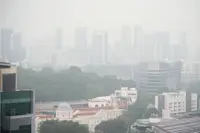
SINGAPORE(The Straits Times/ANN): The heat and haze could linger over Singapore for a longer period as the super El Nino weather phenomenon delays the retreat of the dry season.
Experts told The Straits Times that this year’s “Godzilla” El Nino event could reduce rainfall and result in higher temperatures over the October-November period, compared with non-El Nino years.
Wang Jingyu, a weather expert and assistant professor at the National Institute of Education (NIE), said he expects relief to come only from around December.
By then, the winds would have turned to blow from the north, pushing regional smoke haze away from Singapore. The north-east monsoon season also usually brings more rain over Singapore, which can help to cleanse the air, he said.
The dry season experienced in the equatorial ASEAN region, including countries such as Singapore, Malaysia and Indonesia, typically stretches between June and September.
The 2026 El Nino event overlaps with the dry season and has worsened fire-causing conditions there. It has contributed to Indonesia’s most intense wildfires in 11 years.
Winds blowing from the south bring the smoke haze to Singapore, taking air quality over the Republic to unhealthy levels in September.
During non-El Nino years, the dry south-west monsoon season usually tapers off by September, and the start of the rainy north-east monsoon season tends to set in around late November.
The Meteorological Service Singapore (MSS) told The Straits Times: “El Nino events, particularly strong ones, tend to delay the retreat of the dry season for much of the southern ASEAN region.”
Added the spokesperson from MSS, a unit under the National Environment Agency: “For the event this year, we are predicting transition during late October or early November for Singapore, later than in the previous two years.”
El Nino events tend to reduce cloud cover from October to November, bringing less rainfall and increasing surface temperatures over that period, said Koh Tieh Yong, a meteorologist from the World Climate Research Programme’s Working Group on Asia-Australia Monsoon.
The three strongest El Nino events since 1980 happened in 1982/1983, 1997/1998 and 2015/2016.
The impacts of a single El Nino event tend to spill over two years.
MSS data showed that El Nino events can affect rainfall and temperature during the October-to-November period.
For instance, the long-term average rainfall from 1991 to 2020 for those months was 490.7mm of rain.
This figure drops during strong El Nino events. The average rainfall for those two months was 450.5mm in 1982, 275.3mm in 1997 and 351mm in 2015.
Similarly, the long-term average temperature for those two months was 27.6 deg C. In 1982, the average temperature for those months was 26.8 deg C; in 1997, it was 28 deg C; and in 2015, 28.3 deg C.
“More recent El Nino events also tend to be warmer than those occurring more than 30 years ago due to global warming,” said the MSS spokesperson. “1982’s temperatures were mostly below this average, illustrating the effect of the long-term warming trend.”
She added that El Nino tends to have a stronger influence on rainfall and temperature around the February to March period.
For instance, the long-term average rainfall for those two months is 345.9mm. This dropped to 64.1mm in 1983, 138.9mm in 1998 and 263.5mm in 2016.
In terms of temperature, the long-term average for February and March is 27.6 deg C. During the 1983 El Nino year, the average temperature for the period was 27.8 deg C. In 1998, it was 29.2 deg C, and 28.4 deg C in 2016.
Fire-dousing rains
True relief from haze could only come later in the year, when monsoon rains reach Indonesia in late December or early January, said Koh, who is also an adjunct associate professor at the National University of Singapore.
These rainfall events are expected to greatly help to contain and put out the haze-inducing fires, he said.
However, NIE’s Wang warned that under a strong El Nino, the respite could be weaker and shorter than normal.
“El Nino suppresses cold surges and rainfall, and the monsoon’s own dry phase from late January to March returns quickly,” said Wang.
The north-east monsoon season brings rainier weather over Singapore between November and January, but then has a drier period from February to March.
Said Wang: “So expect a brief improvement around December, followed by a return to warmer, drier and potentially hazy conditions in the latter half of the monsoon.” -- The Straits Times/Asia News Network