On Sept 7, Vichitra Jain stood outside the Nepal Tourism Board in Kathmandu, carrying a photograph of a friend who vanished on a trip to Kailash. Officials were gathered inside to mourn those killed in the Bhotekoshi disaster.
The ceremony ended. The officials left. The gate was shut. Jain stayed looking for answers.
She was one of three foreigners outside that day, waiting for news of missing relatives and friends.
Jain had travelled from India after her Russian friend, Kirill Tretiakov, disappeared, likely in the flood.
She still does not know whether he is alive or dead.
“I don’t know where to go or how to search,” she said. “No one has helped us.”
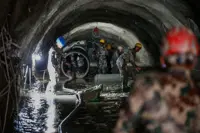
After the catastrophic Bhotekoshi floods of Aug 26, hundreds of foreigners are waiting for an answer that the Nepal government has so far been unable to give: what happened to their loved ones?
A Russian national was also outside the tourism office in Kathmandu, looking for a relative. Nearby, another foreigner held up a photograph of a young man with a tattoo. He spoke little English and struggled to make himself understood, so he held up the photograph and pointed to the man he was trying to find.
He showed the picture to Phur Gelje Sherpa, president of the Nepal Mountaineering Association and operator of Heli Everest, hoping he could help trace him.
Records maintained by the Tourist Police show that as many as 795 tourists remain missing following the floods. Of that number, 607 are foreigners and 188 are Nepalis.
Indians account for the largest number of missing foreign nationals, with 189 people unaccounted for. The list includes 65 Americans, 55 Malaysians, 54 Ukrainians, 37 Chinese nationals, 33 Latvians, 33 Australians, 32 Britons and 30 Canadians.
Eight Germans remain unaccounted for, as do nine Singaporeans, nine South Koreans, six South Africans, six Russians, five Japanese, five New Zealanders and four French nationals.
Two citizens each from Belarus, Ireland, the Netherlands, Portugal and Italy are also listed as missing, along with nationals from several other countries.
Twenty days into the search, the biggest question for the families is no longer how many people are missing. It is whether those on the list are still alive.
Relatives of missing foreign tourists are now asking the Nepal government for more than search operations. They want official documentation of their relatives’ status.
Sunil Sharma, officiating director of the Nepal Tourism Board, said families of foreigners who had been out of contact for three weeks were visiting the board and the Tourist Police office seeking death certificates or, at minimum, official documentation of the search and their relatives’ status.

“They are no longer asking only where their relatives are,” he said. “They want an official record of what happened to them.”
He added, “After three weeks without a trace, they ask for a death certificate, or at least some formal confirmation of their status.”
But the government cannot issue death certificates simply because someone has disappeared, he said. Such certificates can be issued only after a death has been confirmed at a hospital or a body has been identified.
For missing foreign nationals, Tourist Police are instead issuing slips stating that the person is “out of communication”, Sharma said.
Families of Indian tourists have also been asking Nepal for additional official documents needed to file first information reports in India.
Families of Indian pilgrims bound for Kailash have kept up a steady stream of calls and visits to the Tourism Board, Sharma said.
“Some would come straight from the airport after failing to reach their relatives,” he said.
“They would take our number and call again and again, sometimes every day, to ask whether there was any news.”
Every report of a rescue brings a fresh surge of hope.
Families call the Tourism Board almost immediately, asking whether their missing relative might be among those pulled to safety.
“Whenever they hear that someone has been rescued, they call us straight away and ask, ‘Could that be our person?’” Sharma said.
Nepal’s Foreign Affairs Ministry has set up an Emergency Response Team to handle inquiries from the families of foreigners reported missing.
Officials assigned to the team say they receive 13 to 14 email or WhatsApp inquiries each day. They provide updates on the status of those being inquired about.
The number of inquiries, which ran into dozens in the initial days, has been declining with each passing day.
After 21 days, many families still have little more than photographs. Some have pasted photographs of missing relatives at Tribhuvan University Teaching Hospital in Kathmandu.
Others have been staying in hotels nearby while continuing to search. They have received neither confirmation that their relatives are alive nor documentation of their deaths.
Government assurances that the search is continuing have done little to settle their fears.
Three weeks after the flood, Jain is still in Kathmandu. She has not given up the search, but her biggest problem now is knowing where to look.
Nepal has conducted helicopter searches, Jain said.
She was herself flown over some of the affected areas after repeatedly appealing for help and eventually chartering a flight.
But the search has been difficult because there is no clear information about Tretiakov’s last known location or the area where he may have disappeared.
The search has another complication: the border itself.
Floodwaters also tore through areas on the Chinese side of Rasuwagadhi.
“We’ve heard that three Russians were found on the Chinese side,” she said.
“But we don’t know whether they were alive or dead. Kirill could be there too.”
Jain has rented a room in Bauddha and is staying with other foreigners while continuing efforts to search parts of Nepal independently. But the lack of information has made the search even more uncertain, she said.
“We are not looking only for foreigners. Everyone who was travelling in the same group is being searched for,” she said. “The search is not over.”
Tretiakov’s brother, Dmitrii Tretiakov, has called for Nepal and China to coordinate a joint cross-border search. The search should not stop at the border because Kirill could have ended up on either side, he said.
Teams should search not only the areas directly hit by floods and landslides but also forests, high ground, ravines, caves and other places where survivors could have sought shelter.
He said drones, thermal imaging where necessary, trained search teams and rescue dogs should be deployed because missing people could still be alive but injured or unable to move.
Dmitrii has urged the authorities to publish daily maps showing where search teams have worked and which areas remain unchecked.
The maps should track areas covered by drones, patrols, search teams and rescue dogs, he said, giving families a clear picture of what has been checked and what has not.
While the search for Kirill continues, a formal request has also been lodged seeking diplomatic assistance in the search and rescue of Kazakh national Irina Blonskaya, who went missing in Rasuwa.
Her son, Valeriy Blonskiy, sent an urgent appeal on Sept 11 to the Embassy of Kazakhstan in India and Kazakhstan’s honorary consulate in Nepal.
The request said Blonskaya, the group leader, went missing while trekking in Rasuwa after a group became trapped in a high-altitude area between the Rasuwagadhi border crossing and Timure amid severe weather and the natural disaster.
According to the family, a helicopter and rescue team were ready for a high-altitude operation in coordination with the Nepal Mountaineering Association.
Family representatives remained in Kathmandu coordinating with the association, aviation officials and local rescue teams.
The application said the search area around Rasuwagadhi, Timure and the Bhotekoshi river lies within a “restricted border zone” and that the required special flight permission was being processed by the Home Ministry.
The family has asked Kazakhstan to use diplomatic channels to coordinate with the relevant Nepali authorities. — The Kathmandu Post/ANN