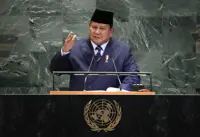
JAKARTA: President Prabowo Subianto will stay home as Foreign Minister Sugiono leads Indonesia’s delegation to next week’s high-level United Nations General Assembly (UNGA) meetings in New York, where Jakarta plans to push for stronger multilateral cooperation and position itself as a “bridge-builder” amid growing global instability.
Sugiono will represent Prabowo at the 81st UNGA, where he is scheduled to attend about 22 meetings throughout the week, including forums involving middle powers and the Organization of Islamic Cooperation (OIC), as well as bilateral meetings with international partners.
The Foreign Ministry said Prabowo would remain in the country to focus on domestic priorities, while emphasising that his absence did not signal any reduction in Jakarta’s commitment to the UN or to multilateral diplomacy.
Indonesia will use the gathering to advance its diplomatic priorities, including its support for multilateralism, inclusivity and world peace, as well as the Palestinian issue, ministry spokesperson Yvonne Mewengkang said, while also emphasising Jakarta’s drive to be a global “bridge-builder”.
“Broadly speaking, the key message Indonesia intends to convey during the General Debate concerns the importance of strengthening national and regional resilience as a means to achieve global resilience,” she told journalists during Thursday’s (Sept 17) press briefing.
The General Debate begins Tuesday in New York, bringing nearly 200 countries together to discuss conflicts, humanitarian crises, climate change and other global challenges under the theme “Restoring Trust, Managing Transformation: A United Nations that Delivers for All”, as multilateralism faces growing strains and a more fragmented world order.
An early September provisional speaking list had placed Indonesia in the sixth afternoon slot on the first day of the debates, with Prabowo listed as the speaker. It remained unclear when Indonesia would deliver its statement after Sugiono was named to attend in his place.
Prabowo’s decision to skip the gathering has drawn attention from analysts, given his regular participation in international forums and the opportunities UNGA offers for direct engagement with world leaders. Prabowo made his UNGA debut last year with a 19-minute speech focused on multilateralism, peace and a two-state solution for Palestine.
He notably pledged that Indonesia would guarantee Israel’s security if Israel recognised an independent Palestinian state. The pledge drew debate domestically and internationally, with analysts describing it as a potential signal of Jakarta’s willingness to engage more closely with Tel Aviv, with which Indonesia has no formal diplomatic relations.
Prabowo later joined eight other countries at a multilateral meeting on Gaza hosted by US President Donald Trump, an early diplomatic effort that preceded Trump’s Gaza peace plan and the subsequent formation of the Board of Peace.
Ahmad Rizky M. Umar, an international relations expert at Aberystwyth University, said Prabowo’s absence was notable, particularly given that an earlier UN list had indicated that he was expected to attend. Umar said the UNGA offered Prabowo opportunities beyond his national address, including bilateral meetings and informal engagements with partner countries and key world leaders, opportunities Indonesia would forgo with his absence.
“There are bilateral meetings and strategic engagements, including those involving the Middle East, that have become effectively inaccessible due to his absence,” Umar told The Jakarta Post on Friday. “We can draft a very beautiful national address, but the setting of our minister delivering it will inevitably reduce our leverage and visibility during the week,” he continued.
Umar said Prabowo’s absence could reflect a more tactical diplomatic calculation, rather than an effort to attract global attention. He also pointed to Indonesia’s relationship with the US as one possible factor, citing difficult negotiations over Washington’s overflight access and the recent announcement of a possible new round of tariffs.
“The US and Indonesia have not had an easy time reconciling their interests,” he said. - The Jakarta Post/ANN