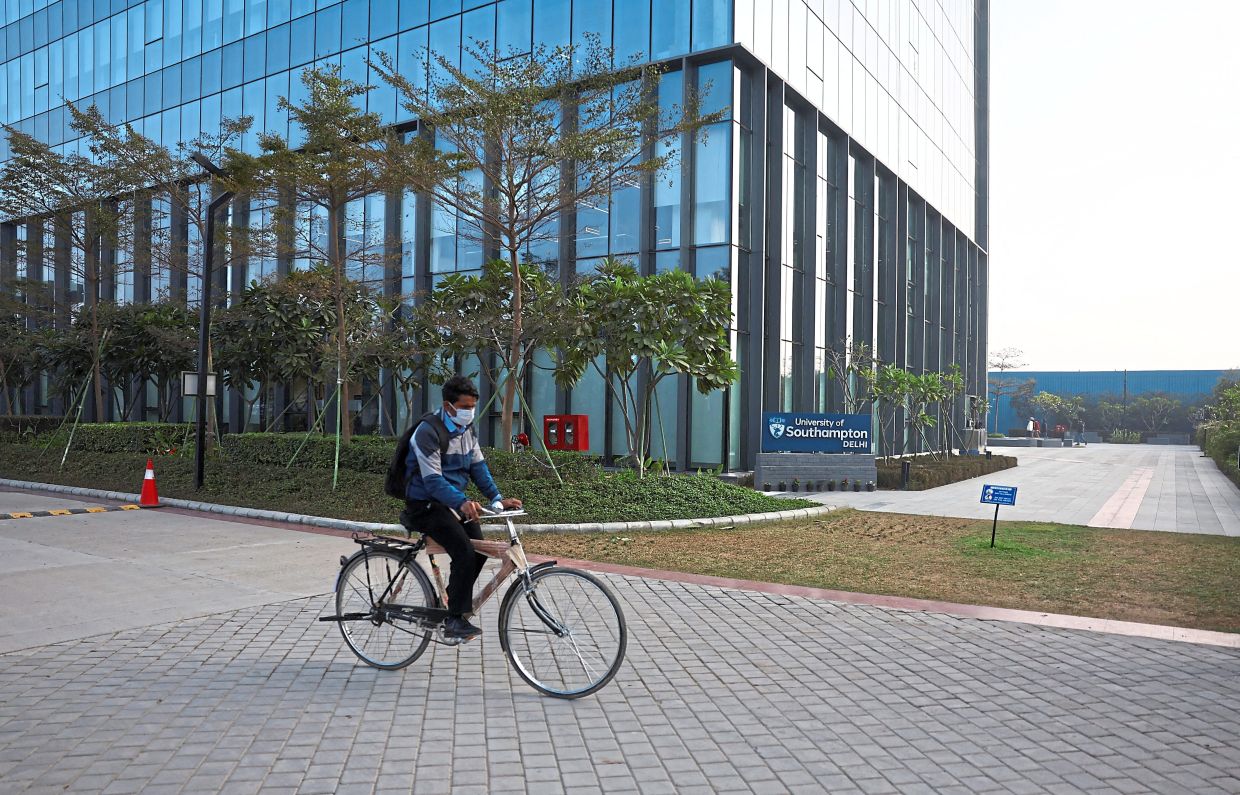
In an office block on the outskirts of Delhi, a first cohort of students gathers for a class in a Business Management degree at the University of Southampton – an institution headquartered nearly 7,000km away.
Far from its sprawling green campuses in southern England, Southampton is the first of several British universities setting up in India to tap one of the world’s fastest growing student markets.
Britain and India agreed to deepen education ties under a 2025 reset in relations that also delivered a free-trade agreement and reciprocal prime ministerial visits.
New Delhi introduced rules in 2023 allowing top-ranked foreign universities to open up and help meet the estimated 70 million student places India will need by 2035. Of the 19 that plan to do so, nine are from the United Kingdom.
India’s move comes as UK universities face pressure at home over the recruitment of international students, with the government aiming to reduce immigration.
Southampton opened its campus in August last year with 120 students on a limited range of courses.
It plans to expand the site over the next decade to reach 5,500 students.
“The new part of the model... is that now universities can start thinking about going to the students,” Prof Andrew Atherton, vice-president of international and engagement at the university, said during a visit to the campus.
“So it’s a two-way flow. Some students will come to universities, but the universities increasingly will go to students. And that, to me, opens up much more choice.”
Education is one of Britain’s top exports, worth £32bil (RM175bil) a year – more than goods such as cars or food and drink.
But universities’ long-established model of recruiting international students is under strain.
In November last year, the government announced a levy on international student fees of £925 (RM5,052) per student per year, and tightened visa rules on how long foreign graduates can stay in Britain.

A new strategy published in January, aimed at lifting education exports to £40bil (RM218bil) by 2030, emphasised expansion overseas rather than recruitment of international students, who count towards net migration.
Stephen Jarvis, vice-chancellor of the University of Surrey, said expansion in India was an opportunity in its own right rather than a reaction to the immigration debate, but added that domestic political wrangling created uncertainty for universities as they try to attract foreign students.
“There is a great talent pool in India that we’re all trying to make sure that we get closer to,” he said.
Surrey plans a new campus in GIFT City, a business hub in Gujarat. Jarvis and Atherton were among representatives from 13 universities who joined British Prime Minister Keir Starmer on a trade mission to Mumbai in October last year.
“It’s a fantastic opportunity for us to provide university education in India for people,” Starmer told reporters on the trip. “There’s no question of visas.”
Some UK universities are under financial pressure. Around 45% of English higher education institutions face a deficit in 2025-26, according to Office for Students data.
Felix Ejgel of S&P said international campuses could help universities “establish a footprint in a target country”, but would likely be loss-making initially.
While new campuses require heavy upfront investment, universities need to diversify and reduce reliance on capped domestic fees, squeezed research grants and international students coming to Britain, said Charlie Jeffery, vice-chancellor at the University of York.
“I think we have to move into a much more proactive mode,” he said after joining Starmer’s trip to Mumbai.
“If universities don’t grasp the nettle and shift themselves strategically away from the dependence on those three big buckets... then they’re probably storing up more trouble for themselves.”
Indian regulations require degrees to match the standard of courses in Britain, though fees are lower to compete with Indian universities.
Courses that have fees of over £25,000 (RM136,550) for an international student in Britain cost in the region of £10,000-12,000 (RM54,620-65,545) for Indian students at the new campuses.
Sadhika Mehrotra, 20, a Politics and International Relations undergraduate in Southampton who grew up in Delhi, said she loved studying in Britain but had friends who had been “very much interested in initially coming to the UK for universities” who were now thinking of staying in India.
“(It’s) in India, but it’s an international university, well-established, from the UK, so why not?” she said.
“It will have its own perks.” — Reuters