GENEVA: Natalia Rjumin-Girardet, a Swiss pilgrim who narrowly escaped deadly flash floods in Nepal while making a spiritual journey to Mount Kailash in Tibet, says "divine providence" saved her.
The 70-year-old yoga teacher was travelling by bus with a group of eight pilgrims of different nationalities along a road bordering the Bhotekoshi River when the disaster struck.
"Suddenly, I saw the (group's) cook jump out of the bus window. Someone else opened the door and I saw a huge mountain... in the fog," Rjumin-Girardet told AFP by phone from a hotel in Kathmandu.
Then she realised that the "mountain" was actually a "massive wave of water and mud".
"I saw everyone start running, so I started running too," she said, her voice trembling.
"I think we had a minute, maybe two, to get out of the bus."
The Russian-born woman with short, grey hair said that by luck, a small, concrete staircase stood right next to where the vehicle had come to a halt, allowing the group to get away.
After the stairs, "we ran" up a hillside, she said, adding that no one in the group remembered how they had reached higher ground, since they were all in a state of "shock".
"Those stairs saved us," she said. "We were incredibly lucky".
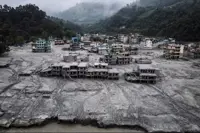
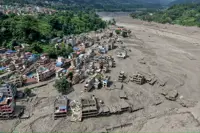
Once she realised she was safe, Rjumin-Girardet said she turned around and saw the devastation below.
"I saw houses, cars and even buses being swept away by the wave," she said.
"It was truly awful," she said, adding that it was only later that the group understood the full scale of the disaster.
Their hotel and the entire village of Syabrubesi where they had spent the night had been completely destroyed.
According to the latest figures, rescue teams have recovered more than 1,100 bodies, while nearly 4,500 people remain missing after the gigantic wave of freezing water, rocks and debris triggered by a glacial collapse roared down the China-Nepal border on August 26.
The members of Rjumin-Girardet's group, who had been on their way to make a pilgrimage to the sacred Mount Kailash in China's Tibet region, see their survival as a "miracle".
"It was divine providence that allowed the group to stay alive," she insisted.
"If we had arrived two or three minutes earlier or later, we might not have been lucky enough to be saved."
She described how the survivors spent the first night after the flash flood huddled in a small barn on a hilltop, in the cold and rain.
"We hardly slept," she said.
The next morning, a helicopter evacuated them to an area where military personnel took charge of them, before transferring them to Kathmandu.
Having lost her phone on the bus, Rjumin-Girardet was finally able to notify her loved ones that she was alive thanks to a friend who had her sister's number.
Today, the group remains very close.
"For us, Aug 26 has become an important date, (marking) a rebirth," she said.
Rjumin-Girardet, who founded Art and Peace -- a Swiss association using art and creativity as tools for dialogue -- said she did not yet know whether she would return to Switzerland or continue her journey.
But she said she hoped lessons could be drawn from the harrowing experience.
"I would like everyone to have more compassion for others," she said.
"Perhaps our world could change a little for the better." - AFP