WASHINGTON, Sept 1 (Reuters): China's state-owned shipping giant COSCO uses concealed equipment on board its ships to spy on military communications near the coastlines of target nations including the U.S., two senior Trump administration officials said.
The officials, who spoke on condition of anonymity to discuss the U.S. assessment of the Chinese program, said COSCO has a decades-long intelligence-collection partnership with Beijing. The arrangement allows China to collect communication signals from vessels and aircraft operating across Europe, North America and Asia, they said.
The advanced equipment aboard the ships is intended to enable China to gather information about "military communications technologies and encryption developments," one of the officials said.
The effort also allows Beijing to monitor key shipping lanes and maritime routes crucial for trade and military navigation, the official added.
COSCO did not respond to a request for comment, while China's embassy in Washington rejected the U.S. claims.
U.S. President Donald Trump and Chinese leader Xi Jinping plan to meet in Washington for a summit later this month, when they are expected to discuss a range of sensitive security and trade issues.
The officials did not detail the type of equipment COSCO ships were allegedly using, but said they were "sophisticated signals intelligence collection" platforms, not routine communications hardware.
They said Beijing uses the information gleaned to bolster its position in territorial disputes and provide maritime reconnaissance and early-warning indications of foreign military targets.
China's embassy in Washington said the Chinese government would never ask any company or individual to "collect or provide data, information or intelligence located abroad against local laws."
"We oppose vilifying China by peddling the so-called 'intelligence collection' narrative, which is totally baseless," embassy spokesperson Liu Chang told Reuters.
ALLEGED TIES BETWEEN CHINESE GOVERNMENT AND SHIPPERS
A report published by the U.S. Naval War College in April 2025 said it was likely that China's People's Liberation Army (PLA) was harnessing the country's fishing and commercial shipping fleets for intelligence and surveillance gathering.
The Pentagon put COSCO on its list of companies linked to China's military in January 2025, a designation that carries serious reputational costs for companies as well as U.S. government procurement bans, but does not entail formal sanctions.
Chinese law requires the country's firms to support government intelligence work.
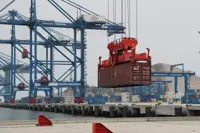
Nonetheless, COSCO remains one of the top global shipping companies calling at U.S. ports and has several terminal service joint ventures for container ships at U.S. ports.
The Trump administration last year planned to implement billions of dollars in port fees on Chinese shipping companies, including COSCO, in an effort to revitalize the atrophied U.S. shipbuilding and maritime industries.
The plan was paused, however, after Trump reached an agreement last October with Xi for a year-long trade war détente. The agreement expires in November, and a possible extension is expected to feature in the September talks between the leaders.
Isaac Kardon, an expert in Chinese maritime strategy at Johns Hopkins School of Advanced International Studies, said the U.S. government would likely have difficulty decisively addressing the security concerns given the degree to which COSCO is interwoven into U.S. trade.
"Taking COSCO out of our supply chains and transport networks could be life-threatening surgery to U.S. trade networks," Kardon said.
(Reporting by Michael Martina; Editing by Don Durfee and Jamie Freed) -- Ruters