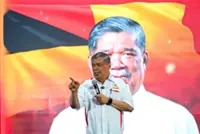
PUTRAJAYA (Bernama): Asean centrality must remain the autonomous compass guiding the region's collective journey, especially as the existing international order faces unprecedented levels of fragmentation, said Foreign Minister Datuk Seri Mohamad Hasan.
He said the bloc must be cognisant that this ethos is not a right but a privilege that needs to be sustained in the face of shifting regional and global dynamics.
"In a fragmented world, our (Asean) centrality and unity matter more than ever. The existing international order is not just under strain; it is facing unprecedented levels of fragmentation, characterised by major power rivalries, geo-economic competition, and frayed multilateralism, the world now is increasingly more complex, analytical and unpredictable.
"Asean must confront this sobering reality with clarity of purpose and ambition. As we navigate an uncertain strategic landscape, we must continue to be a voice of reason and a resilient community committed to peace and shared prosperity,” he said in his speech at the 59th Asean Day celebration here, on Monday.
Also present were Tourism, Arts and Culture Minister Datuk Seri Tiong King Sing, Deputy Foreign Minister Datuk Lukanisman Awang Sauni, Secretary General of the Foreign Ministry Tan Sri Amran Mohamed Zin and heads of foreign diplomatic missions.
Mohamad said Asean’s commitment to regionalism and multilateralism remains the anchor of the region's collective stability and progress.
"Asean must be an agent of change, one that has wisely shaped the global rules and norms to remain open, inclusive and firmly rooted in the principle of justice,” he said.
"An outward-looking organisation in a multipolar world, Asean must continue to punch above its weight by broadening its global partners. Deepening ties and strategic links with diverse partners is not a choice; it is a strategic imperative. But we should engage as equals, and above all, we must be the speakers and not the spoken,” he added.
He added that in an increasingly polarised global environment, member states cannot afford to let internal divisions weaken the bloc's collective influence.
"We cannot afford an Asean that is weak, fragmented, or in conflict with each other. Our national fortunes rise or fall with the region. In these increasingly polarised times, ASEAN must continue to harness its convening power to advance dialogue, diplomacy,” he said.
Mohamad added that the digital economy will be a key driver for Asean's next phase of growth, advancing efforts for the Asean Digital Economy Framework Agreement (DEFA) while modernising existing trade agreements with partners including China, India, and the Republic of Korea.
"Business as usual is no longer an option. As Asean charts its path forward, we must embed sustainability at the heart of our economic agenda," he said, citing the acceleration of the ASEAN Power Grid to advance the green energy transition, attract investments, and enhance long-term energy security.
Established on Aug 8, 1967, by Indonesia, Malaysia, the Philippines, Singapore, and Thailand through the signing of the Bangkok Declaration, Asean has since expanded to a total of 11 members following the inclusion of Brunei in 1984, Vietnam (1995), Laos (1997), Myanmar (1997), and Cambodia (1999).
Timor-Leste, its newest member, was admitted during the 47th Asean Summit in October last year.
This year’s Asean Day celebration was held under the theme "Navigating Our Future Together,” which is also the theme of Asean 2026 under the chairmanship of the Philippines. - Bernama