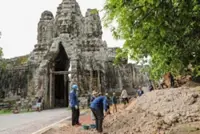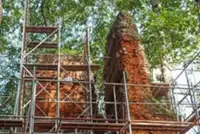
PHNOM PENH (Xinhua): A team of experts from the APSARA National Authority (ANA) is conducting archaeological excavations along the western causeway of the millennium-old Bakong Temple in Cambodia's Angkor Archaeological Park, according to an ANA news release on Wednesday.
Saray Kimhual, head of the restoration team at the ANA's Department of Conservation of Monuments and Preventive Archaeology, said the project will collect technical data and assess the structure's condition, saying that this assessment is required before launching a restoration project aimed at preserving and enhancing the historic architectural feature.
The western causeway measures 70 meters long, 12 meters wide, and approximately 4 meters high.
"Before restoration can begin, the team must carry out archaeological excavations to study the original construction of the causeway," he said. "We also need to recover broken sandstone blocks and fragments of the naga balustrades that have collapsed into and become buried beneath the surrounding moat."
The causeway has suffered severe deterioration over the last 1,000 years.
"The laterite retaining walls on both sides have almost entirely collapsed, while the naga balustrades that once lined the causeway have disappeared from their original positions," Kimhual said. "The principal causes of this damage are the growth of large trees and soil erosion caused by seasonal rainfall."
Chea Socheat, the archaeologist leading the excavation site, said that the western causeway of Bakong Temple has never undergone prior archaeological investigation or restoration.
"The current excavation is essential for collecting comprehensive archaeological and engineering data in accordance with the recommendations and technical standards of the International Coordinating Committee for the Safeguarding and Development of the Historic Site of Angkor and the Sambor Prei Kuk Archeological Site (ICC-Angkor/Sambor Prei Kuk)," he said.
Built in the late ninth century by King Indravarman I, Bakong, made of sandstone and laterite, was the first major mountain temple built in the UNESCO-listed Angkor Archaeological Park in northwest Siem Reap province. -- Xinhua