
SINGAPORE: For much of her final year in junior college, Mavis Wen, 19, had hoped to study in the United States.
She attended college open houses in Boston in June 2025, and had a glimpse of what it would be like to meet students from around the world. She was also drawn to the flexibility of an American liberal arts education, which would let her take electives outside her course, like astrology.
She secured an offer to study electrical engineering at Boston University, but eventually turned it down after a mass shooting there in December 2025 killed two students and wounded nine others.
“We thought Boston, Massachusetts, was safer. But after the shooting, my parents said 100 per cent no,” she said.
The family’s decision was further reinforced by tougher immigration measures recently introduced by US President Donald Trump’s administration.
The latest changes, announced on July 16 and due to take effect in September, introduce stricter visa rules for international students entering the US, including replacing open-ended periods of stay with fixed admission periods of up to four years.
“The political climate in the US now is not the safest for immigrants… It’s a pity. I was disappointed but a bit relieved that I don’t have to go and live there alone,” Wen said.
Videos on social media showing deportation efforts by the US Immigration and Customs Enforcement had also unsettled her parents.
Wen will now be pursuing a double major in industrial design, and innovation and design at the National University of Singapore. She still hopes to do a student exchange programme or pursue postgraduate studies in the US one day.
Her experience reflects a growing unease among some prospective international students as the US tightens immigration policies affecting those travelling to the country to study, work or visit.
But education consultants here said the new visa rules have yet to significantly alter students’ plans, even though they have received more questions from families.
The US Department of Homeland Security (DHS) had said the policy “combats rampant visa abuse and strengthens national security through regular vetting”.
Under the new rules, students on J-1 visas, typically used for short work and study-based exchange programmes, must leave the US when the programme ends.
For those on F-1 visas, which allow foreign students to pursue full-time degree programmes in the US, extending their stay past four years can no longer be done through university administrative procedures.
Instead, students now have to submit formal requests to the US Citizenship and Immigration Services, undergo background checks, submit biometrics and pay filing fees. They will also not be allowed to transfer to another university, switch majors or pursue lateral second degrees.
The grace period to leave the US after studies has also been halved from 60 to 30 days, with stiffer penalties for overstaying.
More than 70 per cent of international students in the US are from Asia, mostly from China and India.
DHS data show there are 4,258 Singaporean students in the US as of September 2025.
Joash Lee, chief executive and founder of college admissions consultancy Sedifly, said all the students his firm is guiding to US colleges are staying the course. About 70 per cent of its students apply to the US.
A survey Sedifly conducted in May 2026 found that over 85 per cent of its prospective students interested in US colleges were proceeding as planned.
Families are, however, asking questions about timelines and requirements much earlier in the process, Lee said, with some open to alternatives like Britain.
Praise Tan, Singapore country manager of consultancy Crimson Education, similarly expects little impact on students already bound for the US. The new policy does not forbid visa extensions, so students can still apply for one when needed, she noted.
Most students complete their studies in approved degree programmes within four years, and those in longer programmes like double majors or doctorate tracks can still apply for visa extensions, she said.
Tan encouraged students to familiarise themselves with the latest visa requirements early and stay in contact with their university’s international student office.
Roughly half of Crimson’s applicants apply to US universities and the other half to Britain.
Lee added: “Our read is that the new oversight targets students who move between institutions without clear academic intent, not those progressing steadily through one extended programme.”
US universities still seen as welcoming
Students The Straits Times spoke to said they are concerned about the broader political climate in the US, but are reassured by support from the universities.
Ahsan Nathyr Noorazman, a JC2 student at Raffles Institution, has his eye on US universities but not a course as yet.
“I’m getting the feeling that Trump doesn’t want international students in the US,” he said, pointing to the administration’s move to revoke Harvard’s right to enrol foreign nationals in May 2025.
“But it seems like Harvard doesn’t agree with the anti-diversity stance. Since the universities want us there, I’m not super concerned,” Ahsan Nathyr said.
All four students with US study visas whom ST interviewed said they still value the experience of studying there despite the policy changes.
Yap Ming Shen, 23, a Nanyang Technological University biological sciences student, will spend a semester at the University of California, Berkeley, from August as part of an exchange programme.
He hopes exposure to the US bioscience industry, home to pharmaceutical giants such as Pfizer and Moderna, will strengthen his career prospects.
“Berkeley is renowned for its bioscience department, and their lecturers are Nobel laureates. So can you imagine, you sit in a lecture, and it’s a Nobel Prize winner teaching you the class,” he said.
For Arshul Garg, 22, the flexibility of the US education system drew him there.
He chose UC Berkeley over universities in Britain after receiving a scholarship, intending to major in chemistry. But after exploring different modules in his first year, he switched to a double degree in political science, and environmental economics and policy.
The new visa rules do not affect him directly as he is already enrolled, but he believes future students could think twice about going to the US.
Had the new rules existed when he applied in 2024, he would have chosen Britain, as it would have been the more stable option, he said.
Another student New Ke Yue, 19, also opted for the US after a two-week bicultural studies trip to New York in 2023, during which she visited New York University and Princeton University.
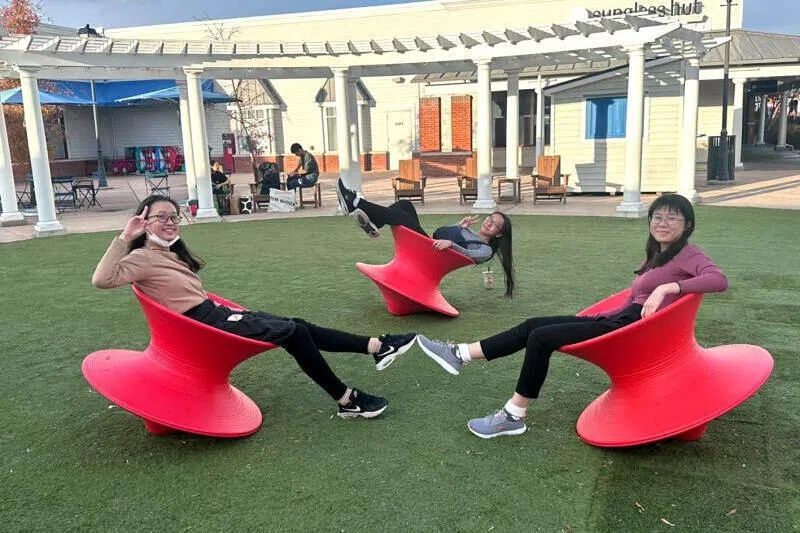
New Ke Yue (right), 19, with her former classmates from River Valley High School in December 2023, at the Tanger Outlets in Pennsylvania, during the school’s two-week bi-cultural studies programme in the United States.
After graduating from River Valley High School in 2024, she was accepted into three local universities. But she decided to go overseas when she received a full scholarship.
New will be starting her first year in September at the University of Chicago, where she is thinking of majoring in economics.
“The University of Chicago is known for being quite quirky and academic. It has produced a lot of philosophers and economists,” she said.
While she expects to complete her degree within four years and therefore avoid any issues under the new rules, she worries there may be more restrictions.
“It shows that the climate in the US has increasingly become more hostile to foreigners in general,” she said.
“But from what I hear from my peers, the universities themselves are still welcoming and helpful towards international students because they see the value in the diverse perspectives that we bring in.” - The Straits Times/ANN