TOKYO (The Japan News/ANN): Artificial intelligence-based robots and systems in Japan are advancing to the point of being able to learn and replicate the skills of culinary professionals, even though it has been considered difficult to teach them as they rely heavily on experience and intuition.
The advent of deep learning has made it possible to automate these skills. Deep learning is an AI training method modelled after neural networks in the human brain.
AI learns features and common elements from large amounts of data, such as images and sounds, to classify and analyse new data with high accuracy.
This use of AI is expected to address labour shortages and the lack of successors in Japan’s food service industry.
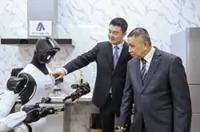
On March 25, Western confectionery manufacturing company Juchheim in Kobe opened a training facility and showroom for Theo, an AI-equipped baumkuchen-cooking robot, on the first floor of its headquarters in Chuo ward, Kobe.
Baumkuchen was first introduced to Japan in 1919 by Karl Juchheim, the German pastry chef who founded the company.
The cake is made by broiling many thin layers of batter, added one at a time, on a rotating spit in an oven. Since broiling times vary depending on temperature and humidity, it is said to take several years to master cooking it.
Theo has learnt the cooking techniques of the company’s skilled workers using cameras and image sensors so that it can determine the optimal conditions. It is said that it can be trained in a new technique in just a few days.
The company exhibited the robot system at the 2025 Osaka-Kansai Expo. Currently, the system is on loan to about 20 businesses nationwide. The company aims to increase this number to 100 by the end of this fiscal year.
Juchheim’s president Hideo Kawamoto said: “It can greatly help the food service industry, which is facing a shortage of successor workers.”
Digitising ‘tacit knowledge’
TechMagic, a Tokyo-based company developing robots that automatically cook stir-fried dishes such as fried rice and yakisoba fried noodles, developed an app in 2025 that uses AI to calculate optimal pan rotation speeds and other parameters based on the recipe the user wants to follow.
Through the app, the company’s robots have learnt the desired cooking times and heat levels for each ingredient, and have increased the accuracy of their work, the company says.
The techniques of skilled craftspeople and cooks are considered “tacit knowledge”, which is difficult to convey to others. While monopolising such techniques can be a competitive advantage, passing them on to the next generation has become a challenge.
In the culinary world, in particular, the sentiment that “skills are not to be taught, but learnt by observation, often through many years of apprenticeship” has remained deeply ingrained. This is changing with the evolution of AI.
Professor Hitoshi Matsubara of Kyoto Tachibana University, an expert in AI development, said: “In the pre-deep learning era, AI could not teach tacit knowledge, but as technology has advanced, it has become possible to digitise skilled workers’ movements, which involve tacit knowledge.”
Severe labour shortages
According to Japan’s Health, Labour and Welfare Ministry, the ratio of job openings to job seekers for food service workers, including regular and part-time positions, was 2.31 in February, much higher than the all-industry average of 1.13.
Against the backdrop of labour shortages, the use of AI in cooking is spreading across the industry.
In 2019, Dentsu developed Tuna Scope, a system that uses AI to analyse cross sections of tuna tails in pictures taken with a smartphone and evaluate their quality. This technology replicates the expert eye for evaluating, called mekiki, which is said to take at least 10 years to master.
The tail meat was served as “AI Tuna” at shops of Kura Sushi, a major conveyor-belt sushi chain.
In 2023, Otafuku Sauce in Hiroshima developed an AI-based search system for its archive of sauce formulas.
In the past, the manual searching for formulas to reproduce sauce flavours based on product development formulas took up to two hours.
The AI search system has trained on the formulas for over 15,000 past products and prototypes, enabling searches to be completed in just five minutes. -- THE JAPAN NEWS/ASIA NEWS NETWORK