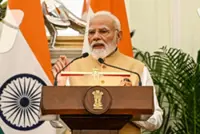
SOUTH-EAST ASIA (Bloomberg): Indian Prime Minister Narendra Modi heads to Indonesia, Australia and New Zealand this week to shore up ties with Indo-Pacific nations as questions grow over the US’s commitment to the region and China’s influence expands.
Modi arrived in Jakarta late Monday, and will hold talks across sectors with President Prabowo Subianto Tuesday, he said in a post on X. Indonesia is a natural partner for New Delhi: the world’s largest archipelago is strategically located between the Indian and Pacific oceans and also has sensitivities over China’s maritime assertiveness.
Defense is expected to feature prominently in Modi’s meeting with Prabowo. India’s ambassador said the two countries are in "very advanced” talks on the BrahMos supersonic cruise missile system and that New Delhi hopes to conclude other deals during the visit. Any progress would signal a larger Indian defense role in the region while helping Indonesia diversify its security partnerships.
Modi’s focus in recent weeks has been on bolstering ties with nations in the western Indian Ocean region, where he visited Seychelles and also met with the leader of Mauritius. He’s now shifting to the eastern part of the Indian Ocean, having hosted Japan’s Prime Minister Sanae Takaichi in New Delhi last week and heading to Indonesia, Australia and New Zealand this week, according to Rudrendra Tandon, an official in India’s Ministry of External Affairs.
The key themes of the visits this week are trade, defense and security cooperation, as well as highlighting cultural connections, said Tandon, who is secretary for the eastern region at the ministry. "But of course, at the same time, we deal with emerging issues like energy, like critical minerals,” he said.
Washington has sent mixed signals about its commitment to the Indo-Pacific. Weeks after Secretary of State Marco Rubio attended a meeting of Quad members - a strategic grouping comprising India, Australia, Japan and the US - the Pentagon said it would rename the Indo-Pacific Command as the US Pacific Command, reversing a change made during Trump’s first term. Coming after the US president’s visit to China, the move was widely seen as signaling reduced US focus on the region and giving Beijing greater strategic space.
"The timing can’t be more conspicuous,” said Dinakar Peri, a security studies fellow at Carnegie India. "The unpredictability of the US, especially in the Indian Ocean Region”, reinforced by the renaming of their command in the region, adds to the urgency, he said.
Defense and security ties will likely be a feature of Modi’s talks with Prime Minister Anthony Albanese in Australia. Defense ministers from both countries met in June and pledged stronger military cooperation, including finalizing a joint maritime security roadmap.
"Since the last visit from Prime Minister Modi in 2023, what’s remained constant is the shared concerns Australia and India have about developments in their region, much of it centered on China and its behaviour,” said Kim Heriot-Darragh, an analyst at the Australia-India Institute. "Those anxieties have likely intensified, with shifts in the US political landscape forming part of the backdrop.”
As Quad members, Australia and India have expanded military ties in recent years, conducting more joint activities in the Indian Ocean, including in the annual Malabar exercise.
Uranium Shipments
Also on the table are possible talks about Australian uranium shipments to India, the Sydney Morning Herald reported. The two sides agreed almost a decade ago to permit the trade, but it’s been delayed by negotiations over safeguards to ensure the material can’t be used for nuclear weapons.
"The India-Australia convergence, politically, is very clear,” said Shruti Pandalai, inaugural India chair at the Lowy Institute. "It’s a meeting of two countries who are trying to navigate shifts - not just about just managing China, but also now managing US unpredictability.”
Modi’s final leg in New Zealand is likely to focus on a free-trade deal announced last year, which is now awaiting approval in the parliament in Wellington. Immigration, however, could emerge as a point of friction, with New Zealand preparing to tighten rules for Indian nationals, according to the Post.
New Zealand Foreign Minister Winston Peters said last month that officials have warned the more restrictive settings could affect bilateral and trade relations with India and, potentially damage New Zealand’s reputation as a place to do business. They may also be open to legal challenge and could lead to retaliatory action, he warned.
In Jakarta, Melbourne and Auckland, Modi is due to address the large Indian diaspora communities in Indonesia, Australia and New Zealand.
--With assistance from Unni Krishnan and Vikram Kumar. -- ©2026 Bloomberg L.P.