
BEIJING: The Communist Party of China (CPC) must persevere with “full and rigorous self-governance” at a point when unpredictable factors are on the rise in the country’s development, President Xi Jinping said on Wednesday (July 1) in celebrations marking the party’s 105th founding anniversary.
The Chinese leader’s comments come amid a push to instill greater loyalty and discipline among party members, suggesting that the world’s second-largest political party intends to run a tighter ship as it contends with domestic and external difficulties.
“We must be prepared at all times to withstand major tests involving high winds and rough waves, or even stormy seas,” Xi said in his 40-minute speech in a ceremony in Beijing. “China’s development is currently at a stage where strategic opportunities coexist with risks and challenges.”
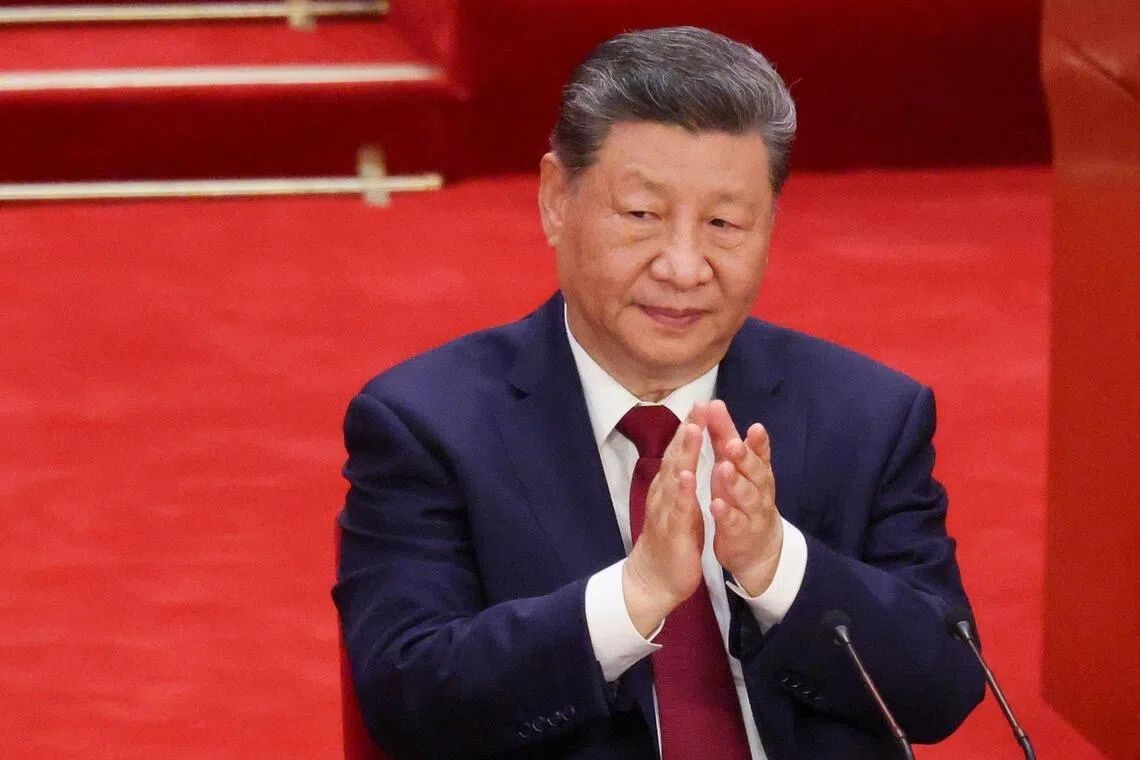
Thousands of top officials and party members gathered at the Great Hall of the People for the ceremony, watching as Xi awarded medals to eight party members for their “outstanding contributions”. Among them were a 90-year-old military veteran and a Henan village party secretary who led rural revitalisation efforts.
Founded in 1921, the CPC currently has more than 101 million members, or about one in every 14 Chinese citizens. Only India’s Bharatiya Janata Party (BJP) has more members, with 140 million.
Xi, who has been the CPC general secretary since 2012, also highlighted the party’s essential role in bringing China to where it is today, while stressing the need to wage a “decisive, sustained, and comprehensive battle against corruption”.
The Central Commission for Discipline Inspection (CCDI), the CPC’s disciplinary body, reported in January that it took to task a record 983,000 people in 2025, a 10.6 per cent increase from 2024. This was the highest annual total in about two decades since figures were released.
The latest cases were reported on June 26, when former Politburo member Ma Xingrui was stripped of his post in the National People’s Congress, China’s parliament, along with six military lawmakers and former financial regulator head Li Yunze.
The drive has been especially pronounced in the military. Top general and close associate of Xi, Zhang Youxia, was placed under investigation in January 2026. The military high command of which Zhang was vice-chairman is now reduced to two members from an original seven in 2022.
Such moves have been seen as a further consolidation of Xi’s power. Observers believe such personnel changes could indicate the party is gearing up for its once-in-five-year congress in the second half of 2027, at which Xi is expected to seek a fourth term.
The intensification of a years-long anti-corruption drive is happening alongside a study campaign to promote greater adherence to the Xi Jinping Thought political doctrine among the CPC’s members.
A new doctrine – Xi Jinping Thought on Party Building – was unveiled at a top-level symposium on June 15, with a party-wide campaign to study and implement it currently underway.
It states the “14 Upholds”, a significant revision from the “13 Upholds” of 2023, as guidelines for party members’ behaviour. The new, 14-point guidelines emphasize the “unified leadership” of the Central Committee and cadre discipline and loyalty.
James Char, an assistant professor at the China Programme the S. Rajaratnam School of International Studies in Singapore, told The Straits Times that both versions of the “Upholds” guidelines continue to emphasise the importance of party-building, political discipline and centralised, unified leadership.
“However, the shift to the updated ‘Upholds’ is another example of the CPC’s focus on orthopraxy – that Party members not only memorise and mouth the right things (that is, orthodoxy), but they should internalise and operationalise the Party’s leadership in the governance of China,” he said.
Xie Maosong, a researcher at the China Institute for Innovation and Development Strategy, a Beijing think-tank, said that the party’s battle against corruption and the process of self-revolution are perpetual endeavours.
“The aim is to ensure that officials ‘dare not’ be corrupt – enforced through disciplinary constraints – and ‘cannot’ be corrupt – ensured by institutional frameworks that keep conduct within bounds,” he said at a talk hosted by the All-China Journalists Association in Beijing on June 23.
Since Xi became president in 2013, the CPC’s anti-corruption campaign has taken down “tigers,” including former security services chief Zhou Yongkang, former top generals Xu Caihou and Guo Boxiong, and hundreds of other senior officials at the provincial level and above.
Jean-Pierre Cabestan, a senior research fellow at the Asia Centre research institute in Paris believes that the CPC’s anti-corruption drive has become an institutionalised mechanism to keep cadres in check.
But the main potential drawback is bureaucratic immobilism, paralysis and lack of initiative, he told ST.
“(This is) not so good for implementing difficult reforms, such as the hukou reform,” he said, referring to China’s household registration system, whose restrictions the authorities have been trying to relax for years.
Cabestan, who has written extensively on the CPC and Chinese politics, said key challenges for the party include ensuring its priorities are obeyed in the provinces and at the grassroots, far from Beijing, as well as attracting young people, who might be turned off by having to study Marxism, to become members.
“Many talented people particularly among the youth prefer to stay away from such duties. The risk is an ageing of the average CPC member and a deeper disconnect from society,” he added. - The Straits Times/ANN