
SEOUL: More than 80 dancers in South Korea move through a series of shifting formations in a dance challenge video set to Taeyang’s latest song, Live Fast Die Slow. They step briskly across the floor, roll their shoulders to the beat and break into bursts of headbanging. As the group closes into a circle, one dancer drops to the floor for a headspin.
The video has drawn more than 420,000 views in two weeks. Taeyang himself liked the clip and shared it on social media.
It sounds like a professional dance crew. In fact, they are elementary school teachers who dance to K-pop with their students in the classroom.
The dancers are members of Doodoomchit School, a K-pop dance education collective that officially launched in 2025 with teachers from Gyeonggi Province. Since then, it has grown into a nationwide network of 176 teachers experimenting with ways to use K-pop dance in the classroom to encourage participation, confidence and communication among students. They also go by their full official name, the K-pop Dance Education Research Association for Teachers.
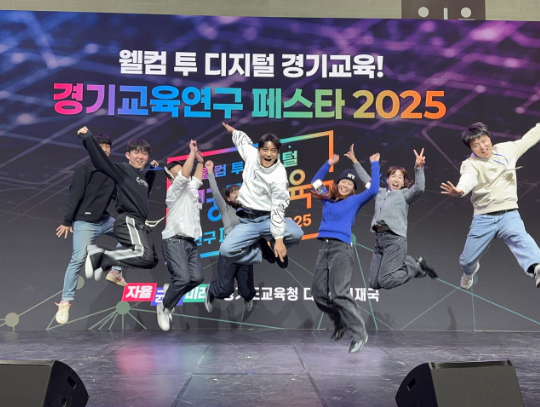
The model has drawn so much attention that the Gyeonggi-do Office of Education plans to introduce it abroad as part of its international exchange initiatives. Later in 2026, members of the group are set to travel to New Zealand to share their approach to K-pop-based education.
At a time when depictions of South Korean schools often focus on violence, conflict and strained teacher-student relationships, as seen in the recent Netflix hit series Teach You A Lesson, these teachers are trying to teach a different lesson – through dance.
“I’ve always loved dancing. It made me happy, and I thought that one day, when I became a teacher, my students and I could share that joy through dance,” said Lee Hyun-gil, Doodoomchit School founder and a teacher at Bucheon Elementary School, in an interview with The Korea Herald on June 23.
Now in his 20th year in the classroom, 42-year-old Lee has been weaving dance into his lessons since his first post in 2007, teaching students K-pop choreography and preparing talent-show performances for school trips.
“What mattered most was seeing how the students changed,” Lee said. “Children who rarely spoke in class began opening up. They felt more comfortable talking to me and participating in lessons. I realised that sharing something I love could make students happy too, and that dance could be a powerful educational tool.”
The conviction led him to upload a dance challenge video with his students to YouTube in 2022, hoping to give them a memorable graduation experience. The clip, set to Crush’s Rush Hour, has since drawn more than 8 million views.
Many commenters saw more than a dance video. They saw students having fun, a teacher sharing his passion and a classroom filled with happiness.
“I think people had been longing to see a classroom like that. There were some videos of students dancing, but hardly any of teachers and students dancing together.”
The response from fellow teachers was equally encouraging. It convinced Lee that his colleagues were searching for the same thing: New ways to connect with students through something they genuinely loved.
Among those inspired was Jeong Ji-yong, 29, a teacher at Hwahong Elementary School in Suwon, who was already familiar with Lee’s videos and joined Doodoomchit School without hesitation. He now runs a dance club at his school and recently won an award with his students at a student-teacher performance competition.
Bae Jio, 27, a teacher at Sanpyung Elementary School in Anseong, said she loved dancing as a student but had largely stopped after becoming a teacher.
“When I heard about the group, I thought, finally, I can bring that side of myself back. But what interested me wasn’t simply dancing. It was figuring out how dance could be used educationally in the classroom.”
For Lee Soo-yeon, 28, the group provided the confidence to try something she had long hesitated to reveal. Lee is a teacher at Jungdong Elementary School in Bucheon.
“My students had no idea I liked dancing. I wasn’t sure how they would react, and I worried that it might undermine my authority as a teacher. Meeting other teachers who shared the same concerns gave me courage.”
How, then, does K-pop dance become education?
The teachers described K-pop as a shared language – a way to connect with students.
“K-pop is one of the easiest ways to motivate students. As soon as they hear familiar music, they’re ready to participate,” said Lee Hyun-gil.
“It helps break down the barriers. When we share something we love, communication becomes more natural, and students see teachers as people they can talk to openly, ask questions freely, and feel comfortable with.”
“Once my students found out that I danced, they started seeing me differently,” added Jeong. “They realised we shared some of the same interests. I was no longer just the adult at the front of the classroom correcting them. I was someone they could connect with.”
From a curriculum standpoint, the approach is not as unconventional as it might seem. South Korea’s elementary school physical education curriculum already includes units on movement and expressive activity, which Doodoomchit School teachers use to encourage creativity, collaboration and self-expression.
This does not necessarily mean teaching exact choreography. Sometimes it simply involves moving to music, playing with rhythm and expressing ideas through the body. The emphasis is less on dance itself than on the learning process it enables.
“The goal isn’t to teach students exact choreography,” Bae said. “What’s important is that they enjoy expressing themselves through movement.”
Lee Soo-yeon, who was initially hesitant to bring dance into her classroom, started with simple movements rather than full choreography.
“What I felt most was how much the students enjoyed it,” she said. “They became more comfortable with me, we communicated more, and there was a lot more laughter in the classroom.”
Not every student is required to dance. Those who prefer not to perform take on other roles, including filming, lighting, stage design or directing. Others help with choreography and formations.
The goal, teachers say, is participation rather than performance. Students learn how to express ideas through movement, collaborate with classmates and create something together.
“Working together on choreography and performances often helps ease tensions and encourages cooperation in ways that traditional classroom activities sometimes cannot,” added Lee Hyun-gil.
Again and again, the teachers returned to one word more than any other – not K-pop, not dance, but happiness.
For the teachers, dance is a vehicle for sharing something they love with their students. Seeing students laugh, grow and succeed becomes a source of energy that returns to the teacher.
“Teachers need to be happy for students to be happy,” Bae said. “When I come to school excited about what I’m doing, I smile more. I become kinder, more enthusiastic. I think students feel that too. When teachers and students genuinely like and connect with each other, it becomes one of the most powerful assets in elementary education.”
“I totally agree,” said Jeong, who arrives at school more than an hour early to run dance activities for students.
“It’s extra work. But I do it because it’s fun, and it makes me happy. The real reward comes in those moments when students succeed in something together.”
For Jeong and others, the goal is simple: To become the kind of teacher students remember.
“I want to be the teacher they look back on and say, ‘That year was a happy one because of the teacher.’”
“’When teachers move, things change.’ This is our slogan,” said Lee. “The movement here doesn’t only refer to dancing. It is the willingness to reach out, communicate and share one’s passions with students.”
Doodoomchit School’s long-term goal is for its methods to no longer feel exceptional at all, but to become part of the ordinary toolkit of any classroom.
“We’re simply trying to share our happiness with students,” he said. “And through that process, we’re seeing them change. That, in itself, we consider to be meaningful education.” - The Korea Herald/ANN