
As the war in Iran disrupts global oil and chemical supplies, China’s coal-heavy energy sector is seizing an unprecedented opportunity. Dannie Peng visited Xinjiang Uygur autonomous region to witness the operations of one of China’s four major bases for large-scale, modern coal-chemical production. In this reporter’s note, she documents her observations and experiences during the trip.
As a journalist working for a non-local, non-state media outlet, gaining access to Xinjiang has never been easy, especially when it comes to its energy sector – a reality I began to understand even more deeply during my week there.
At the end of April, after several months of trying, I finally secured an invitation to visit a large coal mine to observe its unstaffed mining operations in person and set off for northern Xinjiang.
My plan was to use this as a starting point to explore the ecosystem of one of China’s four major bases for modern, large-scale coal chemical production. As the journey continued deeper into this energy heartland on China’s far western edge, a vast and mysterious industrial world gradually began to reveal itself.
My first stop, an open-pit coal mine producing more than 20 million tonnes a year, was in northeastern Changji Hui autonomous prefecture, nearly a four-hour drive from Urumqi, Xinjiang’s capital.
By the time I arrived on the first evening, darkness had already fallen. What lay before me was a landscape utterly unlike the city: wild and desolate, with almost nothing across the vast expanse of the Gobi Desert apart from the mine itself.
I stayed in a cheap two-storey hotel beside the mining area that catered to truck drivers transporting coal to nearby plants or railway stations. It was the only place to stay for dozens of kilometres. The only place nearby serving food was a canteen called “Driver’s Home” beside the hotel.
The next day, after passing through layers of approvals and safety checks, I was allowed into the mine. There, I witnessed how autonomous electric mining trucks, advanced technologies and remote-control platforms are transforming what was once a high-risk and labour-intensive traditional industry.
One manager told me the mine’s workforce had fallen from over 10,000 to fewer than 3,000 owing to automation. For the staff working there, all their daily needs – from food and shopping to entertainment – are met entirely within the mine complex.
The engineers, managers and miners in this isolated world live separated from their families to fuel China’s booming industrial development. In much the same way, the energy base they operate serves as a vital pillar for the country’s overall energy security.
From vast stretches of undeveloped saline-alkali land, the Zhundong National Economic and Technological Development Zone – perched on China’s largest contiguous coalfield with estimated reserves of 390 billion tonnes – pumps coal, electricity and a range of chemical products eastward to China’s economically developed regions.
On the third day of my trip, after driving more than 100km (62 miles) south, I reached Wucaiwan, the development zone’s core area and a boomtown in Changji that has risen swiftly off the back of energy development.
It is home to the zone’s management committee, and dozens of enormous power stations and coal-chemical complexes line its main arteries, standing as monuments to the area’s administrative and economic importance.
Arriving there, I felt even more strongly that I had stepped into an exotic energy kingdom. It is a world dominated by men, especially middle-aged men, with women visible mainly in service roles.
In the local hotels, most of the guests were suppliers, engineers and other professionals doing business within the energy sector. As a solo female traveller with a young, modern appearance, I drew curious glances whenever I was out on the street or in restaurants.
One day, over breakfast at the hotel, a manager from a Urumqi-based company supplying energy-saving equipment to large local power plants asked: “Why would your company send a young girl out to do business in such a remote place?”
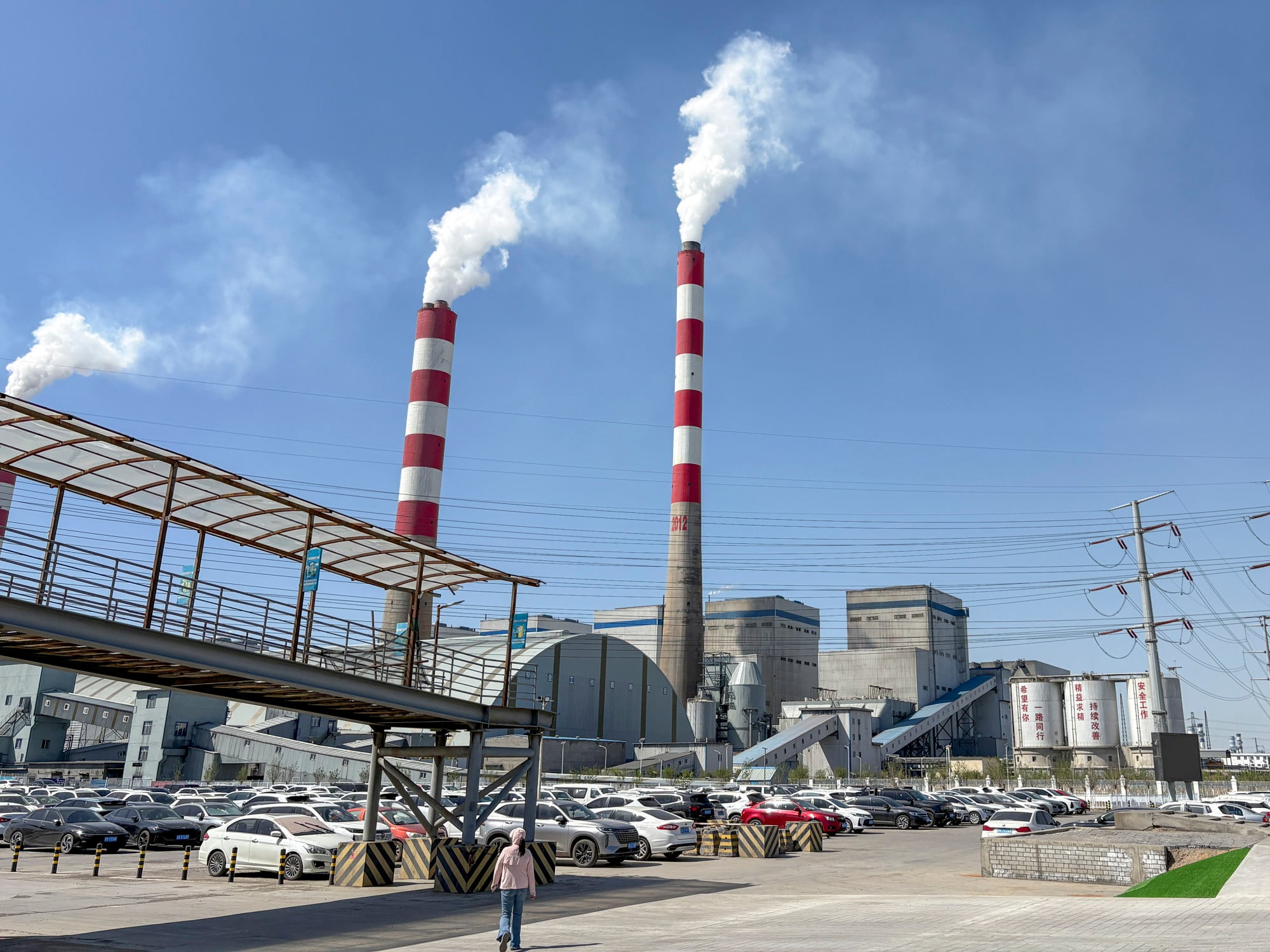
This is indeed a relatively closed ecosystem, with few outsiders ever venturing in. Consequently, when I – a Beijing-based reporter working for a Hong Kong-headquartered news organisation – contacted local government officials with interview requests, they became highly wary.
Later, one of them even privately confided that they suspected I might be a “spy”.
As required, I submitted interview requests to every level of the local government, but in the end, received no response. Someone from the Xinjiang Uygur autonomous region’s publicity department even told me repeatedly that I had dialled the wrong number.
Just as I was on the verge of giving up in despair, I made one last attempt. On the morning of my fourth day there, through personal contacts, I managed to reach an official responsible for the zone’s investment promotion.
He poured tea and welcomed me warmly, but as I sat in the meeting room preparing to start my questions, his expression changed instantly the moment he saw my business card. He immediately ended the conversation.
Noticing an industrial map hanging on his office wall, I asked whether he could at least explain it to me.
He refused, saying: “The Zhundong zone is a national energy base. This is all confidential information.”
Of course, I can understand that in Xinjiang, a battleground for ideologies and public opinion, officials and industrial workers in critical sectors naturally have their guard up against potential information leaks and unauthorised interviews. As one coal logistics veteran told me: “They’ve learned many hard lessons from past experience.”
Fortunately, by speaking to unofficial sources, I still managed to gather some information, obtain the industrial planning map and acquire other materials. These helped me eventually piece together the reality of a rapidly emerging industrial ecosystem built around coal development. It is a system based on decades of research, government support, robust infrastructure and powerful market demand.
In this ambitious development blueprint, large-scale collieries are taking the lead in pushing for advanced electrification and automation. Most of the extracted coal is then transported to nearby power or chemical plants, where it is either converted into electricity to fuel downstream metallurgy or used directly as feedstock for manufacturing a wide range of basic and high-end chemicals.
The massive energy hub’s strategic importance in bolstering China’s energy self-reliance and security is particularly pronounced as the conflict in Iran disrupts global supplies of oil, gas and downstream chemicals.
It was a week full of frustration, adventure and novelty. At times I felt like an ill-timed visitor in this vast energy world. Yet, as I moved between the towering chimneys and sprawling giant factories, I knew that only by getting this close could I truly feel the pulse of China’s energy engine.
-- SOUTH CHINA MORNING POST