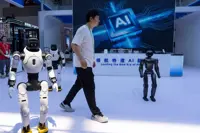
BEIJING: Tired of housework and wishing someone would take care of all the chores? If one company in Wuhan, Hubei province, has its way, all the daily domestic drudgery would soon be the responsibility of robot housekeepers that could become as common as basic household appliances in the future.
Wuhan-based Hubei Giga World Robot Co has announced plans to send 100 humanoid robots to ordinary households on a free trial basis. The project is set to begin in the third quarter of this year and is seen as a milestone in advancing the large-scale application of robots in real households.
A promotional video by the company shows how its robot housekeeper, SeeLight S1, can perform a wide range of household chores.
The morning starts with See-Light S1 making the bed, warming bread in the microwave, cooking stir-fried tomatoes and eggs, pouring milk, and placing food on the dining table. Once the people at home leave for work, it loads clothes into the washing machine, tidies up the bathroom and cleans the toilet, then sanitizes its hands with wet wipes. Next, it hangs the laundry out and then folds the clothes neatly once they are dry. It straightens the messy sofa and tea table. Finally, it feeds the fish and waters the plants.
"Its intelligence lies in its ability to independently complete long-sequence, multistep and meticulous housework in real, unstructured home settings, rather than mechanically repeating single actions," said Ye Yun, partner and vice-president for research and development at Hubei Giga World Robot Co.
"The core is an embodied foundational model boasting a complete closed-loop capability spanning perception, comprehension and execution. It can understand real-world environments instead of relying on preset routes or rigid scripts," he added.
According to Ye, the robot can understand and execute commands given in everyday spoken language.
Even when deliberately disrupted, it keeps working until tasks are finished, demonstrating "strong independent decision-making and anti-interference capabilities in complex home environments", Ye said.
Moreover, it can adapt to the spatial layouts of different homes. When furniture is rearranged, the robot re-perceives and reinterprets the surroundings in real time, adjusts its operations and completes its tasks — a key distinction from conventional devices that rely on fixed programs.
"It also keeps learning through daily use and becomes smarter over time," Ye said.
While full details of the free trial programe are yet to be released, the company's official WeChat account has already received more than 2,000 messages from people eager to sign up.
One netizen wrote that she is a working woman who is exhausted from taking care of two children and elderly parents every day. She wants a home robot so that she can spend more time with her children.
Another message was from a couple, both 75 years old, who lived without help and struggled with cooking and cleaning. They hoped that a robot could handle household chores, remind them to take medication and chat with them.
A third netizen noted that she has two dogs and two cats that constantly leave her home in a mess, adding that she is curious whether robots can truly provide convenience for humans.
According to Zhu Zheng, co-founder and chief scientist of the company, trial participants will be selected based on the principle of "reflecting real-life households and covering diverse family structures".
During the trial period, the company will provide necessary usage guidance and feedback channels.
Ye added that with users' informed consent, the company will collect data generated while the robot performs tasks, in order to verify functions, identify faults and drive iterative upgrades. All collected data will be used solely for product research and optimisation.
A Morgan Stanley report forecast that by 2050, the global humanoid robot market could reach $5 trillion, with over 1 billion units in operation. China is likely to have the highest number of humanoid robots in use by 2050, at 302.3 million, followed by the United States with 77.7 million.
According to the Hubei company's survey, the public finds 50,000 (US$7,388) to 100,000 yuan an acceptable price range. With increased shipment volumes, costs are expected to drop rapidly within the next one to two years. Zhu, the company's co-founder, said that the ultimate goal is to bring general-purpose humanoid robots into thousands of households, delivering tangible social value to people's lives.
Huang Quanzhou, who is in charge of operations at the Hubei Humanoid Robot Innovation Center, said the free trial marks a key transition from laboratories and factories to real households, which feature varied layouts, fragmented tasks and numerous sources of interference.
"These home environments differ greatly from traditional industrial settings with fixed workflows," he said.
Huang added that the free trial will help ordinary people experience robots more directly, popularize their use and explore a commercial model covering maintenance and after-sales services.
"Against the backdrop of a rapidly ageing society and a growing number of dual-income households, there is strong demand for home companionship and routine housekeeping services," he said.
Huang said that in one to three years, humanoid robots will be more common in high-end residential communities and elderly care institutions. Over the next five years and beyond, as mass production lowers costs and technology advances, they will increasingly enter ordinary homes just like refrigerators and washing machines, he added, signalling enormous market potential. - China Daily/ANN