
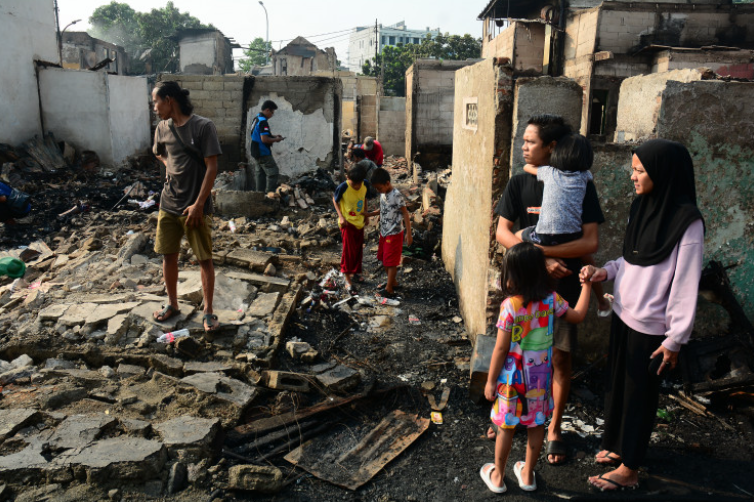
The blaze was first reported at around 8.55pm, according to Jakarta governor special staffer Cyril Raoul 'Chico' Hakim.
“The fire is believed to have been caused by an electrical short circuit in one of the residents’ houses,” Chico said on Tuesday, adding that the authorities were still investigating the exact cause of the incident.
The Jakarta Fire and Rescue Agency deployed 35 fire trucks and around 170 personnel to Kemayoran Gempol after receiving reports of the incident.
Firefighters managed to contain the blaze by 11.30pm. They stayed to launch a cooling operation, to reduce the temperature of the burning material to prevent a new fire from breaking out, until 4.15am on Tuesday.
Some 304 houses were destroyed by the fire, with around 679 residents in two community units (RW) in Kebong Kosong subdistrict affected by the blaze.
People who lost their homes took shelter at nearby Jusuf Hamka Field on Jl. Benyamin Sueb in Kebon Kosong, where authorities distributed emergency assistance to affected residents.
The Jakarta administration also deployed health workers to provide psychological assistance to displaced residents. No fatalities were reported, while three people were treated at the Hermina Kemayoran Hospital and Cipto Mangunkusumo General Hospital (RSCM) for minor injuries and respiratory problems.
The Kemayoran incident has put a spotlight on the persistent risk of fire in Jakarta, especially in densely populated neighbourhoods like the one in Kemayoran Gempol.
Throughout 2025, Jakarta recorded 1,847 fires, according to data from the city’s Disaster Mitigation Agency (BPBD). Around 67 per cent of the blazes occurred in residential areas and buildings.
The Jakarta Fire and Rescue Agency reported that two out of three fire incidents across the capital last year were caused by electrical faults, followed by gas leaks, as well as misplaced candles and cigarette butts. Deputy Jakarta Governor Rano Karno urged vigilance against the risk of fires.
“Hopefully, this incident will be the last,” Rano said upon visiting the displaced residents on Tuesday.
“The public must remain vigilant and protect their surroundings because every fire results in significant losses to all parties.”
Authorities have repeatedly warned that unsafe electrical installations, overloaded power outlets, aging equipment and poor maintenance remain among the leading causes of fires in residential areas, especially densely populated ones.
The Kebon Kosong subdistrict in Kemayoran has seen several major fires in recent years. Last January, a blaze allegedly triggered by electrical faults destroyed more than 500 houses. Another fire in December 2024 damaged around 200 semi-permanent houses in the same area.
To prevent more large fires from breaking out, Jakarta Governor Pramono Anung issued a gubernatorial instruction in April 2025 requiring each neighborhood unit (RT) to be equipped with basic firefighting kits.
Pramono is also aiming to upgrade all of the city’s low-income areas by 2027, as both unchecked building quality and a lack of permits increase the risk of fire threatening thousands of Jakartans who still live in unregulated, poorly constructed housing.
Experts have been pushing the Jakarta administration to also expand the city’s fire service network. The capital currently has around 5,000 firefighters operating from 172 fire stations across six municipalities, far below the estimated 11,000 personnel needed to fully cover Jakarta’s 267 subdistricts. - The Jakarta Post/ANN