




In Hong Kong’s busy commercial area of Causeway Bay, a post office located in a major shopping centre served just a few dozen customers during lunch on Thursday.
Across 90 minutes, when nearby restaurants and shops were filled with residents pressed for time, the post office stayed mostly empty, its workers outnumbering the people they were serving.
Hongkong Post is struggling with the same existential threat facing other traditional mail service operators worldwide: how to stay relevant in a world where communication has gone digital and nimble logistics companies have taken over parcel deliveries.
In the 1997-98 financial year, Hongkong Post earned HK$1.23 billion (US$157 million) in profit. Over the past eight financial years, the self-financed government department has racked up HK$2.9 billion in losses.
On Wednesday, the government offered a lifeline, asking lawmakers to consider its plan to inject HK$4.6 billion into the department to sustain its operations for the next three years. That would give the service some breathing room while additional cost-saving measures were adopted and new sources of revenue explored, it said.
At the branch in the shopping centre, Sherry Wong, an office clerk in her thirties, said she only made the trip to file tax returns for her colleagues.
While she had previously tried picking up parcels from online retailers at post offices before, the arrangement was inconvenient, she said.
“The business hours are not so friendly for us office workers, as the branches close at 6pm, when we get off work,” she said.
Office clerk Eva Yu, who is in her sixties, said she only visited branches once a year to mail tax returns.
“I compared the delivery prices of Hongkong Post and others for my company, and found the former was more expensive,” she said.
Local CourierPost, the government arm’s express document delivery service, charges HK$37 for an item weighing no more than 500 grams (17.6 ounces) for non-account users.
In contrast, private operator SF Express charges just HK$18 for local door-to-door document delivery.
An earlier report by the Audit Commission hit out at Hongkong Post’s uncompetitive pricing, saying it had contributed to its sluggish business.
The department blamed multiple factors, including remuneration policies and procurement procedures.
But the higher prices had not put off one customer at the shopping centre branch, a “half-retired” man in his sixties, surnamed Wai, who said he still preferred the government service because he felt it offered better confidentiality.
“Hongkong Post is a government branch and it will be safer. Especially when sending important documents, I do not want a private company to process my sensitive data,” he said.
Hongkong Post’s long-distance mail service was also reliable and the charges were reasonable, he added.
Many customers the South China Morning Post spoke with said the government should ensure the postal service provider continued to operate.
While they used it only rarely, its services might be needed by others, such as elderly residents, they said.
In addition to sending letters and parcels, residents can use the post office to settle government and utility bills, and elderly residents can withdraw cash via the EPS payment system under the “EasyCash” initiative.
Staff members can also help residents set up their iAM Smart and eHealth accounts, the government’s one-stop identity and medical record systems.
Over at the King’s Road Post Office in Fortress Hill in the afternoon, queues as long as 10 people occasionally formed, but similar to the Causeway Bay branch, many customers were simply mailing tax returns or settling utility bills.
However, Tina Lam, an office clerk in her fifties, said she came to buy stamps.
“I prepared some stamps in advance as I sometimes send local letters and celebratory cards to friends,” she said.
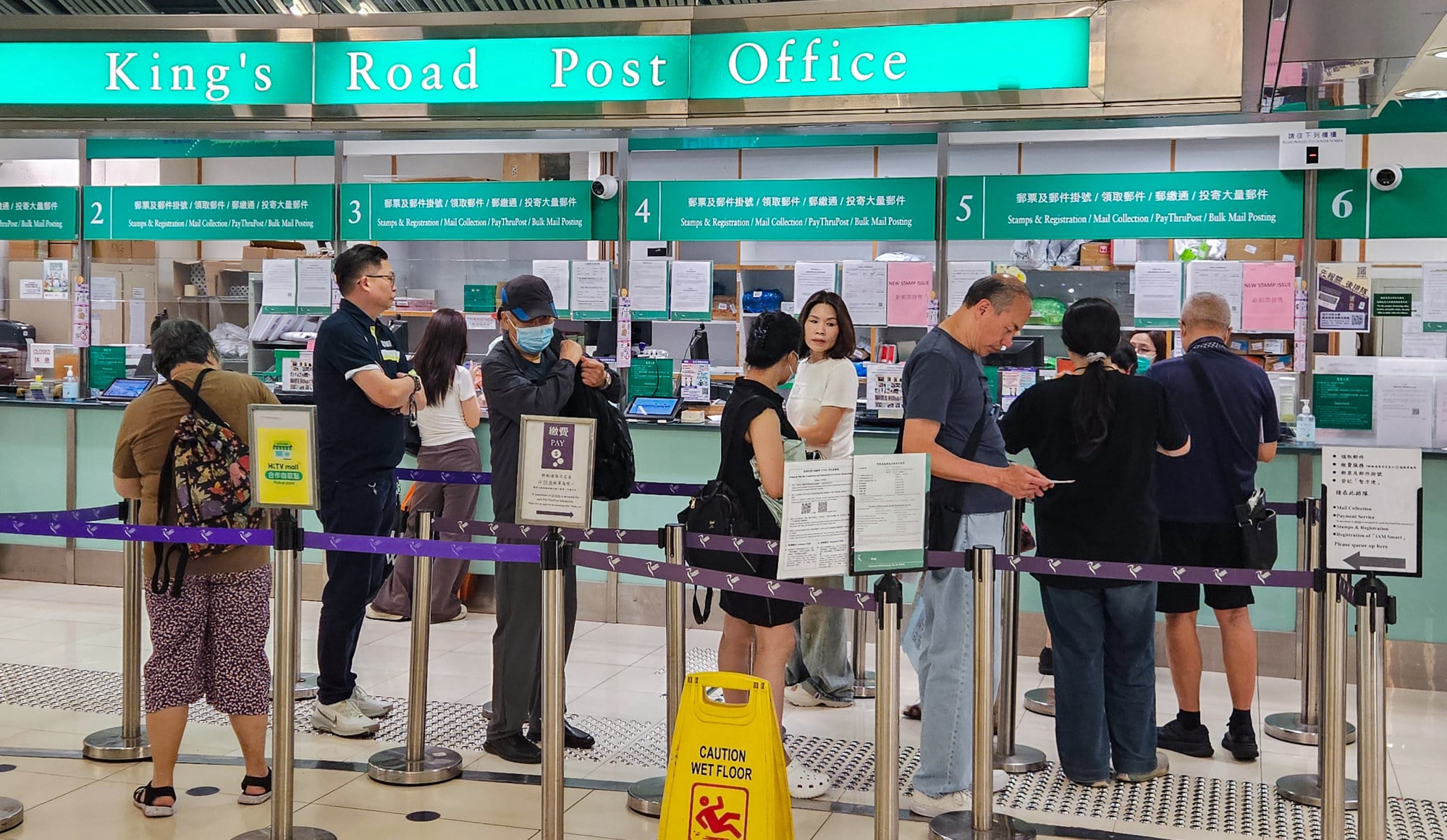
For Lam, physical cards for special occasions were worth the extra effort in the ephemeral digital age.
According to the document submitted to the Legislative Council by the Commerce and Economic Development Bureau on Wednesday, the cash reserves maintained by Hongkong Post could cover its operations for less than a year.
Hongkong Post has operated on a self-financing basis since the establishment in 1995 of the Post Office Trading Fund, which manages its operations, with the postmaster general serving as the fund’s general manager.
The volume of mail processed by Hongkong Post has plummeted from more than 1.1 billion items in 2019-20 to 611 million in 2024-25, a decline of 44.5 per cent, the bureau said in its paper.
The drop was “expected to continue or even worsen in the years to come”, it warned.
But the bureau said Hongkong Post was “actively exploring emerging markets”, focusing on developing postal logistics business in regions with growth potential including nations under Beijing’s belt and road trade umbrella, as well as Asean and Middle Eastern countries.
Lawmakers are scheduled to discuss the matter next Tuesday at a meeting of the panel on economic development. -- SOUTH CHINA MORNING POST


