
A Chinese-American was found guilty on Wednesday of acting as a Chinese agent in a case involving a Chinese police station set up in New York’s Chinatown.
The week-long trial of Lu “Harry” Jianwang, 64, was seen as a test of Washington’s ability to counter what prosecutors said were efforts by Beijing to expand its influence and intimidate Chinese communities well beyond its shores.
On the three charges Lu faced in the US Eastern District Court of New York, he was found guilty of acting as an unauthorised agent of China and of obstruction of justice but not guilty of conspiracy to act as a foreign agent.
“We’re obviously disappointed by the verdict,” said John Carman, Lu’s lawyer, standing beside Lu outside the courthouse. “Harry’s motives were pure.”
Carman said Lu planned to appeal.
Lu was accused of using the fourth floor America Changle Association office, located in a building in Manhattan’s Chinatown, to establish an overseas Chinese police station that performed ordinary administrative tasks but also monitored and harassed overseas Chinese. The association is a prominent Fujianese-American community group.
A co-defendant in the case, Chen Jinping, pleaded guilty to working as an unauthorised agent for China in December 2024 and awaits sentencing as does Lu.
Some 40 other Chinese officials were indicted separately at the time on charges of harassment and intimidation of dissidents. But they were located in China and not likely to come to the US, so those charges were seen as largely symbolic.
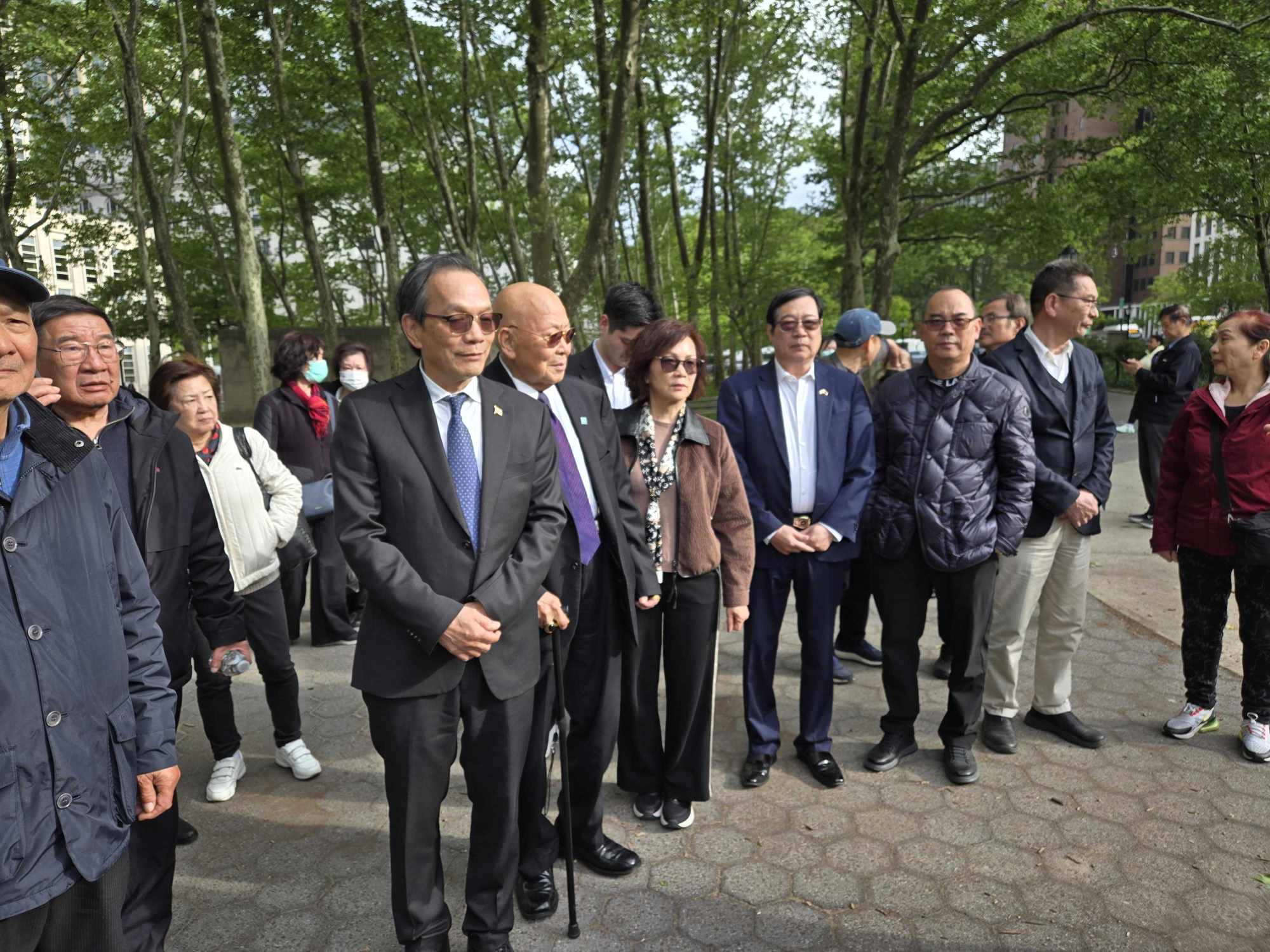
“The cautionary tale here is that if you’re a member of a community that originated in another country, you have to be very, very careful how you deal with people from your home country,” said Carman, surrounded by three dozen Lu supporters. “This is true, most especially if you’re from a Chinese-American community.”
The government welcomed the verdict.
“A police station operating in New York City at the direction of the Chinese government has been exposed, its sinister purpose disrupted, and its founder held accountable for blatantly disregarding the law and our country’s sovereignty,” said US Attorney Joseph Nocella.
A key part of the government’s case focused on messages found in Lu’s phone when he was interviewed by the FBI at his home in New York’s Bronx borough.
In addition to some 50 contacts from the Fuzhou Ministry of Public Security (MPS) and related government branches, there were messages asking Lu to investigate Falun Gong practitioners and dissidents living in the US, including Xu Jie, a resident of Pomona, California.
The FBI reportedly determined that Lu was trying to delete messages and added the obstruction charge in 2023.
Xu, who took part in the Tiananmen Square 1989 protests before moving to Laos and then the US, testified during the trial that he had been harassed repeatedly since arriving in the US in 2018 but did not know Lu or anyone else who was presumably involved.
Xu had travelled to New York after the overseas police station was set up to protest its existence, which he publicised on YouTube. At various times he received up to 176 threatening calls a day, had his car vandalised and his house and office broken into, he testified.
US prosecutors led by trial lawyer Lindsey Oken said Lu and others received orders from China to harass pro-democracy activists, referencing a banner inside the Chinatown facility that read: “Fuzhou Police Overseas Service Station, New York, USA”.
Carman countered during cross-examination that Xu may have been motivated by money, been biased and appeared to have a vendetta against the Communist Party and Chinese government.
The fact that a banner was prominently displayed and the overseas police centres, also known as “Overseas 110”, were publicly disclosed, indicated that it was not a conspiracy, Carman argued, adding that the centre’s failure to register was a “minor administrative error”.
“This is license renewal,” Carman said. “This isn’t ‘Spy Time’. This isn’t international espionage.”
Carman further argued that, while there may have been the occasional minor overreach, the alleged secret police station mainly operated as a convenience centre for overseas Chinese to renew their drivers’ licenses during the pandemic and a social hub for elderly to play ping pong. Lu, he said, was in the wrong place at the wrong time when the FBI raided the facility.
The centre where the alleged Chinese police station operated was located in a plain building, some six storeys tall, lodged between a spa, a hotel and a coffee shop. The police facility has since been closed down.
According to Safeguard Defenders, a Spanish civic group, China’s Fuzhou, Qingtian, Nantong and Wenzhou public security bureaus set up some 102 overseas police stations in 53 countries, most in Europe and North America. This network has managed to “persuade” tens of thousands of Chinese nationals to return to China, sometimes after pressuring their family members, the NGO alleged.
A 2025 report by Japan’s National Institute for Defence Studies on MPS external influence activities cited an alleged pattern of Chinese police officials providing instructions to overseas residents for “law enforcement” activities to be carried out by the local overseas Chinese. This provided deniability and generally avoided a direct link to China, the report said.
MPS has legitimate international activities, the report added, including cooperating with foreign police agencies on training and counterterrorism and dealing with Chinese who have committed crimes overseas.
But the MPS has also engaged in “several covert and clandestine operations beyond its jurisdiction, combining various intelligence collection and influence measures both through physical and cyber domain”, it added.
The Chinese embassy in Washington said it was not aware of the specifics of the Lu case. “China is a country that upholds the rule of law, strictly abides by international law, and respects the judicial sovereignty of all countries,” said spokesman Liu Pengyu. “The so-called secret police stations do not exist.”
An FBI computer analyst, Jessica Volchko, testified during the trial that data deleted from Lu’s phone and subsequently recovered indicated that his contacts included three WeChat groups created by Liu Rongyan of the Fuzhou Public Security Bureau. In total, these amounted to more than 2,000 chat records, she testified, with one group counting 65 members drawn from “Police-Overseas Chinese Service Stations” around the world, and the other two groups showing a combined total of 120 members. -- SOUTH CHINA MORNING POST