




Driven by global appetite for artificial intelligence, China’s computing hardware exports have emerged as a pivotal new engine for growth, providing Beijing with strategic leverage as US tech titans accompany President Donald Trump on a high-stakes visit to the Chinese capital this week, according to analysts.
Chinese trade received another significant boost from the technology sector in April, as integrated circuit (IC) export value doubled year on year to US$31.09 billion, according to data released last week by the General Administration of Customs. Volume rose 3.7 per cent to 32.04 billion units.
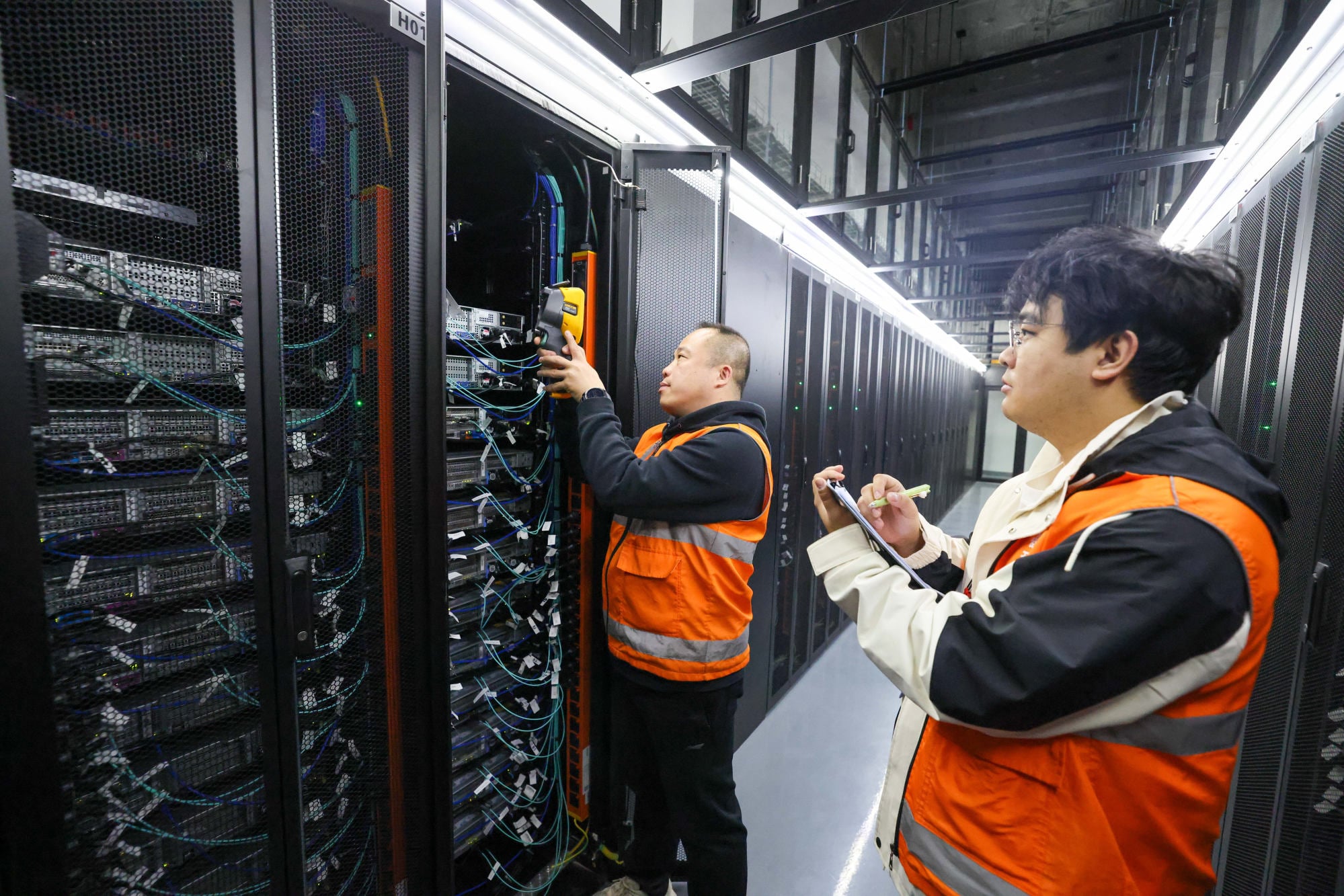
Meanwhile, exports of automated data processing machines and parts – which include computers, laptops and servers – jumped 47.6 per cent year on year to US$23.81 billion. The two sectors alone accounted for roughly half of China’s total export growth last month, according to a Monday note by Bank of America (BofA).
The prominent role of tech products in April’s trade data reflects how computing-related goods have become a “new and important growth driver for China’s exports”, Citic Securities analysts said in a note on Monday, citing surging global demand in AI.
“China’s economy is now facing twin shocks: AI boom and Iran crisis. So far, the AI boom has more than offset the drag from the Iran crisis,” said Macquarie Group’s chief China economist Larry Hu.
The official numbers were released days ahead of a highly anticipated meeting between President Xi Jinping and Trump, who will be joined by US tech executives including Tesla CEO Elon Musk, Apple’s Tim Cook and Meta Platforms’ president and vice-chairman Dina Powell McCormick.
Trump’s business delegation will be “looking for plenty of favours” in Beijing, with Musk possibly seeking a licence to sell robotaxis and room to expand sales of his AI-enabled robots, Gavekal Dragonomics co-founder Arthur Kroeber wrote in a note on Tuesday.
Beyond the desire of US tech executives to deepen their presence in the Chinese market, China’s rising dominance in AI hardware exports “gives Beijing more wind in its sails” heading into the summit, said Lizzi C. Lee, a fellow at the Asia Society Policy Institute’s Centre for China Analysis.
“It reinforces the case that China remains central to AI-linked manufacturing and global advanced supply chains, even under tariff pressure,” she said. However, Lee added that it might also “sharpen US and EU concerns about overcapacity and supply-chain exposure”.
“Computing power products” – including chips, chipmaking equipment and servers – accounted for 7.2 per cent of China’s exports in the first three months of this year, compared with 4.9 per cent in full-year 2025, according to Citic.
Exports of knowledge-intensive services – including telecommunications, computer and information services – also rose. In the first quarter, they grew 6.1 per cent, according to government data, driven by the growing adoption of Chinese AI models overseas.
AI-related demand will continue to drive China’s semiconductor exports and lift overall trade figures through 2026, Citic said. However, BofA analysts cautioned that this growth was largely “price-driven”, pointing out that while export values have soared, actual volumes have stayed relatively stable.
Sharp price increases in chips, computer parts, and electronic components have “provided a strong upward push” to China’s export value, Citic Securities said.
Global memory chip prices were expected to rise 40 to 50 per cent in the first three months of this year, followed by a further 20 per cent jump in the second quarter, according to Counterpoint Research.
China also continues to rely heavily on technology imports.
Chip imports were up 11.3 per cent year on year in volume and up 54.7 per cent in value amid surging domestic demand for AI computing power in April. The ongoing growth in AI capital expenditure should continue to “provide cyclical support” for both exports and imports in China, BofA said. -- SOUTH CHINA MORNING POST


