China is the United States’ “most consequential threat and competitor in space,” leveraging its capabilities “as a tool of diplomacy and influence”, US lawmakers were told at a congressional hearing on Wednesday, as the two countries’ race to the moon intensifies.
The US and China are locked in a high-stakes space race, with both nations aiming to put astronauts on the moon in the coming years. While China has set a 2030 target for its first crewed lunar landing, the US’ Artemis programme aims to return astronauts to the lunar surface by 2028 and to begin establishing an outpost by 2030, setting up a tight race between the two superpowers.
“As nations align with either the US or China in standards, the winner will not just supply technology – it will set the terms by which information flows, networks interoperate, and how the world is seen,” said Kari Bingen, director of the Aerospace Security Project at the Centre for Strategic and International Studies, at a hearing of the House Foreign Affairs Subcommittee on Europe.
Randy Fine, a Republican congressman from Florida, told the hearing that when it comes to space, he is “very concerned about China, as I know many people are. I think China sees itself at war with us. I think we don’t oftentimes look at it the same way”.
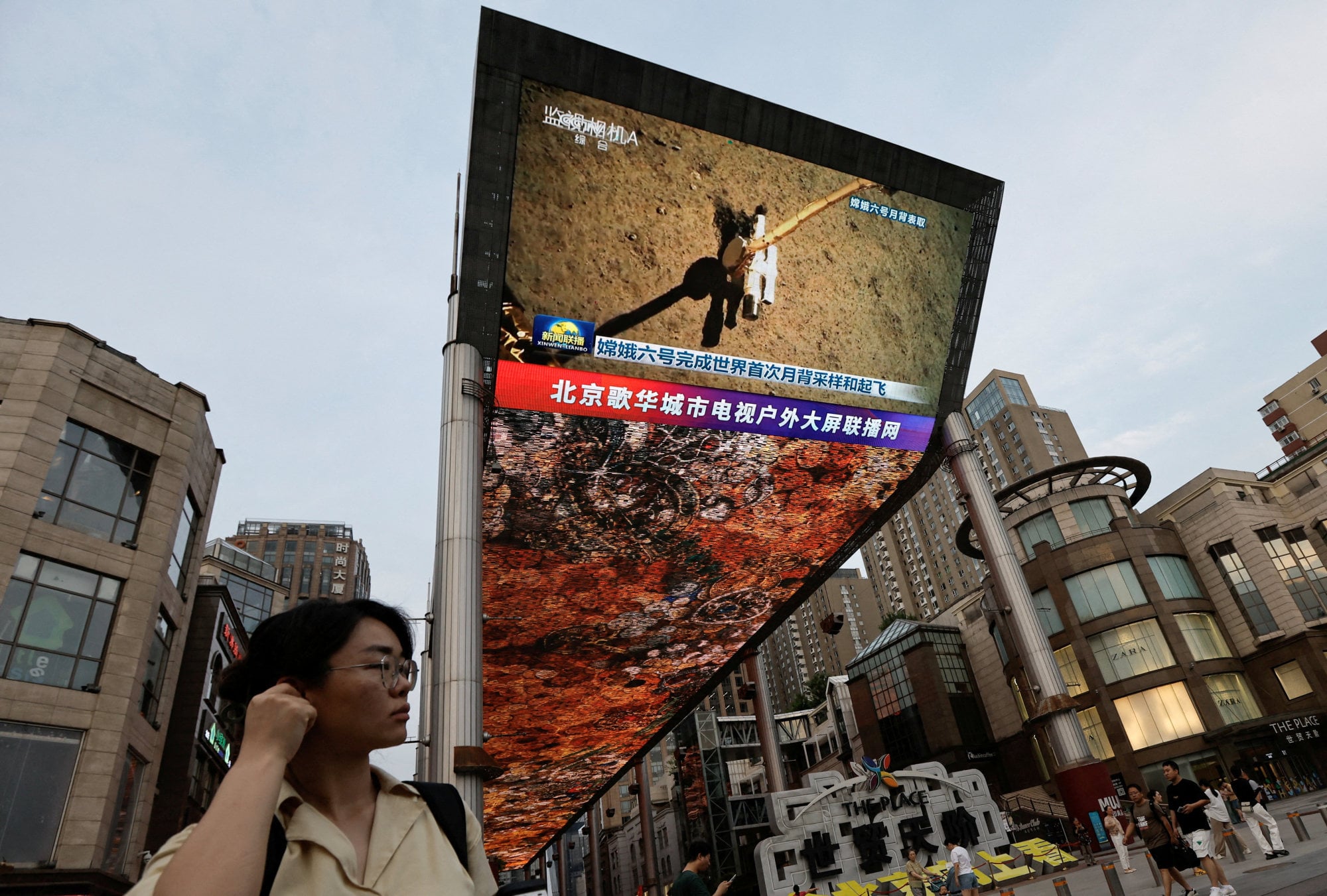
The past year has seen several key developments in the modern space race, as the US completed the second successful mission in its Artemis programme and China made key advancements in preparation for its 2030 moon mission.
The US remains the only country to have successfully put humans on the moon. Other nations, including China, India, and the former Soviet Union, have successfully landed robotic missions on the lunar surface.
The Wednesday hearing, titled Orbits of Influence: Emerging Threats to US Space Security and Foreign Policy Implications, took place on the same day Trump hosted Artemis II astronauts at the White House. Three American astronauts and one Canadian were part of the Nasa mission.
Elsewhere in the hearing, witness Bingen accused China of using space to assert influence over other countries by “expanding its partnerships across the Global South”.
“China has made itself the default partner for developing nations seeking space capabilities,” said Young Kim, a Republican congresswoman from California, adding that this is being done through integrated packages supporting developing space programmes, including satellites, launch services and ground infrastructure.
“Beijing has expanded its footprint across the Global South in ways that often embed Chinese technology standards and potential dual-use dependencies,” she added.
Scott Pace, director of the Space Policy Institute at George Washington University, said China is advancing its ambitions through the “famous” Belt and Road Initiative, which includes a growing space component linking partner countries.
Bingen noted that China has developed agreements with a wide range of countries across the Global South, Latin America and Africa.
“They are putting space ground antennas, ground station command and control sites. It’s basic technology, software and hardware that allows those ground stations and those antennas to communicate with the government system or a commercial system,” Bingen said.
She noted that while China is building out its commercial space sector, it remains heavily driven by the People’s Liberation Army and the state.
The hearing also touched on the US-Russia space race during the Cold War, when Russia was still known as the Soviet Union.
Much of the 20th century was defined by that competition, but the landscape has shifted in recent years. While Russia remains a threat, China has emerged as a key player, “marking one of the swiftest climbs in the history of any modern space programme”, Bingen noted.
“For decades, the United States has engaged in strategic competition in space. This began with a space race in the Cold War, and continues today as we race back on our way to the moon,” Bill Keating, a Democratic congressman from Massachusetts, said.
“Yet the race to achieve new heights in space continues – the US, China and Russia are increasingly competing in space in the military and security sectors.” -- SOUTH CHINA MORNING POST