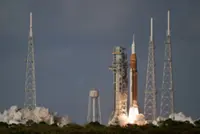
ASIA (dpa): The Artemis II mission, which took four US astronauts around the Moon and to a record-breaking distance from Earth, was a reminder of how little we know about the satellite’s far side. Now scientists are doing something similar for planets far beyond our solar system.
Astronomers at NASA and the University of Birmingham have found indications that a Jupiter-sized planet around 280 light years away has unusual properties that cast doubt on how much can be said for sure about planetary formation.
Compared to Jupiter and the Sun, the planet appears to have "a lower concentration of heavy elements, relative to hydrogen," and also has a lower metallicity than its host star, which is about one-quarter the size of its star - a "small, cool red dwarf," according to the university.
Despite having 2.5 times the mass of the rest of the Solar System planets combined, Jupiter is less than one-thousandth the mass of the Sun - though the latter is not a red dwarf.
"These findings have implications for our understanding of the giant planet formation process that occurs early in a star’s lifespan," said Anjali Piette, assistant professor in astronomy at the University of Birmingham, who said the planet, known as TOI-5205, stands out among giant planets known to scientists for having such a low metallicity relative to its star.
Piette and colleagues at NASA, Carnegie Science, the University of Zurich, Pennsylvania State University and the Academia Sinica Institute of Astronomy and Astrophysics used data and imagery from the James Webb Space Telescope, launched in 2021 and the most powerful tool of its kind, to come up with their analysis.
"Recent discoveries of transiting giant exoplanet around M dwarfs present an opportunity to investigate their atmospheric compositions and explore how such massive planets form around low-mass stars contrary to the prediction from formation models," the team said in their paper, which was published in The Astronomical Journal.
They observed three transits of the planet across its star to figure out that its atmosphere likely includes methane and hydrogen sulphide. They then leaned on "sophisticated models of planetary interiors" to generate that the planet is about 100 times more metal-rich than its atmosphere.
"These results suggest a very carbon-rich, oxygen-poor planet atmosphere," said Shubham Kanodia of Carnegie Science. It's not one for humans to visit, then - and that’s before the mind-bogglingly prohibitive distance is factored in.
TOI-5205 is around 280 light years from Earth. To put that in perspective, even one light year is an unfathomable 9.46 trillion kilometres or almost 5.9 trillion miles.
The closest star to us after the Sun - Proxima Centauri at 4.25 light years - would take the Voyager 1 space probe around 75,000 years to reach.
And that probe is over 25 billion kilometres from Earth, having reached interstellar space in 2012. That sounds far, but it has not yet even travelled one light day from Earth since being launched in 1977.
And Voyager 1, by the way, is travelling at an eyeball-popping 61,500 kilometres per hour. At that speed it would take the probe less than seven hours to reach the Moon from Earth, compared to the approximately five days it took Artemis II on its recent fly-by. As for Earth, Voyager could circle the whole planet at the Equator in around three-quarters of an hour. -- dpa